If your NdFeB line is already running and you’re asked to squeeze more slices out of the same shift, the answer almost never comes from buying a bigger machine. It comes from the process variables around the wire — wire type, wire count, tension, feed rate, coolant chemistry — and how they interact with the specific NdFeB grade you cut. This post is a decision guide for diamond wire saw NdFeB efficiency: what actually moves throughput and cost per slice, and what usually does not.
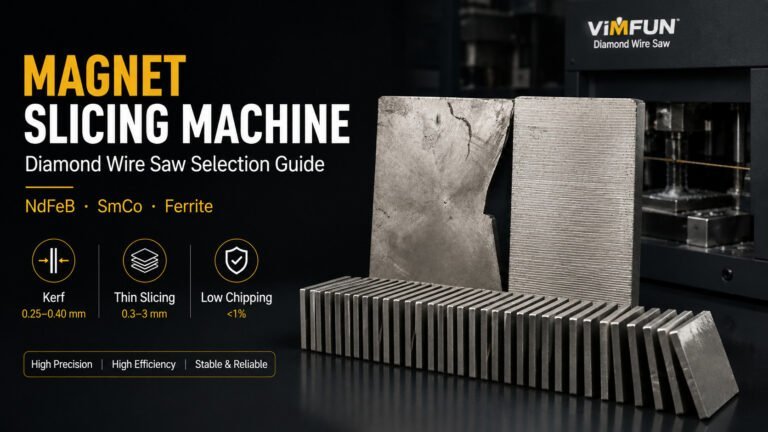
If you’re still choosing between wire saw and other cutting methods for magnets, start with multi-wire vs. inner-diameter saw for magnets. If you’re planning the whole line rather than optimizing an existing one, see the magnet slicing machine selection guide. This page assumes the line is committed and you’re chasing efficiency inside it.
Where Diamond Wire Saw NdFeB Efficiency Actually Comes From
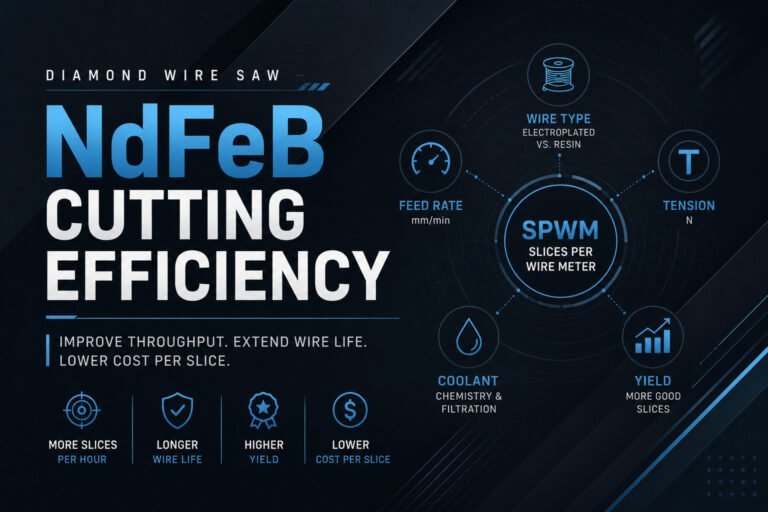
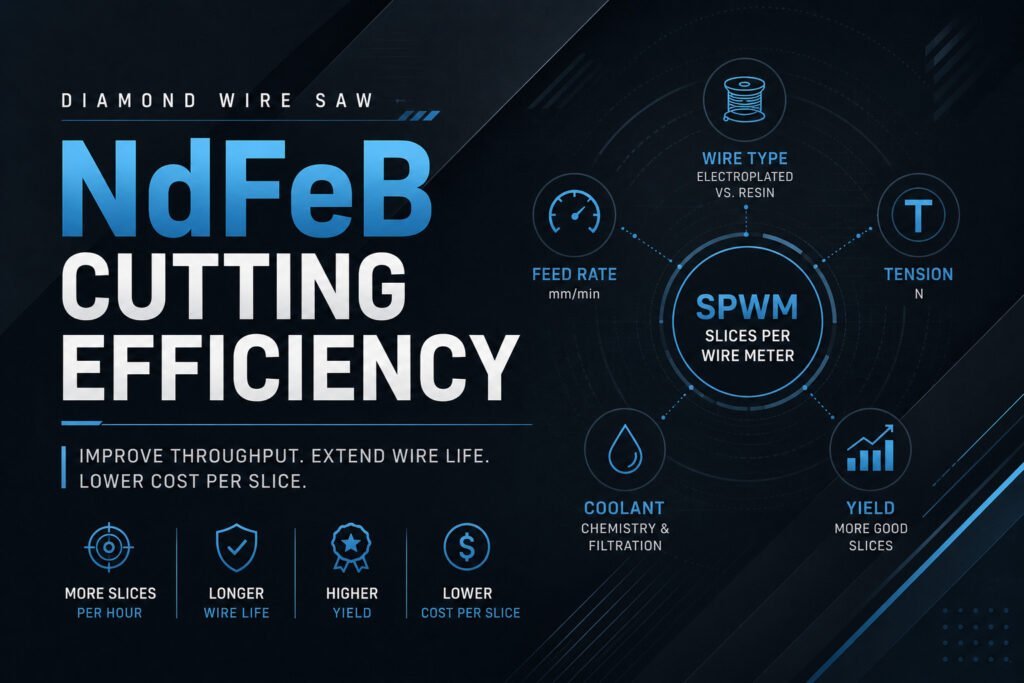
Efficiency on a diamond wire saw NdFeB line is not one number. It’s a stack of four:
- Slices per hour — how many finished slices come off the fixture per hour, including load/unload.
- Wire life — how many meters of NdFeB block a single strand of wire can cut before it stops meeting kerf, TTV, or surface roughness spec.
- Yield — how many of those slices actually pass QC.
- Cost per slice — total consumables (wire, coolant, blades, fixtures) plus labor and depreciation divided by good slices.
Optimizing only #1 (raw throughput) at the expense of #2 or #3 is the most common mistake we see. Faster feed rates push slices/hour up, but if wire life drops sharply or edge chipping increases scrap, cost per slice can get worse even as the machine runs faster. Always measure all four together.
For a deeper look at kerf-side losses (which feed directly into #3 and #4), see NdFeB cutting kerf loss reduction.
Diamond Wire Types: Electroplated vs. Resin-Bonded
Two wire types dominate NdFeB cutting today, and they behave very differently under production conditions.
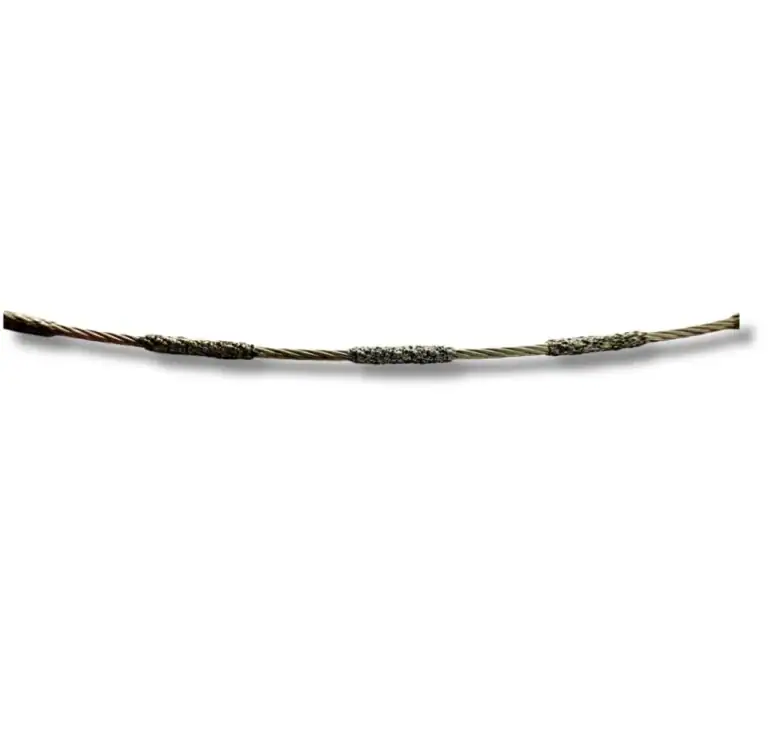
Electroplated diamond wire uses a single layer of diamond grit bonded electrolytically to a steel core. It cuts fast, has a narrow kerf, and is the default choice for thin NdFeB slices where kerf loss dominates cost. Downside: once the diamond layer wears through, the wire is done — there’s no gradual degradation window.
Resin-bonded diamond wire embeds diamond in a polymer matrix. It cuts slower per pass but wears more predictably, giving longer usable life on harder NdFeB grades. It’s often preferred for large blocks where wire life matters more than raw feed rate.
Which is more efficient? Depends on your dominant constraint:
| Your bottleneck | Better choice | Why |
|---|---|---|
| Kerf loss on thin slices (<1 mm) | Electroplated, thin diameter (0.20–0.25 mm) | Narrower kerf directly reduces waste |
| Wire cost on high-grade N52+ blocks | Resin-bonded | Longer life on hardest material |
| Cycle time on small blocks | Electroplated | Faster feed rate acceptable |
| Surface roughness spec ≤ Ra 0.6 μm | Resin-bonded, finer grit | Smoother cut, less downstream lapping |
Neither is “the efficient one.” Match wire to constraint.
Multi-Wire vs. Single-Wire: Where Multi-Wire Really Wins
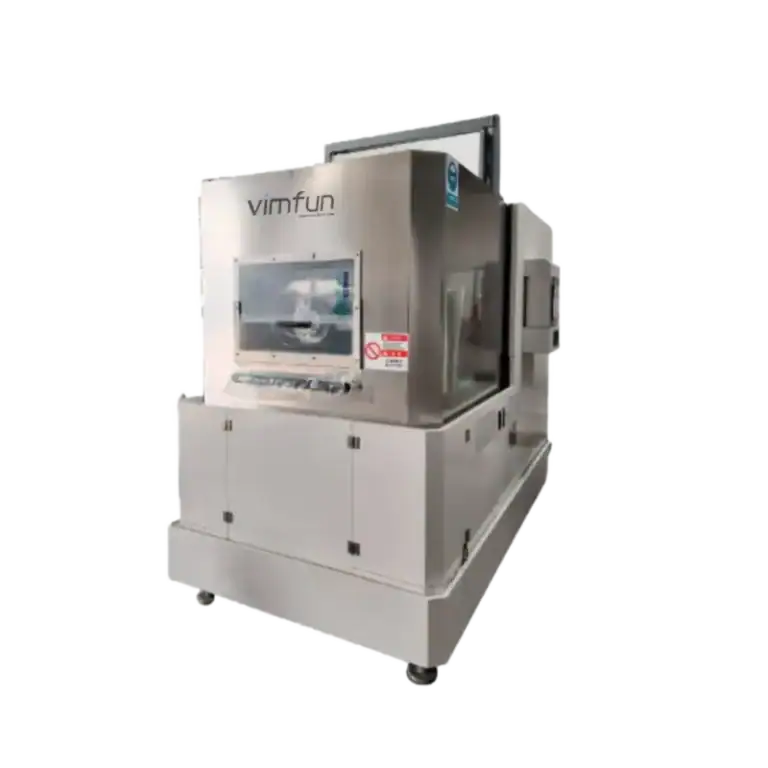
Multi-wire slicers cut dozens of parallel slices in one pass. On paper the throughput multiplier is dramatic. In practice, three conditions must all hold before multi-wire actually beats single-wire on cost per slice:
- Block homogeneity. NdFeB blocks with grain orientation variation or magnetic domain inconsistency produce slice-to-slice thickness drift across the wire web. If your incoming block QC allows large variation, multi-wire yield suffers.
- Batch size stability. Multi-wire setup is longer than single-wire. If your product mix changes every 2–3 batches, setup time eats the throughput gain.
- Downstream capacity. A multi-wire slicer producing 40 slices in the time a single-wire produces 4 will overload downstream grinding/coating if they haven’t been scaled to match.
Rule of thumb: multi-wire pays off on stable, high-volume runs of a single SKU (like motor magnets for one customer). It usually does not pay off on job-shop mixed runs. If you have both, keep a single-wire machine in the line for the mixed portion.
Efficiency Metrics That Matter (And a Few That Don’t)
The three metrics we track when auditing a NdFeB line:
1. Slices per wire meter (SPWM). Total good slices produced divided by wire consumed. This is the single most useful efficiency indicator because it captures both throughput and wire life. Track it per operator, per shift, per block grade. Large SPWM variation between operators usually means process discipline, not equipment.
2. Effective feed rate. Not the feed rate you set on the HMI — the actual average including retract cycles, coolant flushing, and wire re-tensioning. On a poorly maintained machine, effective feed can be 40% of setpoint. Log it.
3. Coolant contamination cycle. How many blocks you cut before coolant particulates degrade cut quality. Extending this cycle through better filtration is often the cheapest efficiency gain available.
Metrics that get too much attention:
- Peak feed rate — meaningless if effective feed is much lower.
- Wire tension setpoint — matters, but tension stability across the block is what actually affects surface quality; a stable 22 N beats an unstable 25 N.
- Machine max spindle speed — you rarely run near it on NdFeB.
Real-World Efficiency Levers Most Lines Underuse
Five levers we see underused when auditing NdFeB cutting operations:
Coolant chemistry match. NdFeB is corrosion-sensitive. Generic silicon wafer coolants often leave residue that shows up in downstream coating adhesion failures. Coolants formulated for rare-earth cutting cost more per liter but reduce scrap. Confirm compatibility with your specific NdFeB grade — high-Dy formulations react differently than standard N52.
Wire pre-conditioning. New electroplated wire cuts erratically for the first ~30 minutes as loose diamond grit sheds. A short run on a scrap block before starting production reduces first-slice defects.
Fixture rigidity. Vibration transferred from fixturing shows up as TTV variance and reduced wire life. Aluminum jigs that were “good enough” for smaller blocks often flex under multi-wire loads. Check with a dial indicator under load, not statically.
Block orientation control. Cutting parallel to the magnetic easy axis vs. perpendicular changes both wire load and slice flatness. Fix the orientation convention across shifts.
Preventive wire changes. Running a wire to failure produces one bad batch that costs more than the wire you saved. Schedule changes based on SPWM decline, not visible wear.
For downstream considerations that affect what “good slice” means, see NdFeB magnet grinding and polishing.
Cost per Slice: The True Measure of Diamond Wire Saw NdFeB Efficiency
Skip the theoretical model. Track for two weeks:
- Wire consumed (meters)
- Coolant added and drained (liters)
- Fixture wear (visual)
- Good slices out (post-QC count, not gross)
- Rework hours
- Operator hours
Divide total cost by good slices. Compare across shifts, block grades, and machines. The variance will point you at your actual efficiency ceiling — usually it’s one shift or one operator or one block supplier, not the machine itself.
Do not compare your cost per slice to competitor numbers you find online. NdFeB grade, block size, slice thickness, and surface spec all change the number by 2–5x. In-house trend matters. Cross-company benchmarks usually don’t.
NdFeB Cutting Content Map: Which Page Answers Which Question
| Page | The question it answers |
|---|---|
| This blog | “How do I improve efficiency on my running NdFeB line?” |
| NdFeB cutting machine (Pillar) | “What machine should I use to cut NdFeB?” |
| Magnet slicing machine (T2-Hub) | “How do I select the full slicing setup?” |
| Kerf loss reduction | “How do I minimize material waste in the cut?” |
| Multi-wire vs. ID saw | “Which cutting technology should I choose?” |
| Large NdFeB block slicing | “How do I cut blocks larger than 200 mm?” |
If your problem is “what to buy,” start with the Pillar or T2-Hub. If your problem is “what to change on my running line,” this blog is the right starting point.
FAQ
Does a faster wire always mean higher diamond wire saw NdFeB efficiency?
No. Beyond a grade-dependent threshold, higher wire speed increases heat load, accelerates diamond loss, and shortens wire life faster than it increases slices per hour. Effective SPWM usually peaks well below the machine’s maximum wire speed.
Is multi-wire always more efficient than single-wire for NdFeB?
Only when block supply is stable, SKU mix is narrow, and downstream capacity matches the higher output. In job-shop or mixed-batch operations, single-wire often wins on total cost per slice.
Can I improve efficiency without changing equipment?
Yes. Coolant chemistry, fixture rigidity, wire pre-conditioning, and operator process discipline typically deliver more measurable diamond wire saw NdFeB efficiency gain than a machine upgrade in the first 90 days.
What’s the single biggest hidden efficiency loss?
Effective feed rate diverging from setpoint due to unplanned retract cycles, tension oscillation, and coolant flushing. It usually goes untracked and can hide a 30–40% throughput gap.
Request an Efficiency Audit
Send us your current SPWM, block grade mix, wire type in use, and target throughput. We’ll review your process variables against the levers above and identify the two or three changes most likely to move your cost per slice — before recommending any equipment change.