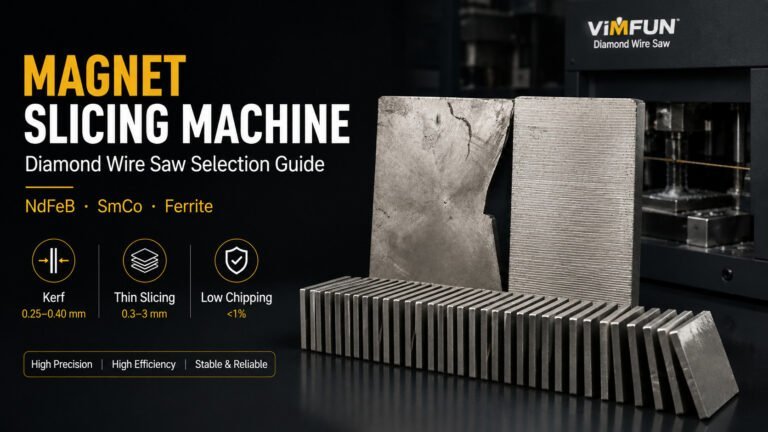
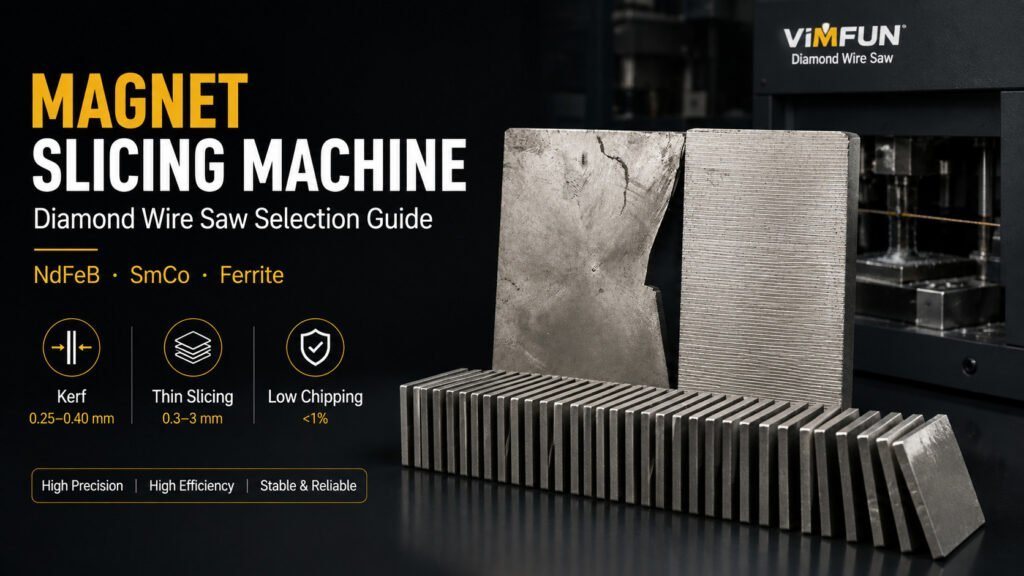
Si vous découpez encore des blocs de NdFeB avec une scie à diamètre intérieur, vous perdez 0,6 à 1,0 mm d'aimant par coupe et vous subissez un taux d'écaillage supérieur à 3% sur les tranches fines. Une taille correctement aperçu des machines de découpe d'aimants en utilisant un fil diamanté, la déduction est réduite à 0,25–0,40 mm et l'écaillage est inférieur à 1% — cela permet à lui seul de récupérer 20–30% de tranches supplémentaires par boule sur un bloc typique de 200–600 mm.
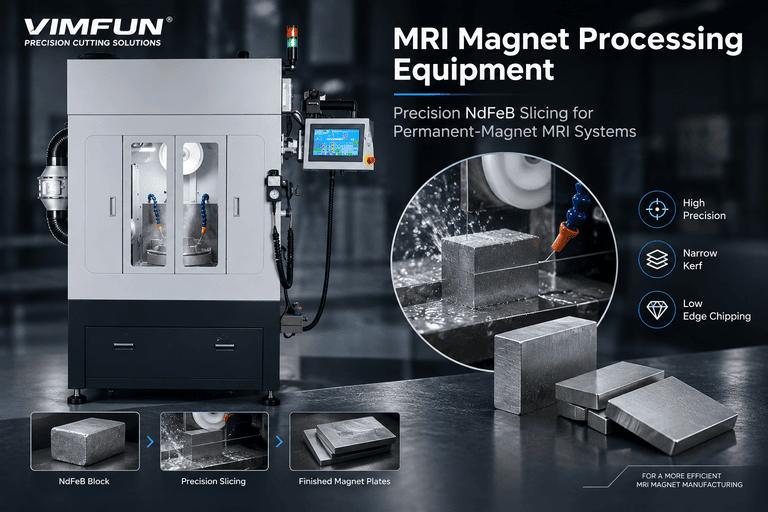
Cette page est le centre d'équipement pour la découpe d'aimants. Elle explique le fonctionnement des scies à fil diamanté sur les aimants frittés, comment choisir une machine en fonction de la taille de la pièce et de l'épaisseur de la tranche, et où le choix de la machine change pour les lignes de production de SmCo, de ferrite et de qualité moteur.
Qu'est-ce qu'une machine de découpe d'aimants ?
Une machine de découpe d'aimants est une scie à fil diamanté configurée pour découper des aimants permanents frittés — NdFeB, SmCo et ferrite dure — en tranches finies, blocs ou segments d'arc. L'élément de coupe principal est un fil diamanté électrodéposé ou brasé (diamètre typique de 0,18–0,35 mm) qui tourne en continu sur une bobine à 1500–2400 m/min tandis que la pièce avance à 0,3–1,2 mm/min.
La raison pour laquelle les scies à fil ont remplacé les scies à diamètre intérieur pour la découpe d'aimants est simple : le NdFeB fritté est dur (Hv 550–650) et cassant. Les scies à diamètre intérieur concentrent la force de coupe sur un seul bord de lame, de sorte que l'écaillage des bords et les fissures sous-jacentes sont fréquents. Le fil répartit la charge sur des dizaines ou des centaines de grains abrasifs en même temps.
Comment fonctionne réellement la scie à fil diamanté pour aimants
Deux types de fils sont utilisés sur les lignes d'aimants :
| Type de fil | Diamètre | Durée de vie sur NdFeB | Idéal pour |
|---|---|---|---|
| Diamant électrodéposé | 0,20–0,30 mm | 15–30 km | Découpe fine à haut volume |
| Diamant brasé | 0,30–0,45 mm | 40–80 km | Blocs épais, segments d'arc |
Le fil électrodéposé a un grain plus fin et coupe plus vite, mais s'use plus tôt. Le fil brasé dure plus longtemps mais laisse une coupe légèrement plus rugueuse. Sur un bloc de NdFeB de 500 mm, nous utilisons généralement l'électrodéposition pour les tranches de moins de 2 mm et le brasage pour les blocs qui seront réusinés par la suite.
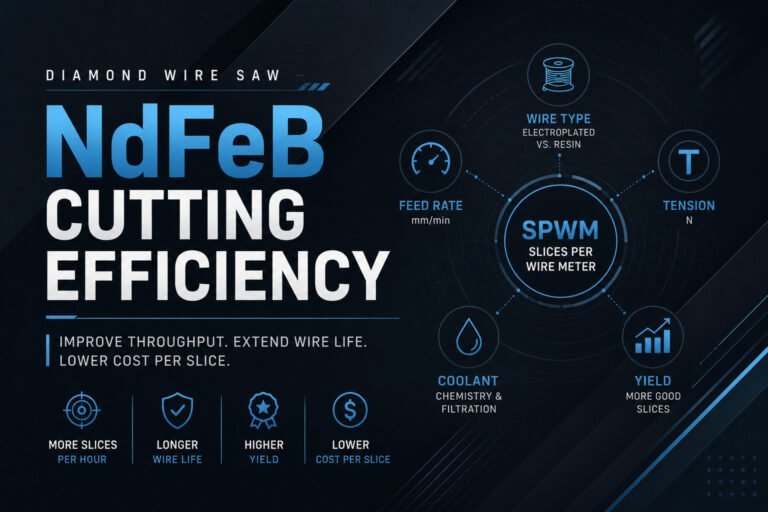
Un point à surveiller : le fil diamanté sur les aimants nécessite un liquide de refroidissement à base d'eau avec inhibiteur de corrosion. L'eau pure rouille la surface fraîchement coupée du NdFeB en quelques heures, et les liquides de refroidissement à base d'huile standard laissent des résidus qui interfèrent avec le meulage en aval. La plupart des lignes de production utilisent une concentration de liquide de refroidissement synthétique de 3–5%.
Si vous comparez la scie à fil et la scie à diamètre intérieur au niveau du processus, consultez notre comparaison scie multi-fil vs scie à diamètre intérieur pour les chiffres de déduction et de rendement comparatifs.
Sélection de la machine de découpe à fil NdFeB par taille de bloc
La variable de sélection la plus importante est la taille du bloc. Une machine surdimensionnée brûle du capital ; une machine sous-dimensionnée étouffe le débit. Ci-dessous, comment nous dimensionnons l'équipement de découpe à fil d'aimant NdFeB en fonction du plus grand bloc que vous prévoyez de traiter.
Petits blocs de moins de 200 mm — SOMS3-430S
Pour la R&D, le prototypage ou la production d'aimants de capteurs où les blocs mesurent 50–180 mm, une scie à fil oscillante compacte est le bon choix. La SOMS3-430S est une machine oscillante à fil unique — le fil se déplace d'avant en arrière sur une courte course plutôt que de fonctionner en boucle continue. L'oscillation est plus lente par coupe mais produit des dommages sous-jacents très faibles, ce qui est important lorsque vous découpez des pièces d'aimant en néodyme qui iront directement au revêtement sans étape de rodage.
Blocs standard de 200–600 mm — SOM4-630D (Scie multi-fil pour blocs NdFeB)
C'est là que se situe la majeure partie de la production. Une scie multi-fil découpe un bloc entier en 50–200 tranches parallèles en un seul cycle de coupe, entraînée par un seul fil qui s'enroule plusieurs fois autour de deux rouleaux guides. La SOM4-630D traite des blocs jusqu'à 630 mm de long et vous offre la possibilité d'un pas de 0,25–1,0 mm en fonction de l'épaisseur de la tranche. Pour toute application de scie multi-fil pour blocs NdFeB dans la gamme 200–600 mm, c'est le cheval de bataille.
Chiffre réel : sur un bloc de 400×100×80 mm, une SOM4-630D fonctionnant à une vitesse de fil de 1800 m/min et une avance de 0,6 mm/min produit environ 65 tranches en 130 minutes avec une déduction de 0,30 mm.
Grands blocs de 600–1000 mm — SOM4-750D et SOM4-1000D
Pour les segments d'aimants d'éoliennes et les grands noyaux de moteurs industriels, la longueur des blocs va jusqu'à 1 m. Les SOM4-750D et SOM4-1000D utilisent des systèmes de tension de fil renforcés (35–50 N) pour maintenir le voile du fil sous contrôle sur les longues coupes. Le contrôle du voile est la différence entre une variation d'épaisseur de ±10 μm et ±40 μm — cette dernière échoue à la plupart des spécifications d'aimants de moteur.
Pour une introduction plus large aux configurations de découpe NdFeB pour toutes les tailles de blocs, consultez notre aperçu des machines de découpe NdFeB.
Machine de découpe de tranches d'aimants minces (0,3–3 mm)
Les tranches fines posent leur propre problème. En dessous de 1 mm, la tranche elle-même devient suffisamment flexible pour que les forces de coupe la fassent fléchir, ce qui se traduit par des bords effilés et du gauchissement. Une machine dédiée à la découpe de tranches d'aimants minces résout ce problème de deux manières :
- Vitesse de fil plus élevée — 2000–2400 m/min au lieu des 1500–1800 m/min standard, de sorte que chaque grain abrasif enlève moins de matière par passe
- Vitesse d'avance réduite — 0,2–0,4 mm/min au lieu de 0,5–0,8 mm/min
- Collage rigide de la pièce — le bloc est collé à une plaque de support en graphite ou en céramique avant la découpe, et la coupe pénètre de 0,3–0,5 mm dans le support
La SOM2-600S est configurée pour cela : broche à haute vitesse, axe d'avance de précision et un support de pièce conçu pour le collage sur plaque de support. La sortie typique est de tranches de NdFeB de 0,3–2,0 mm avec une variation d'épaisseur de ±5 μm.
Avertissement : le rendement des tranches fines sur le NdFeB de grade N52+ est significativement inférieur à celui du N42 — les grades supérieurs sont plus cassants. Si vous spécifiez une ligne pour des tranches fines N52 ou N54, prévoyez un taux de rebut de 8–12% même sur une machine bien réglée.
Découpe d'aimants SmCo et Ferrite
Le SmCo (Hv 500–600) se découpe de manière similaire au NdFeB mais est plus sensible thermiquement. Les vitesses de fil diminuent généralement de 10–15% et le débit de liquide de refroidissement doit être plus élevé. La ferrite est beaucoup plus douce (Hv 480–550) mais très abrasive pour le fil — attendez-vous à une durée de vie du fil 40–50% plus courte qu'avec le NdFeB.
Pour les outils et les paramètres de coupe spécifiques au SmCo, consultez la page des machines de découpe d'aimants SmCo.
Équipement de découpe d'aimants de moteur par application
L'application finale détermine le choix de la machine plus que la nuance du matériau. Voici comment l'équipement de découpe d'aimants de moteur se répartit par utilisation finale.
| Application | Taille de tranche typique | Volume | Machine recommandée |
|---|---|---|---|
| Moteurs de traction VE | Segments d'arc de 30×20×3 mm | Haut | SOM4-630D ou SOM4-750D |
| Servomoteur industriel | Blocs de 15×10×2 mm | Moyen | SOM4-630D |
| Haut-parleur / audio | Anneaux de 50×50×5 mm | Moyen | SOM4-630D |
| Éolienne | Segments de 100×30×20 mm | Faible, épais | SOM4-1000D |
| VCM / capteur | Tranches fines de 5×5×0,5 mm | Volume élevé, fin | SOM2-600S |
Pour les spécificités de découpe d'aimants de moteurs VE — y compris la production de segments d'arc par encollage puis découpe — consultez notre page d'équipement de fabrication d'aimants de moteurs VE. Pour la production de segments d'éoliennes, consultez la page de machine de découpe d'aimants d'éoliennes.
Planification du débit des machines de tranchage d'aimants
Pour quiconque planifie une ligne de découpe, le débit est plus important que les spécifications d'une seule machine. Voici comment le débit des machines de tranchage d'aimants évolue en pratique :
SOM4-630D unique, bloc NdFeB de 400 mm, tranches de 1,0 mm :
- Temps de cycle : ~110 min par bloc (configuration + coupe + déchargement)
- Tranches par cycle : ~380
- Sortie effective : ~200 tranches/heure par machine
Ligne de 4× SOM4-630D :
- Sortie combinée : ~800 tranches/heure
- Ratio d'opérateurs : 1 opérateur pour 2 machines
- Consommation de fil : ~15 km/jour par machine
Le goulot d'étranglement est rarement la vitesse de coupe elle-même. Sur la plupart des lignes, le chargement des pièces, le remplacement du fil et le nettoyage des tranches finies consomment 30 à 40 % du temps d'horloge. Si vous planifiez une mise à niveau de ligne, surveillez l'automatisation du chargement aussi attentivement que la spécification de coupe.
Après la découpe, la plupart des tranches d'aimants subissent un meulage et un revêtement. Pour l'étape en aval, consultez notre page de meulage et polissage d'aimants NdFeB.
Limitations connues
Quelques éléments qu'une machine de découpe d'aimants ne résoudra pas :
- Blocs d'entrée déformés. Si le bloc fritté lui-même présente une déviation de planéité supérieure à 0,2 mm, les tranches fines qui en sont issues hériteront de cette déformation. Corrigez-la au stade du pressage/frittage, pas à la scie.
- Tranches fines de nuance N54+ inférieures à 0,5 mm. Le rendement s'effondre. Si vous en avez besoin, prévoyez une étape de finition par électroérosion à fil, pas seulement une scie à fil.
- Remplacement entièrement automatisé du fil. La plupart des machines de découpe d'aimants nécessitent toujours un chargement manuel du fil tous les 15 à 30 km. Des changeurs de fil automatisés existent sur les lignes de tranches de silicium mais n'ont pas encore été adoptés à l'échelle de production sur les lignes d'aimants.
Gamme d'équipements de découpe d'aimants Vimfun
Référence rapide pour les cinq machines discutées ci-dessus :
| Modèle | Enveloppe de coupe | Plage de tranches | Meilleur ajustement |
|---|---|---|---|
| SOMS3-430S | Bloc ≤200 mm | 0,5–5 mm | R&D, aimants de capteurs |
| SOM2-600S | Bloc de ≤600 mm | 3–3 mm | Production de tranches minces |
| SOM4-630D | Bloc de ≤630 mm | 5–10 mm | Production standard de NdFeB |
| SOM4-750D | Bloc de ≤750 mm | 1–15 mm | Aimants pour gros moteurs |
| SOM4-1000D | Bloc de ≤1000 mm | 2–20 mm | Segments d'éoliennes |
Envoyez-nous un échantillon d'aimant et la géométrie de tranche cible — nous la découpons gratuitement et vous envoyons les tranches finies ainsi qu'un rapport de mesure sur la largeur de coupe, le TTV et la rugosité de surface avant que vous ne vous engagiez sur une spécification de machine.
FAQ
Quelle est l'épaisseur de tranche la plus fine qu'une machine de découpe de tranches d'aimants puisse produire ?
3 mm sur les nuances de NdFeB jusqu'à N45, en utilisant une machine de découpe de tranches d'aimants minces comme la SOM2-600S avec collage de plaque de support. En dessous de 0.3 mm, il faut un fil EDM.
Quelle est la durée de vie d'un fil diamanté sur le NdFeB ?
Fil électrodéposé : 15–30 km selon la nuance et l'épaisseur de la tranche. Fil brasé : 40–80 km. La ferrite use le fil 40–50 % plus rapidement que le NdFeB.
Une seule machine peut-elle traiter le NdFeB, le SmCo et la ferrite ?
Oui — une SOM4-630D traite les trois avec des changements de paramètres (vitesse du fil, vitesse d'avance, débit de liquide de refroidissement). Le matériel de la machine est le même.
Quelle perte de largeur de coupe dois-je attendre par rapport à une scie ID ?
Scie à fil diamanté : largeur de coupe de 0.25–0.40 mm. Scie ID : 0.6–1.0 mm. Sur un bloc typique, la scie à fil récupère 20–30 % de tranches en plus.
Offrez-vous une découpe d'échantillon gratuite ?
Oui. Envoyez un bloc d'aimant et la spécification de la tranche — nous découpons, mesurons et renvoyons les tranches avec un rapport sans frais.