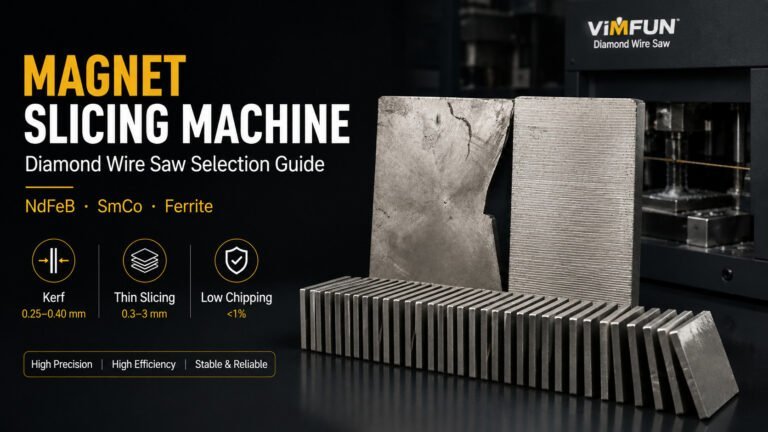
If you are still slicing NdFeB blocks with an ID saw, you are losing 0.6–1.0 mm of magnet per cut and eating a chipping rate above 3% on thin slices. A properly sized 자석 슬라이싱 기계 using diamond wire drops kerf to 0.25–0.40 mm and pulls chipping under 1% — that alone recovers 20–30% more slices per boule on a typical 200–600 mm block.
This page is the equipment hub for magnet slicing. It walks through how diamond wire saws work on sintered magnets, how to pick a machine by workpiece size and slice thickness, and where the machine choice changes for SmCo, ferrite, and motor-grade production lines.
What Is a Magnet Slicing Machine?
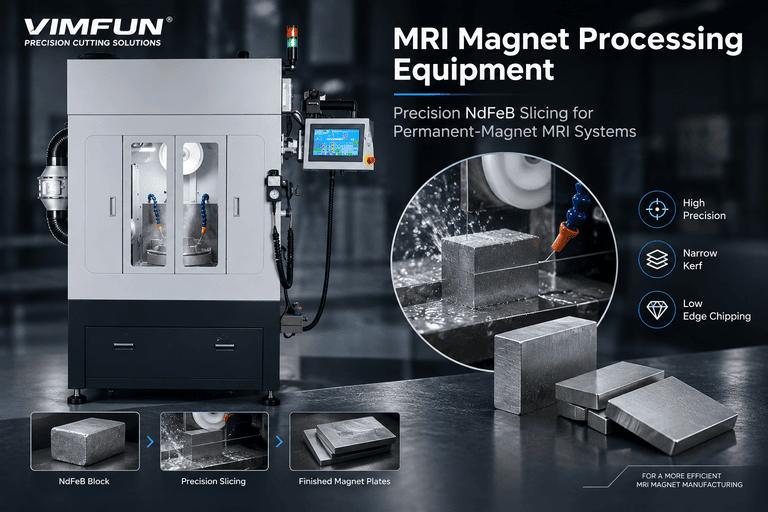
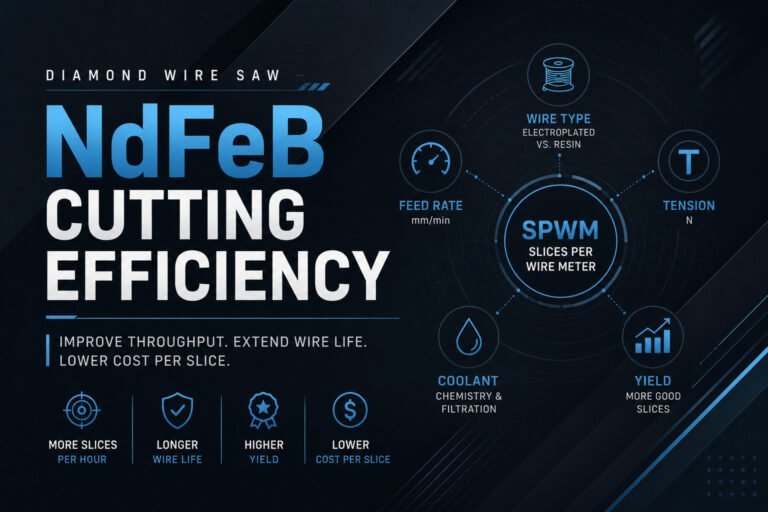
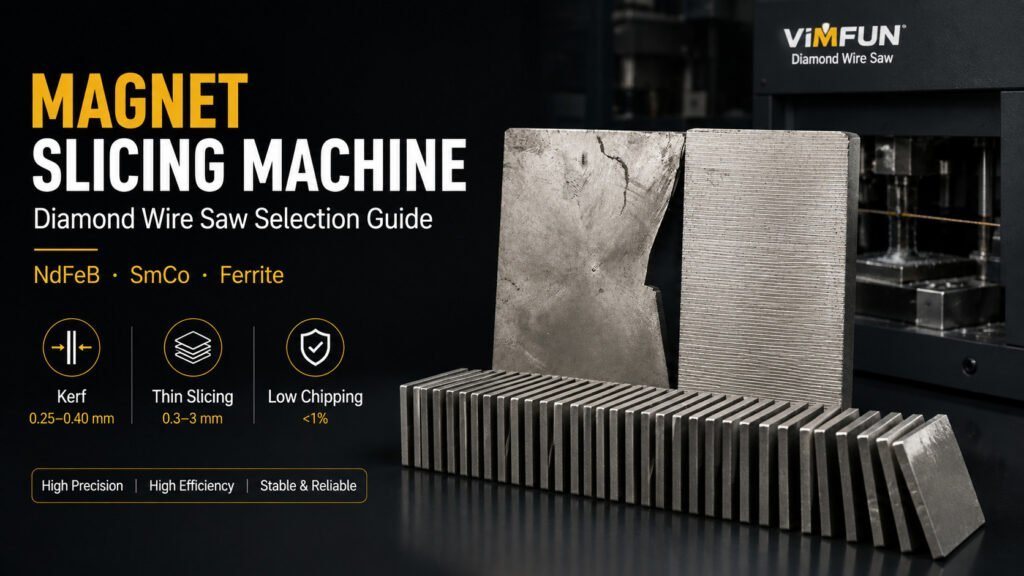
A magnet slicing machine is a diamond wire saw configured to cut sintered permanent magnets — NdFeB, SmCo, and hard ferrite — into finished slices, blocks, or arc segments. The core cutting element is an electroplated or brazed diamond wire (typical diameter 0.18–0.35 mm) that runs continuously over a wire spool at 1500–2400 m/min while the workpiece feeds down at 0.3–1.2 mm/min.
The reason wire saws replaced ID saws for magnet cutting is simple: sintered NdFeB is hard (Hv 550–650) and brittle. ID saws concentrate cutting force on a single blade edge, so edge chipping and subsurface cracks are frequent. Wire distributes the load across dozens or hundreds of abrasive grains at the same time.
How Diamond Wire Saw for Magnets Actually Works
Two wire types show up on magnet lines:
| 와이어 유형 | Diameter | Life on NdFeB | 에 적합 |
|---|---|---|---|
| 전기 도금 다이아몬드 | 0.20–0.30 mm | 15–30 km | High-volume thin slicing |
| Brazed diamond | 0.30–0.45 mm | 40–80 km | Thick blocks, arc segments |
Electroplated wire has finer grit and cuts faster, but wears out sooner. Brazed wire lasts longer but leaves a slightly rougher cut. On a 500 mm NdFeB block, we usually run electroplated for slices under 2 mm and brazed for blocks that will be re-machined afterward.
One gotcha: diamond wire on magnets requires a water-based coolant with corrosion inhibitor. Straight water rusts the freshly cut NdFeB surface within hours, and standard oil coolants leave residue that interferes with downstream grinding. Most production lines use a 3–5% synthetic coolant concentration.
If you’re weighing wire saw vs. ID saw at the process level, see our multi-wire saw vs. inner-diameter saw comparison for the head-to-head kerf and yield numbers.
NdFeB Wire Saw Machine Selection by Block Size
The single most important selection variable is block size. An oversized machine burns capital; an undersized machine chokes on throughput. Below is how we size NdFeB magnet wire saw cutting equipment by the largest block you plan to run.
Small Blocks Under 200 mm — SOMS3-430S
For R&D, prototyping, or sensor-magnet production where blocks are 50–180 mm, a compact oscillating wire saw is the right call. The SOMS3-430S is a single-wire oscillating machine — the wire moves back and forth in a short stroke rather than running as a continuous loop. Oscillation is slower per cut but produces very low subsurface damage, which matters when you are cutting neodymium magnet slicing wire saw workpieces that will go straight to coating without a lapping step.
Standard Blocks 200–600 mm — SOM4-630D (NdFeB Block Multi-Wire Saw)
This is where most production sits. A multi-wire saw slices a whole block into 50–200 parallel slices in one cut cycle, driven by a single wire that wraps repeatedly around two guide rollers. The SOM4-630D handles blocks up to 630 mm long and gives you the option of 0.25–1.0 mm pitch depending on slice thickness. For any NdFeB block multi-wire saw application in the 200–600 mm range, this is the workhorse.
Real-world number: on a 400×100×80 mm block, a SOM4-630D running at 1800 m/min wire speed and 0.6 mm/min feed produces roughly 65 slices in 130 minutes with 0.30 mm kerf.
Large Blocks 600–1000 mm — SOM4-750D and SOM4-1000D
For wind turbine magnet segments and large industrial motor cores, block length runs up to 1 m. The SOM4-750D and SOM4-1000D use reinforced wire tension systems (35–50 N) to keep wire bow under control on long cuts. Bow control is the difference between ±10 μm thickness variation and ±40 μm — the latter fails most motor-magnet specs.
For a broader intro to NdFeB cutting configurations across all block sizes, see our NdFeB cutting machine overview.
Thin Magnet Slice Cutting Machine (0.3–3 mm)
Thin slices are their own problem. Below 1 mm, the slice itself becomes flexible enough that cutting forces cause it to deflect, which shows up as tapered edges and warp. A dedicated thin magnet slice cutting machine solves this in two ways:
- Higher wire speed — 2000–2400 m/min instead of the standard 1500–1800 m/min, so each abrasive grain removes less material per pass
- Reduced feed rate — 0.2–0.4 mm/min instead of 0.5–0.8 mm/min
- Rigid workpiece bonding — the block is bonded to a graphite or ceramic support plate before cutting, and the cut goes 0.3–0.5 mm into the support
The SOM2-600S is set up for this: high-speed spindle, precision feed axis, and a workpiece holder designed for support-plate bonding. Typical output is 0.3–2.0 mm NdFeB slices with ±5 μm thickness variation.
Fair warning: thin slice yield on Grade N52+ NdFeB is meaningfully lower than N42 — the higher grades are more brittle. If you’re spec’ing a line for N52 or N54 thin slices, budget for 8–12% scrap rate even on a well-set-up machine.
SmCo and Ferrite Magnet Cutting
SmCo (Hv 500–600) cuts similarly to NdFeB but is more thermally sensitive. Wire speeds usually drop 10–15% and coolant flow needs to be higher. Ferrite is much softer (Hv 480–550) but very abrasive on wire — expect 40–50% shorter wire life than NdFeB.
For SmCo-specific tooling and cut parameters, see the SmCo magnet cutting machine page.
Motor Magnet Slicing Equipment by Application
The end application drives the machine choice more than the material grade does. Below is how motor magnet slicing equipment breaks down by end use.
| 애플리케이션 | Typical slice size | 물량 | Recommended machine |
|---|---|---|---|
| EV traction motors | 30×20×3 mm arc segments | 높은 | SOM4-630D or SOM4-750D |
| Industrial servo | 15×10×2 mm blocks | 중간 | SOM4-630D |
| Speaker / audio | 50×50×5 mm rings | 중간 | SOM4-630D |
| Wind turbine | 100×30×20 mm segments | Low, thick | SOM4-1000D |
| VCM / sensor | 5×5×0.5 mm thin slices | High volume, thin | SOM2-600S |
For EV motor magnet cutting specifics — including glue-then-cut arc segment production — see our EV motor magnet manufacturing equipment page. For wind turbine segment production, see the wind turbine magnet cutting machine page.
Magnet Wafering Machine Throughput Planning
For anyone planning a slicing line, throughput math matters more than single-machine specs. Here is how magnet wafering machine throughput scales in practice:
Single SOM4-630D, 400 mm NdFeB block, 1.0 mm slices:
- Cycle time: ~110 min per block (setup + cut + unload)
- Slices per cycle: ~380
- Effective output: ~200 slices/hour per machine
Line of 4× SOM4-630D:
- Combined output: ~800 slices/hour
- Operator ratio: 1 operator per 2 machines
- Wire consumption: ~15 km/day per machine
The bottleneck is rarely cutting speed itself. On most lines, workpiece loading, wire replacement, and finished slice cleaning consume 30–40% of clock time. If you’re planning a line upgrade, watch loading automation as carefully as the cut spec.
Post-slice, most magnet slices go through grinding and coating. For the downstream step, see our NdFeB magnet grinding and polishing page.
Known Limitations
A few things a magnet slicing machine will not fix:
- Warped input blocks. If the sintered block itself has more than 0.2 mm flatness deviation, thin slices coming off it will inherit that warp. Fix it at the pressing/sintering stage, not at the saw.
- Grade N54+ thin slices below 0.5 mm. Yield collapses. If you need this, plan for a wire-EDM finishing step, not just wire saw.
- Fully automated wire replacement. Most magnet slicing machines still need manual wire loading every 15–30 km. Automated wire changers exist on silicon wafer lines but have not landed on magnet lines yet at production scale.
Vimfun Magnet Slicing Equipment Lineup
Quick reference for the five machines discussed above:
| 모델 | Cut envelope | Slice range | Best fit |
|---|---|---|---|
| SOMS3-430S | ≤200 mm block | 0.5–5 mm | R&D, sensor magnets |
| SOM2-600S | ≤600 mm block | 0.3–3 mm | Thin slice production |
| SOM4-630D | ≤630 mm block | 0.5–10 mm | Standard NdFeB production |
| SOM4-750D | ≤750 mm block | 1–15 mm | Large motor magnets |
| SOM4-1000D | ≤1000 mm block | 2–20 mm | Wind turbine segments |
Send us a magnet sample and target slice geometry — we cut it free and send you the finished slices plus a measured report on kerf, TTV, and surface roughness before you commit to a machine spec.
자주 묻는 질문
What is the smallest slice thickness a magnet slicing machine can produce?
0.3 mm on NdFeB grades up to N45, using a thin magnet slice cutting machine like the SOM2-600S with support-plate bonding. Below 0.3 mm requires wire-EDM.
How long does diamond wire last on NdFeB?
Electroplated wire: 15–30 km depending on grade and slice thickness. Brazed wire: 40–80 km. Ferrite wears wire 40–50% faster than NdFeB.
Can one machine handle NdFeB, SmCo, and ferrite?
Yes — a SOM4-630D handles all three with parameter changes (wire speed, feed rate, coolant flow). The machine hardware is the same.
What kerf loss should I expect vs. an ID saw?
Diamond wire saw: 0.25–0.40 mm kerf. ID saw: 0.6–1.0 mm. On a typical block, wire saw recovers 20–30% more slices.
Do you offer a free sample cut?
Yes. Send a magnet block and slice spec — we cut, measure, and return the slices with a report at no cost.