The speaker magnet market runs on volume and cost per unit. A single mid-tier consumer audio brand can consume 20–40 million ferrite driver magnets a year. At that scale, the choice of speaker magnet cutting machine determines whether the margin structure works — not just whether the geometry is correct.
This page covers what a speaker magnet cutting machine actually needs to do in high-volume audio production, why ferrite dominates the format, and how the equipment specification changes when you move from consumer speakers to professional audio or automotive applications.
Speaker Magnet Industry Overview
The audio magnet market is stratified by three end-use tiers, and each tier has different cutting requirements:
| Segment | Volume | Magnet Material | Typical Cutting Priority |
|---|---|---|---|
| Consumer audio (earbuds, portable, home theater) | Very high — hundreds of millions of units/year | Ferrite dominant, NdFeB in premium | Cost per cut, throughput |
| Automotive audio (OEM in-car systems) | High, growing | Ferrite + NdFeB mixed | Batch consistency, spec compliance |
| Professional audio (studio monitors, PA, instrument) | Mid volume | NdFeB dominant, high-grade ferrite | Precision, magnetic performance uniformity |
| Specialty (hearing aids, medical audio) | Low volume | High-grade NdFeB | Precision, biocompatibility |
Most speaker magnet cutting machines in production today service the consumer and automotive tiers. That means a machine designed for this application has to balance three things: cutting cost per unit, throughput, and geometric consistency across large lots. Precision above what audio-driver performance actually needs is wasted capex.
For general magnet-cutting equipment across all applications, our magnet slicing machine selection hub covers the broader range of equipment types and how they compare.
Ferrite vs NdFeB for Audio Applications
Understanding which material is going into the driver is the first specification step. The material choice cascades into every downstream equipment decision.
Ferrite (barium or strontium hexaferrite):
- Low cost — typically $2–4/kg for cutting-grade stock
- Lower magnetic performance (BHmax around 3.5–4.5 MGOe)
- High volume resistivity — cuts cleanly with diamond wire without significant conductive dust issues
- Brittle — requires low-force cutting to avoid chipping and micro-cracks at driver mount points
- The dominant material in the consumer speaker segment
NdFeB (sintered neodymium-iron-boron):
- Higher cost — typically $50–90/kg depending on grade
- Much higher magnetic performance (BHmax 30–52 MGOe)
- Enables smaller, lighter drivers with equivalent or better output
- Cutting generates conductive dust (fire/health hazard) — requires wet cutting with slurry management
- Standard in premium consumer, portable, and professional audio
For dedicated ferrite cutting equipment specifications, our ferrite magnet cutting wire saw page covers the machine architecture built specifically for ferrite’s material characteristics.
Practical implication for a speaker magnet cutting machine: if your production is 80%+ ferrite, spec the machine around ferrite’s low-force, high-volume needs. If you’re running mixed NdFeB + ferrite, you either need two machine lines or a machine with dust-management and slurry systems built in — not an add-on retrofit.
High-Volume Cutting Solutions for Speaker Magnet Production
A production-grade speaker magnet cutting machine at consumer-audio volumes needs to hit three throughput characteristics:
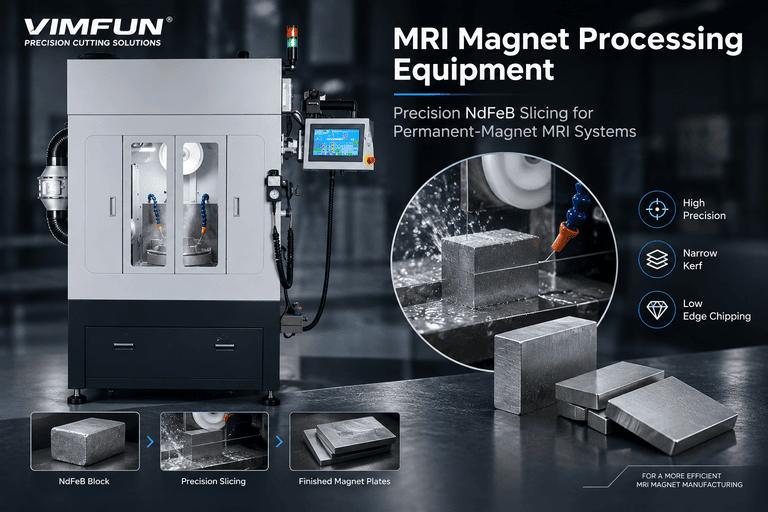
Multi-wire architecture. Single-wire cutting is fine for prototype and low-volume runs. Once you’re in the millions of units per year, multi-wire configurations that cut 20–40 magnets simultaneously become mandatory. The throughput multiplier is roughly linear with wire count.
Automated feed and unload. Manual loading caps throughput at operator speed. Automated magazine feed with vibratory or robotic unload runs continuously and reduces per-unit labor cost by 60–80%.
Fast wire change and consumables replacement. Diamond wire life at ferrite volumes is finite — every hour of downtime for wire change is lost throughput. Machines designed for high-volume audio production optimize the wire change path: quick-swap mounts, pre-tensioned wire cassettes, and tool-free replacement.
Typical production-tier configurations we deliver for speaker magnet applications:
- Multi-wire diamond saw, 20–40 wire configuration
- Automated magnet blank feed
- Slurry recovery and filtration for NdFeB lines
- Dry cutting with dust extraction for ferrite-only lines
- Integrated dimension verification (inline optical measurement)
- 15,000–40,000 magnets per shift depending on driver size
For manufacturers running consumer-scale volumes, the difference between a well-specified speaker magnet cutting machine and a general-purpose diamond wire saw is roughly 3× throughput at 40% lower labor per unit. That gap is where the margin structure actually lives.
Cost Optimization for Speaker Magnet Manufacturing
The cost of cutting a speaker magnet is not the wire time — it’s the total cost per finished unit including yield loss, downtime, and consumables. Speaker magnet buyers who focus only on machine purchase price typically miss the actual cost driver.
Where cost actually accumulates:
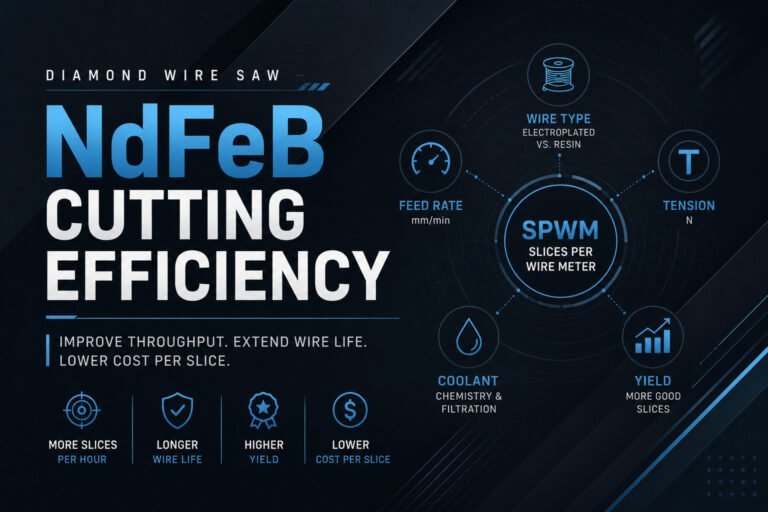
- Wire consumption — diamond wire is the largest consumable line item. Cheaper wire costs less per meter but wears faster, and the total wire cost per magnet often flips. Mid-tier wire from a reliable supplier usually beats premium wire on total cost, and beats budget wire on both cost and yield.
- Yield loss from chipping — ferrite chips at cut edges create rejects. High-force cutting is faster per magnet but produces higher reject rates. The optimum feed rate isn’t the fastest — it’s the rate where wire cost + yield loss is minimized.
- Kerf material loss — narrower kerf (thinner wire) recovers more magnets per blank. For ferrite at 5–10 mm thick, moving from 0.35 mm wire to 0.25 mm wire can add 3–6% to yield.
- Machine uptime — every hour of unplanned downtime at 20,000 magnets/hour production is 20,000 magnets of lost output. Uptime engineering matters more than peak speed.
A realistic cost example: for a mid-range consumer speaker magnet production line running 8 million ferrite units per year, moving from a general-purpose diamond wire saw to a properly-specified speaker magnet cutting machine typically reduces total cutting cost per magnet by 20–35% over the first 24 months of operation. The savings come from throughput, wire consumption efficiency, and yield — not from the equipment price tag.
Practical Notes and Limitations
One honest constraint: a speaker magnet cutting machine optimized for high-volume ferrite is not the right choice for small-batch or prototype production. The setup time and consumables minimum load don’t amortize below ~50,000 magnets per production run. For prototype and low-volume specialty audio work, a single-wire or small multi-wire configuration is more economical.
Similarly, machines optimized for consumer-audio ferrite throughput are not the right fit for premium NdFeB studio-monitor magnets, where geometric precision and magnetic performance uniformity outrank throughput. Those production lines need different fixturing, different wire spec, and different QC integration.
Sizing the machine correctly to the actual production application is the largest single decision. Overspecifying costs capex; underspecifying caps throughput.
If you’re planning a speaker magnet production line and need to evaluate cutting equipment options, send us your magnet material, unit dimensions, and target monthly volume. We’ll come back with a machine configuration and a projected cost-per-magnet estimate.
Request Speaker Magnet Quote
External references:
[1] Grand View Research — Permanent Magnet Market Analysis: https://www.grandviewresearch.com/industry-analysis/permanent-magnet-market
[2] IEC 60268 — Sound System Equipment Standards: https://webstore.iec.ch/publication/1213