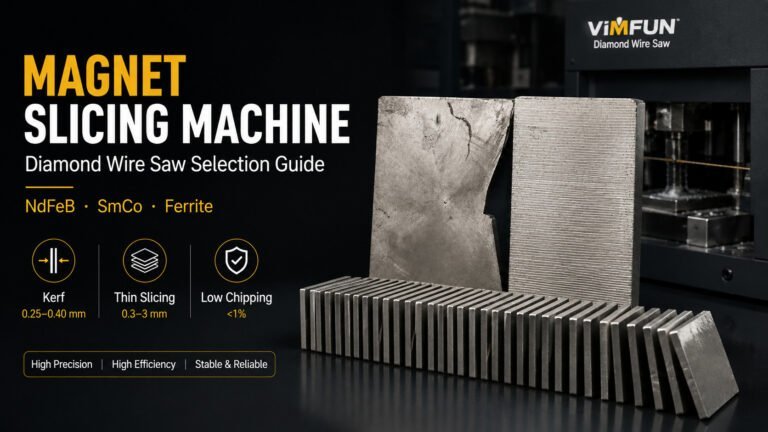
A SmCo magnet cutting machine is specialized slicing equipment configured to process samarium cobalt rare earth alloys without chipping, cracking, or thermal-induced demagnetization. Because SmCo is harder and more brittle than NdFeB—and because its chief advantage is stability at elevated temperatures—every cutting parameter must be dialed in to preserve coercivity and maintain tight dimensional tolerances through the full production run.
What Is a SmCo Magnet Cutting Machine?
A SmCo magnet cutting machine is a precision cutting system—most commonly a diamond multi-wire saw or an inner-diameter (ID) saw—optimized for samarium cobalt alloys. Standard NdFeB settings cannot be carried over directly. SmCo’s higher Vickers hardness (~550–650 HV versus ~450–500 HV for sintered NdFeB) and lower fracture toughness (K₁c ≈ 1.0–1.3 MPa·m^0.5) mean that feed rates must be slower and vibration control tighter to prevent subsurface micro-cracking that degrades slice-to-slice magnetic uniformity.
SmCo is produced in two principal grades, each with distinct processing requirements:
- SmCo₅ — maximum continuous operating temperature ~250 °C; simpler alloy composition; slightly easier to slice
- Sm₂Co₁₇ — operating temperature up to 350 °C; higher energy product (BHmax up to 34 MGOe); more sensitive to heat spikes during cutting
Both grades are processed on the same machine class, but Sm₂Co₁₇ demands more conservative cutting parameters because any localized temperature rise near the Curie point risks irreversible demagnetization in the finished slice.

Key Parameters for SmCo Magnet Cutting Machine Operation
| Parameter | SmCo Recommended Range | NdFeB Typical Range | Notes |
|---|---|---|---|
| Wire diameter (diamond wire) | 0.20–0.28 mm | 0.22–0.32 mm | Finer wire reduces kerf loss on costly billet |
| Wire speed | 800–1,200 m/min | 1,000–1,500 m/min | Lower speed limits chipping at grain boundaries |
| Feed rate | 0.3–0.8 mm/min | 0.5–1.2 mm/min | SmCo brittleness requires slower infeed |
| Wire tension | 18–25 N | 20–30 N | Adjust per wire-diameter workbook spec |
| Coolant temperature | 18–22 °C | 20–25 °C | ±1 °C control prevents thermal micro-cracking |
| Slice thickness tolerance | ±0.03–0.05 mm | ±0.05–0.08 mm | Aerospace and sensor specs often demand tighter range |
Ranges reflect common industry practice for sintered rare-earth magnet processing. Always validate against your machine manufacturer’s workbook and the material certification sheet for each billet lot.
How to Set Up Your SmCo Magnet Cutting Machine
Step 1: Confirm Material Grade and Fixture
Identify whether you are processing SmCo₅ or Sm₂Co₁₇ before selecting wire speed and feed targets—the two grades differ in brittleness index and heat sensitivity. Mount the billet with low-outgassing epoxy or mechanical clamping. Avoid moisture-containing adhesives: coolant interaction can contaminate the cut face and cause staining that is misread as surface cracking during QC inspection.
Step 2: Set Wire Tension and Check Bow
Thread diamond wire to specification and measure bow under no-load conditions at operating speed. SmCo’s hardness causes greater wire bow than softer magnetic materials. If midpoint bow exceeds 0.05 mm, reduce wire speed by 50 m/min or increase tension by 1 N incrementally—never more than 1 N per adjustment step—and recheck before cutting any product material.
Step 3: Establish Coolant Flow and Run a Trial Cut
Use a water-based coolant at pH 8.5–9.5. SmCo is more corrosion-resistant than NdFeB, so coolant chemistry here is primarily about lubricity and slurry removal rather than rust inhibition. Confirm pump flow is continuous and chiller setpoint is stable before slicing. Then cut one piece from a sacrificial block of the same grade and inspect under 10× magnification for edge chipping, wire marks deeper than 5 μm, and TTV exceeding 0.05 mm. Adjust as needed before committing to production billets.
SmCo vs. NdFeB Cutting: Why the Parameters Differ
Engineers moving from NdFeB cutting machines to SmCo commonly see chipping and cracking in the first production run. The root cause is fracture toughness: SmCo’s K₁c is roughly 30–40% lower than sintered NdFeB, so vibration spikes that NdFeB absorbs will propagate cracks in SmCo grain boundaries.
A second difference is material cost. SmCo billets carry significantly higher raw-material value than NdFeB of equivalent volume, which makes kerf loss a direct cost lever rather than a secondary concern. Switching from a 0.28 mm wire to a 0.20 mm wire recovers meaningful material per slice and pays back quickly at SmCo prices—particularly for Sm₂Co₁₇ grades used in precision aerospace actuators and high-temperature sensor arrays.
For operations running both alloys, the safest practice is to maintain dedicated SmCo wire sets. Partially worn NdFeB wire transfers higher impact forces that SmCo cannot tolerate.
According to Arnold Magnetic Technologies, Sm₂Co₁₇ magnets maintain more than 95% of their room-temperature flux density at 150 °C—a retention rate that makes them the preferred choice in rare-earth magnet cutting equipment lines serving aerospace and industrial drive applications where NdFeB would require derating or active cooling.
Troubleshooting Common SmCo Magnet Cutting Problems
Edge Chipping on Every Slice
Reduce feed rate by 10–15% immediately and verify fixture clamping torque. Chipping almost always originates from mechanical shock at slice entry or exit. If the problem continues after slowing the feed, inspect wire under magnification for diamond loss or micro-cracks—worn wire impacts the workpiece rather than cutting cleanly, and that impact energy is enough to initiate fracture in SmCo.
TTV Out of Tolerance (> 0.05 mm)
Check wire bow at full operating speed first. If bow is within spec, re-inspect the fixture: SmCo has a density of approximately 8.2–8.4 g/cm³, somewhat higher than NdFeB, which means the same billet geometry carries more weight. Insufficient mid-span support allows sag that translates directly into TTV error across a multi-slice run.
Thermal Cracking Mid-Cut
A temperature spike or coolant supply interruption is the cause. Verify pump flow is uninterrupted and that the chiller has not drifted from setpoint. Thermal cracks in SmCo are non-recoverable—quarantine all slices from that run and inspect each piece individually before releasing to the next process step. Vacuumschmelze application notes document that temperature excursions above 80 °C at the cut interface are sufficient to initiate micro-cracking in Sm₂Co₁₇ slices thinner than 3 mm.
SmCo Magnet Cutting Machine Solutions for High-Temperature Applications
Our equipment is validated on samarium cobalt and other rare earth alloys before shipment. Whether you are producing SmCo₅ rings for sensor arrays, Sm₂Co₁₇ arc segments for high-temperature motors, or thin slices for aerospace actuators, we configure each SmCo magnet cutting machine to your material grade, target geometry, and annual production volume.
Our SmCo line integrates with a broader motor magnet slicing equipment portfolio covering torque rings, arc segments, and custom profiles for high-temperature drive applications. If your process continues to lapping or surface finishing after slicing, our NdFeB magnet grinding and polishing page covers post-cut surface treatment benchmarks that apply across sintered rare earth alloys including SmCo. Contact our application engineering team with your material grade, slice dimensions, and throughput target—we will recommend the right machine and provide process parameter guidance before your first cut.
External references: