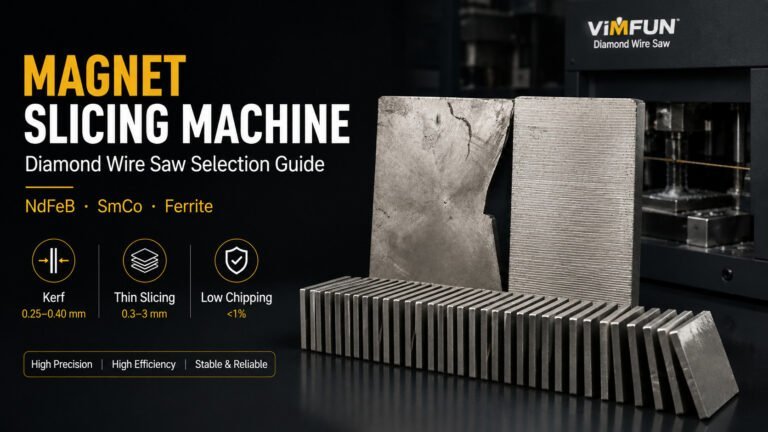
A ferrite magnet cutting wire saw slices sintered ceramic magnets without the edge chipping, microcrack accumulation, and dimensional drift that destroy yields in high-volume production. Ferrite is harder and more thermally stable than NdFeB, but it is brittle in a different way: it chips at corners rather than delaminating, and it tolerates faster feed rates — until it doesn’t, and an entire batch arrives at the grinding stage with beveled edges that exceed tolerance.
This page covers what ferrite’s material properties mean for wire saw selection, which process parameters matter most, and how a ferrite magnet cutting wire saw setup differs from the NdFeB configurations most equipment suppliers default to.
Why Ferrite Magnet Cutting Wire Saw Setup Differs from NdFeB
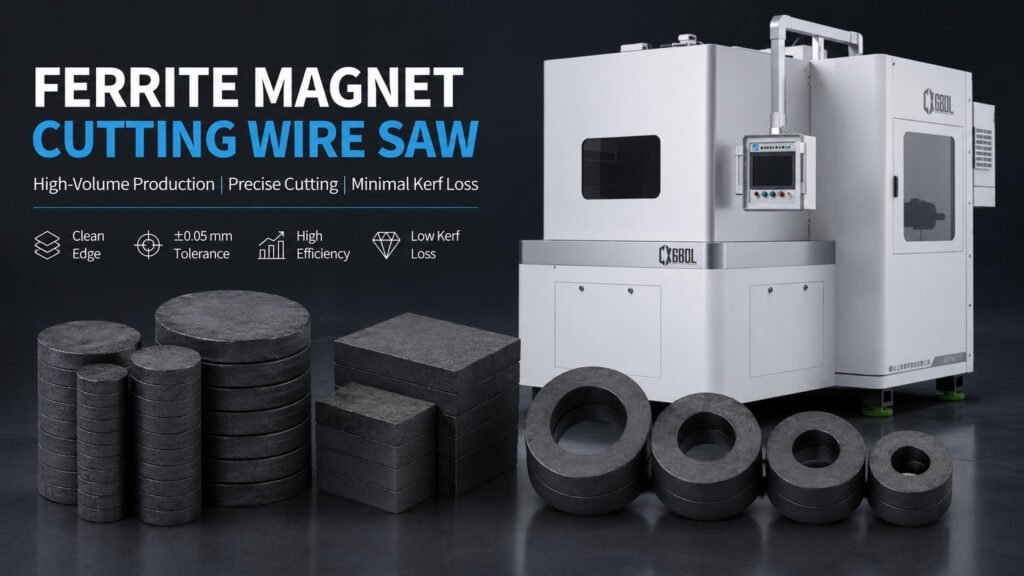
Ferrite magnets — also called ceramic magnets — are composed of iron oxide combined with barium or strontium carbonate, sintered at high temperature into a dense, hard ceramic. Their Mohs hardness sits at approximately 5.5–7, which is comparable to NdFeB, but their fracture behavior under cutting stress is different.
NdFeB fails by delamination along grain boundaries when wire tension spikes. Ferrite fails by chipping at corners and exit edges when lateral force at the cut zone exceeds the material’s transverse rupture strength. This distinction matters for equipment selection: wire tension management is the dominant concern for NdFeB; exit-edge force control and fixture support are the dominant concerns for ferrite.
The other meaningful difference is production volume. Ferrite magnets are used in speaker magnets, small DC motors, sensors, and holding magnets — applications that run at production volumes where NdFeB equivalent applications rarely operate. A ferrite operation cutting speaker magnets for consumer electronics may process hundreds of billets per week. At that volume, the economics of kerf loss, wire consumption, and cycle time look different than they do for a NdFeB operation cutting wind turbine segments.
This cost sensitivity makes wire saw choice for ferrite a throughput problem, not just a quality problem. See NdFeB cutting machine for a comparison of how machine selection logic differs across magnet materials.
Ferrite Material Properties That Affect Cutting
Understanding ferrite’s cutting behavior starts with three properties that directly determine parameter selection:
Hardness and abrasivity. Ferrite’s hardness (5.5–7 Mohs) places it in the range where diamond wire cuts efficiently but where abrasive wear on the wire is meaningful. Ferrite is harder than most polymers and soft metals but softer than silicon carbide or sapphire. Wire life on ferrite is generally longer than on NdFeB at equivalent cut areas because ferrite does not have the same metallic binding matrix that accelerates abrasive loading.
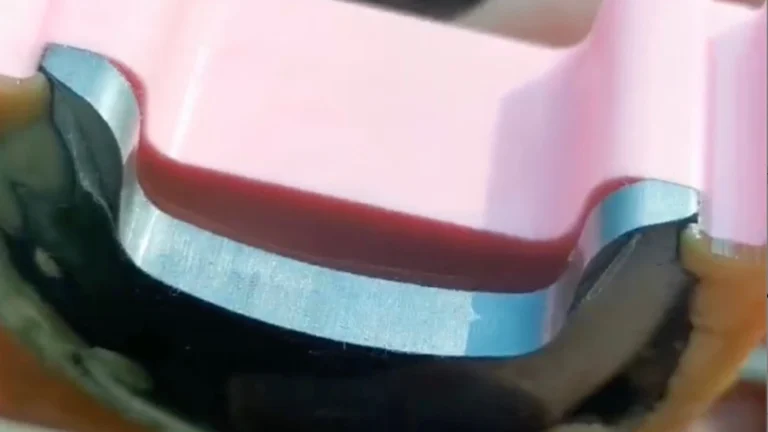
Brittleness and chip formation. Ferrite fractures in a brittle, transgranular mode under cutting stress. At slow feed rates, cutting proceeds by controlled material removal. As feed rate increases past a threshold, the cutting zone generates sufficient lateral force to initiate chipping at the exit edge — the point where the wire exits the workpiece. This exit-edge chipping is the primary yield failure mode in ferrite wire saw production, and it is the reason feed rate cannot simply be maximized in the way it sometimes can with more ductile materials.
Thermal stability. Unlike NdFeB, ferrite does not lose magnetic performance with moderate heat exposure, and it does not oxidize aggressively during cutting. This means coolant requirements for ferrite are less critical than for NdFeB in terms of chemical compatibility — but coolant flow still matters for flushing debris from the cut zone and preventing abrasive re-cutting of the wire path.
Ferrite Magnet Cutting Wire Saw Parameters
Four parameter groups determine ferrite cutting outcomes. Getting all four right simultaneously is what separates a stable production process from one that requires constant adjustment.
Wire diameter. For ferrite billets in the 20–80 mm dimension range, diamond wire in the 0.3–0.5 mm diameter range is appropriate. Smaller diameter wire reduces kerf loss — critical when cutting thousands of billets — and reduces lateral force at the cut face. However, smaller wire requires more precise tension control to maintain a stable wire path. At production volumes where wire cost is a significant budget item, a well-controlled 0.35 mm wire setup outperforms a simpler 0.5 mm setup on material recovery per kilogram of raw ferrite.
Feed rate. Ferrite tolerates faster feed rates than YIG garnet or optical crystals because its cleavage behavior is less sensitive to lateral force below the chipping threshold. The practical approach is to establish a baseline feed rate that produces clean exit edges on first-article cuts, then increase in measured increments while monitoring the exit edge under magnification. The chipping threshold for a given ferrite grade and billet geometry is consistent once found — it does not shift during a production run unless wire condition changes.
One important caveat: the chipping threshold shifts when moving between ferrite grades. Barium ferrite and strontium ferrite have slightly different transverse rupture strengths, and the threshold feed rate differs correspondingly. If your production switches between grades, re-establish the baseline rather than assuming the same parameter set applies.
Wire tension. Ferrite cutting requires sufficient tension to maintain wire path straightness — dimensional drift from a wandering wire path produces out-of-spec thicknesses that fail at the next processing stage. Unlike NdFeB, where tension spikes cause delamination, ferrite’s primary tension-related failure is path deviation from insufficient tension, not material fracture from excessive tension. The practical range is narrower than for softer materials but wider than for fragile optical crystals.
Coolant. Water-based coolant with cutting-specific additives is standard for ferrite wire saw operations. The primary function is debris flushing — ferrite particulate is fine and abrasive, and without continuous flow it re-enters the cut zone and accelerates wire wear. A secondary function is workpiece cooling, though ferrite’s thermal stability means this is less critical than in NdFeB or optical crystal operations. Coolant pH should be maintained in the neutral-to-mildly-alkaline range (7–9) to avoid surface etching on cut faces. For background on sintering — the densification process that determines ferrite’s final hardness and grain structure before cutting — Wikipedia’s overview is a useful reference for understanding why ferrite from different suppliers cuts differently even at the same nominal grade.
Ferrite vs NdFeB vs SmCo: Cutting Behavior Comparison
| Property | Ferrite | NdFeB | SmCo |
|---|---|---|---|
| Hardness (Mohs) | 5.5–7 | ~6 | ~6–7 |
| Primary failure mode | Exit-edge chipping | Delamination / grain boundary fracture | Surface cracking |
| Thermal sensitivity | Low | High (oxidizes, demagnetizes) | Low–moderate |
| Feed rate tolerance | Moderate–high | Low–moderate | Low |
| Wire tension sensitivity | Low–moderate | High | High |
| Typical production volume | Very high | Moderate | Low |
| Coolant criticality | Moderate | High | High |
| Kerf loss impact | Moderate (cost-sensitive) | High (material cost) | Very high (material cost) |
Practical implications for a mixed-material operation:
If your production line cuts both ferrite and NdFeB, the same machine can handle both with separate parameter sets — but the fixture setup differs. NdFeB requires magnetic-compatible fixturing that doesn’t interfere with the workpiece field during cutting. Ferrite doesn’t require this consideration, which simplifies fixturing for high-volume batch production.
For operations cutting SmCo alongside ferrite, see SmCo magnet cutting machine for how SmCo’s brittleness and corrosion sensitivity change the parameter logic compared to ferrite’s more forgiving profile.
High-Volume Production Considerations for Ferrite
Ferrite operations differ from NdFeB operations not just in material parameters but in production structure. A few factors that matter at scale:
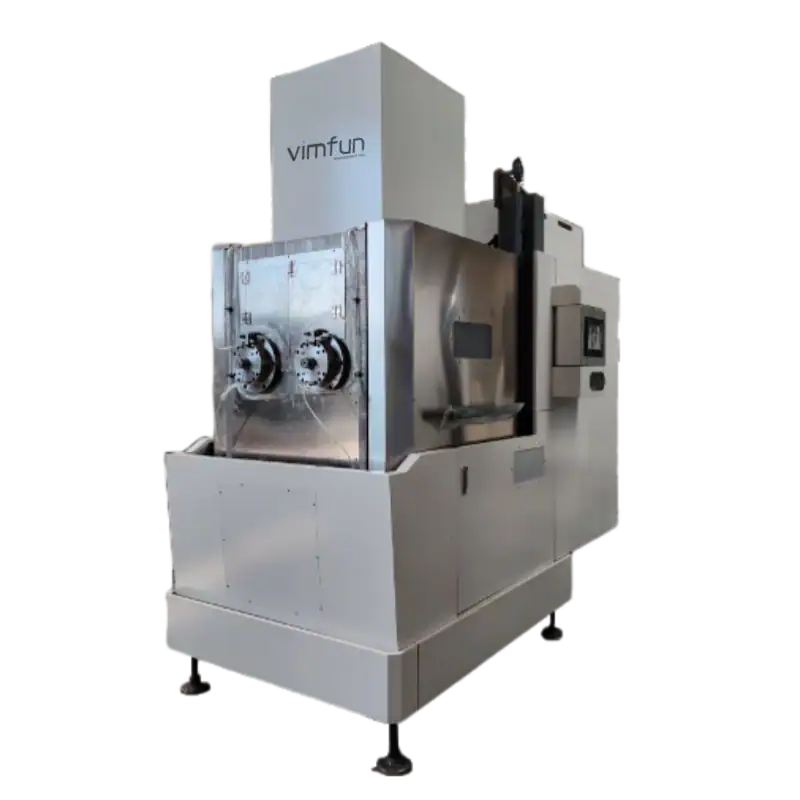
Batch size and setup time ratio. At the volumes typical of ferrite production — speaker magnets, small motor magnets — the ratio of setup time to cutting time matters more than in low-volume NdFeB operations. A machine platform that requires 30 minutes of calibration per batch is a meaningful throughput constraint at 50+ batches per week. Multi-wire configurations that cut multiple billets simultaneously improve this ratio at the cost of upfront capital.
Wire consumption economics. At high volumes, wire cost becomes a significant operating expense. Wire life on ferrite depends heavily on whether debris flushing is adequate — a coolant flow problem that goes unnoticed for half a shift can consume wire in two hours that would normally last a full day. Monitoring wire condition on a defined interval (not just at end-of-life) and tracking cuts-per-wire as a production KPI catches this before it becomes a cost problem.
Dimensional consistency across a batch. Ferrite buyer specifications for speaker magnets, motor magnets, and sensors typically include tight thickness tolerances — ±0.05 mm is common in competitive supplier relationships. Holding this tolerance across a batch of several hundred pieces requires that wire tension and feed rate remain stable throughout the run, not just at the start. This is where closed-loop parameter monitoring earns its cost: a machine that drifts in the last quarter of a long batch run produces out-of-spec pieces that weren’t predicted at batch start.
For multi-machine production line setup and how ferrite cutting integrates with downstream grinding and coating stages, see magnet production line equipment.
Equipment Selection for Ferrite Wire Saw Production
Selecting a ferrite magnet cutting wire saw platform for production requires matching machine capability to production volume, not to single-part quality metrics.
For low-to-medium volume (under 50 billets/day): A single-wire saw with manual or semi-automatic loading, closed-loop tension control, and a parameter recall function covers most requirements. The flexibility to run different ferrite grades and geometries without significant reconfiguration time is more valuable at this scale than raw throughput.
For high-volume production (50+ billets/day): Multi-wire configurations that cut multiple billets per pass become economically justified. At this scale, per-billet kerf loss accumulates significantly over a week’s production, and the material recovery improvement from a well-configured multi-wire setup offsets the capital premium. Automatic loading and unloading becomes worth evaluating because manual handling at high throughput introduces variability that affects dimensional consistency.
What not to prioritize for ferrite specifically:
- Maximum wire speed rating (ferrite rarely needs the top speed any production machine offers)
- Single-part surface finish capability (downstream grinding corrects surface texture; the wire saw only needs to deliver correct geometry)
- Tension precision for NdFeB spike prevention (ferrite’s primary tension concern is minimum tension for path stability, not spike prevention)
For full equipment configuration options applicable to ferrite, SmCo, and NdFeB production in the same facility, submit your daily volume, billet dimensions, and tolerance requirements through the quote form. The configuration that works for a speaker magnet operation running barium ferrite at 200 pieces/day differs from one for a mixed operation including rare earth grades — a conversation before quoting avoids over- or under-specifying the platform.
For related cutting applications across the magnetic materials range, see rare earth magnet cutting equipment and the magnetic materials overview page.
FAQ
Can I cut ferrite on the same wire saw I use for NdFeB?
Yes, with a different parameter set and fixture approach. Ferrite runs at higher feed rates and doesn’t require the same tension spike prevention as NdFeB. If your machine has parameter recall, store separate profiles for each material. The main setup change is fixturing — ferrite doesn’t require the magnetic-field-compatible fixturing that some NdFeB setups need.
What causes exit-edge chipping in ferrite wire saw cutting?
Feed rate above the chipping threshold for the specific ferrite grade and billet geometry. The threshold is consistent for a given setup — find it on first-article cuts by increasing feed rate incrementally until chipping appears, then back off and lock the parameter. Chipping that appears randomly across a batch usually indicates wire condition change (worn wire requires slower feed to maintain clean cutting) rather than a parameter problem.
How does ferrite wire saw cutting compare to diamond blade cutting for high-volume production?
Wire saw produces narrower kerf (less material waste), generates less heat at the cut face, and creates less lateral force at the cut zone. At high production volumes where raw material cost is measured per kilogram rather than per unit, the kerf loss difference accumulates meaningfully. Diamond blade cutting remains faster for single-cut operations on large billets but is less economical for multi-piece slicing at volume.
What coolant is recommended for ferrite wire saw cutting?
Water-based cutting fluid, pH 7–9, with adequate flow rate to flush ferrite particulate from the cut zone. Oil-based coolants leave residue that complicates the phosphate or nickel coating processes typically applied to ferrite magnets after grinding. Alkaline coolants above pH 9 risk surface etching on freshly cut ferrite faces.
How should I adjust parameters when switching between barium ferrite and strontium ferrite grades?
Re-establish the feed rate baseline on first-article cuts for each grade change. Barium and strontium ferrite have slightly different transverse rupture strengths, which shifts the chipping threshold. Don’t assume the parameter set that worked for one grade applies directly to the other — a brief first-article validation avoids a batch of chipped parts.