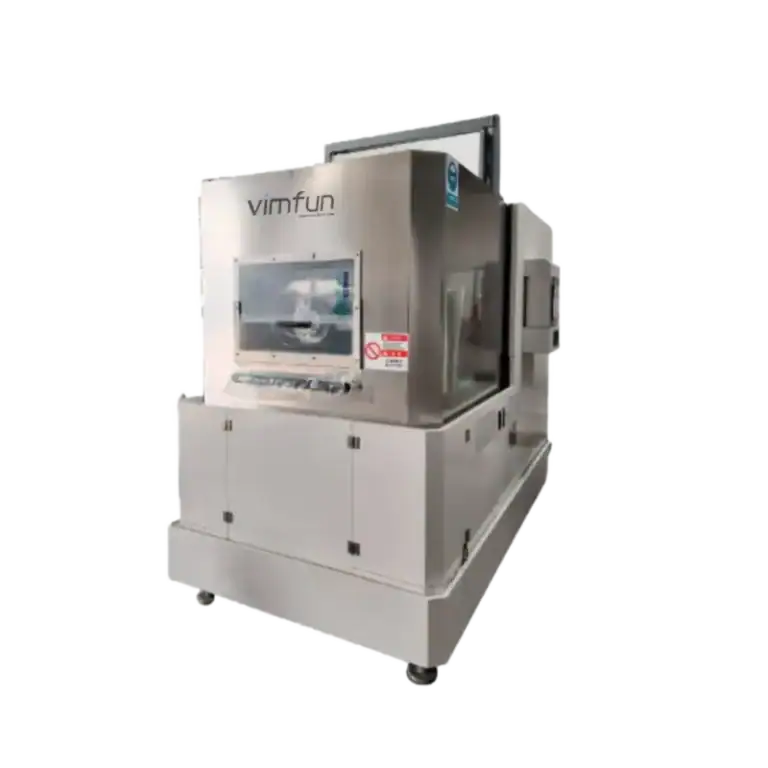
Magnet production line equipment is the integrated set of slicing, grinding, lapping, and polishing machines that converts raw sintered NdFeB blocks into finished magnet components ready for assembly. Instead of purchasing standalone machines and hoping they work together, a properly configured magnet production line equipment package matches throughput capacities, tolerance handoffs, and material flow across every processing stage — eliminating the bottlenecks that plague most magnet factories running disconnected equipment.
Whether you are building a new rare earth magnet manufacturing line from scratch or upgrading an existing facility to higher volumes, the configuration decisions you make at the planning stage determine your cost per piece for the next 5-10 years.
What Is Magnet Production Line Equipment?
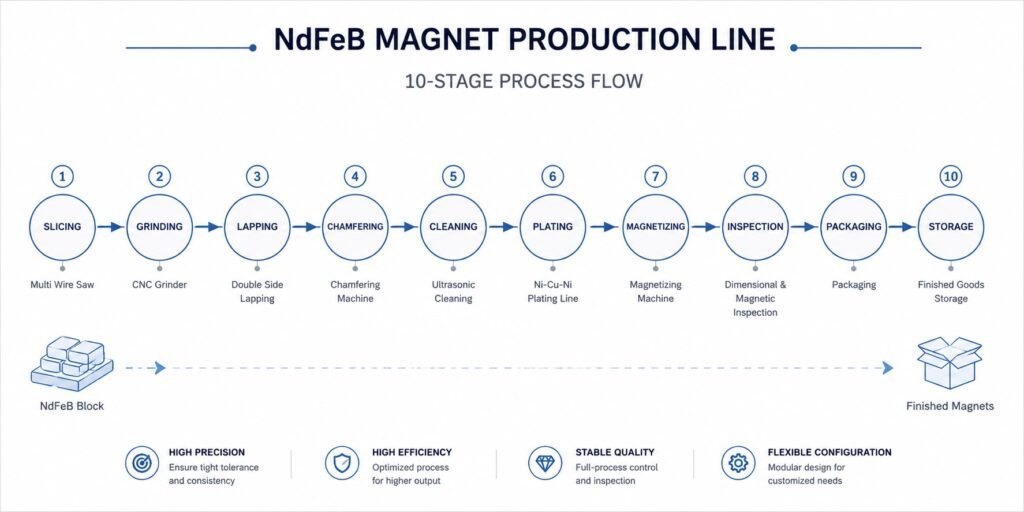
Magnet production line equipment refers to the complete machinery system required to process sintered NdFeB blocks through all post-sintering stages: slicing, edge grinding, surface lapping, and final polishing. A complete line also includes material handling systems, coolant/filtration units, in-process measurement stations, and centralized process control software.
The distinction from standalone equipment is critical: individual machines are optimized for their own operation, but magnet production line equipment is optimized as a system. Each station’s output rate, dimensional tolerance, and surface condition must match what the next station requires. When stations are mismatched — for example, a slicing machine producing 500 pieces/hour feeding a lapping machine that handles only 200 pieces/hour — the result is work-in-process inventory accumulation, extended cycle times, and increased handling damage.
According to the International Magnetics Association (IMA), global NdFeB magnet demand is projected to grow at 8-10% annually through 2030, driven primarily by EV traction motors, wind turbine generators, and industrial automation. This growth is pushing magnet manufacturers to transition from batch-process workshops to continuous-flow production lines with matched throughput at every stage.
Magnet Production Line Equipment: Core Station Configuration
A standard magnet production line equipment setup consists of four primary processing stations. The specific machine selection at each station depends on your target magnet geometry, material grade, and annual volume.
| Station | Function | Key Equipment | Output Feeds To |
|---|---|---|---|
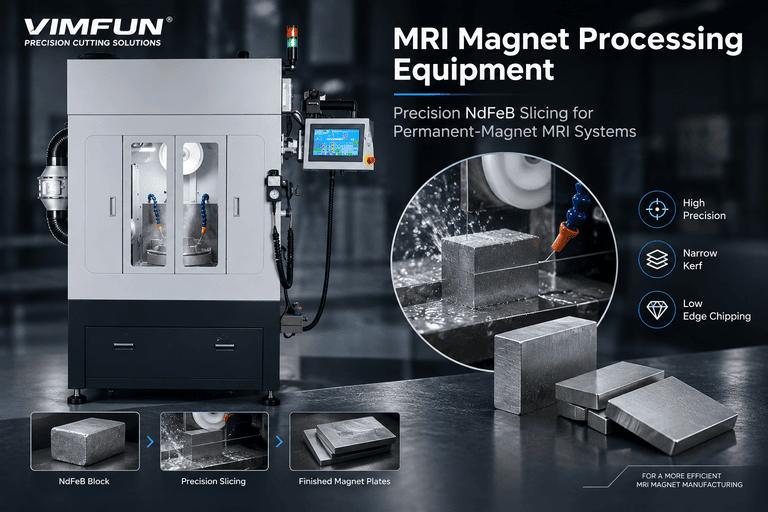
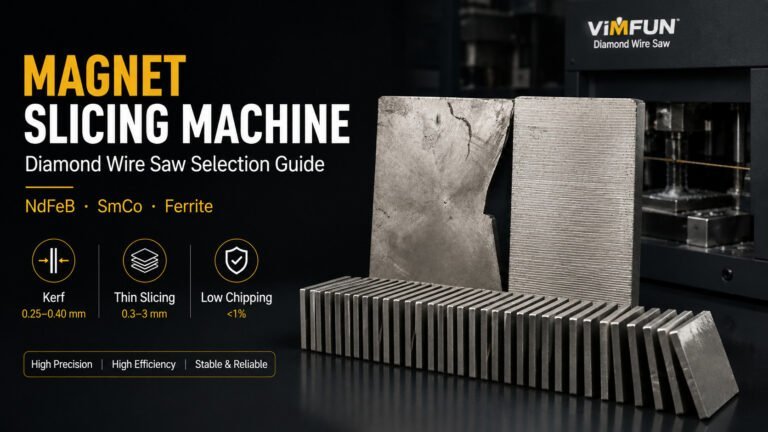
| 1. Slicing | Cut sintered blocks into individual segments | Multi-wire diamond saw, single-wire CNC saw | Grinding |
| 2. Edge Grinding | Shape segment profiles, chamfer edges | CNC surface grinder, cylindrical grinder | Lapping |
| 3. Double-Sided Lapping | Achieve thickness uniformity (TTV) | Double-sided lapping machine with diamond pellets | Polishing or Coating |
| 4. Polishing / Final Finishing | Surface quality for coating adhesion | Single-sided polisher, ultrasonic cleaner | Coating / Assembly |
Supporting systems that connect these stations:
- Coolant management: Centralized coolant supply with magnetic particle separation and temperature control. NdFeB cutting generates fine magnetic debris that contaminates coolant rapidly — a shared filtration system with automatic backwash is more cost-effective than individual machine filters.
- Material handling: Automated transfer trays or conveyor links between stations. Manual handling between machines is the #1 source of edge chipping on finished magnets.
- In-process measurement: Dimensional gauging between stations catches drift before it compounds. A thickness check after slicing prevents an entire batch from failing at the lapping stage.
For the slicing station specifically, multi-wire diamond wire saws dominate high-volume magnet production because they cut multiple slices simultaneously from a single block. For a detailed comparison of cutting technologies, see our guide on NdFeB cutting machines.
How to Size Magnet Production Line Equipment for Your Output
Sizing magnet production line equipment correctly means matching throughput capacity across all stations so no single machine becomes a bottleneck. The following framework covers three common production scales.
Tier 1: 10,000 Pieces/Month (Laboratory to Small Production)
This volume suits new product development, prototype supply, or niche magnet applications where geometry changes frequently.
Recommended configuration:
- 1× single-wire diamond wire saw (handles varied block sizes, quick changeover)
- 1× manual or semi-auto surface grinder
- 1× single-sided lapping machine
- Manual transfer between stations
At this scale, flexibility matters more than speed. A single-wire saw with CNC path control can handle rectangular, arc, and trapezoidal geometries without dedicated tooling for each shape. This is the typical entry point for manufacturers supplying EV motor magnet components in qualification quantities.
Tier 2: 100,000 Pieces/Month (Mid-Volume Production)
This volume covers most industrial magnet suppliers serving automotive tier-2, wind energy, and industrial motor markets.
Recommended configuration:
- 2× multi-wire diamond wire saws (parallel operation for throughput)
- 1× CNC double-spindle surface grinder
- 1× double-sided lapping machine (batch processing)
- Semi-automated tray transfer between stations
- Centralized coolant system with magnetic separator
At 100K/month, the slicing station typically requires two machines running in parallel because multi-wire saws, while efficient per cut, require setup time between block loads. Two machines allow continuous operation — one cutting while the other is being loaded. This is the volume range where wind turbine magnet manufacturers typically operate, producing large arc segments in sustained volumes.

Tier 3: 1,000,000+ Pieces/Month (High-Volume Mass Production)
This volume targets automotive OEM direct supply, consumer electronics (VCM actuators, smartphone haptics), and high-volume sensor magnet production.
Recommended configuration:
- 4-6× multi-wire diamond wire saws (dedicated lines by geometry)
- 2× CNC grinders (roughing + finishing separation)
- 2× double-sided lapping machines (continuous batch rotation)
- 1× automated polishing line
- Fully automated material handling with robot loading
- MES (Manufacturing Execution System) integration
- SPC (Statistical Process Control) at every station
At this scale, magnet production line equipment operates as a connected system rather than individual machines. Each piece is tracked from raw block to finished part, and process parameters are adjusted automatically based on upstream measurement data.
Magnet Production Line Equipment Automation Levels
Not every facility needs — or can afford — full automation from day one. Most successful magnet production line equipment deployments follow a staged automation path:
| Level | Material Handling | Process Control | Measurement | Typical Volume |
|---|---|---|---|---|
| Manual | Hand-carried trays | Operator-set parameters | Spot-check with calipers | <30K/month |
| Semi-Auto | Roller conveyors + manual load | Recipe-based parameters, operator override | Sample measurement every N pieces | 30K-200K/month |
| Full Auto | Robot loading, automated conveyors | MES-driven parameter adjustment | 100% in-line dimensional gauging | >200K/month |
| Smart Line | AGV transport, automated warehouse | AI-assisted process optimization, digital twin | 100% gauging + SPC + auto-correction | >500K/month |
The critical insight: automation ROI in magnet production comes primarily from reducing handling damage, not from labor savings. NdFeB magnets are brittle — every manual pick-and-place risks edge chipping. At volumes above 100K/month, handling damage typically accounts for 2-5% scrap. Automated transfer alone can cut this to under 0.5%, which on rare earth magnet materials at current prices represents significant cost recovery.
Complete Magnet Production Line vs Standalone Machines: Key Differences
| Factor | Standalone Machines | Complete Magnet Production Line Equipment |
|---|---|---|
| Throughput matching | Buyer’s responsibility | Pre-engineered to balance across stations |
| Floor layout | Ad-hoc arrangement | Optimized material flow, minimal WIP distance |
| Coolant system | Individual machine tanks | Centralized supply + filtration |
| Quality handoff | Manual inspection between steps | Automated tolerance cascade |
| Changeover | Each machine set independently | Recipe-based changeover across all stations |
| Lead time to production | Faster (buy individual machines) | Longer (system design + integration) |
| Total cost of ownership | Lower upfront, higher operating | Higher upfront, lower operating per piece |
When standalone machines make sense: You are producing fewer than 30,000 pieces/month, running multiple magnet types with frequent changeover, or adding a single processing capability (e.g., adding lapping to an existing cutting shop).
When a complete line makes sense: You have a committed volume above 100,000 pieces/month for a defined geometry family, your scrap rate from handling damage exceeds 2%, or your customer requires full traceability from block to finished part (automotive PPAP, medical device MDR).
Magnet Production Line Equipment: Planning Checklist Before You Invest
Before requesting quotes for magnet production line equipment, prepare answers to these questions — they determine 80% of your configuration:
1. Define your part family
- How many distinct magnet geometries will the line produce?
- Dimensional range: length (mm), width (mm), thickness (mm)
- NdFeB grade range (N35-N52, SH/UH/EH variants)
2. Set your volume target
- Monthly volume per geometry
- Growth projection: will volume double in 2-3 years? (Size equipment for 1.5× current target)
3. Specify your tolerance requirements
- Dimensional tolerance: typical ±0.05mm for motor magnet applications, ±0.02mm for precision sensors
- TTV (Total Thickness Variation): determines whether you need lapping
- Surface roughness Ra: determines whether you need polishing
4. Assess your facility constraints
- Available floor space (a mid-volume line requires approximately 200-400 m²)
- Power supply capacity (multi-wire saws draw 15-30 kW each)
- Compressed air availability
- Wastewater treatment for cutting coolant
5. Define your automation roadmap
- Start manual and automate later? Or invest in automation from day one?
- Do you need MES integration for customer traceability requirements?
According to Allied Market Research, the permanent magnet market is expected to reach $45 billion by 2030. Manufacturers investing in properly configured production lines now will be positioned to capture this growth without the quality issues that plague facilities running mismatched equipment.
The difference between a profitable magnet operation and one struggling with scrap, bottlenecks, and customer complaints usually comes down to how well the production line was planned at the beginning. Get the configuration right, and everything downstream — yield, cost, delivery — falls into place.