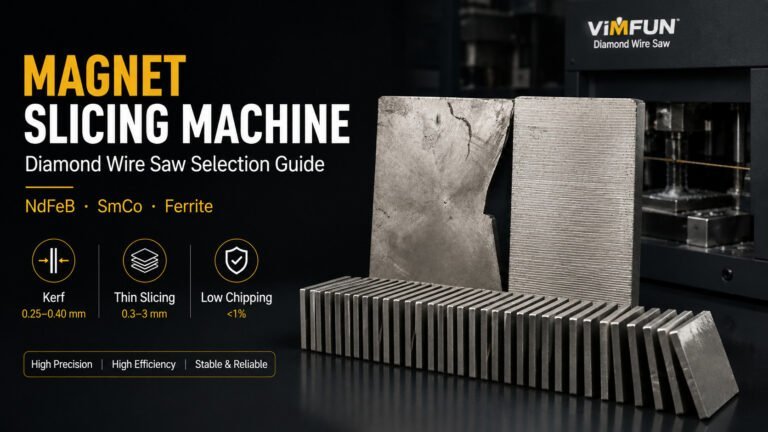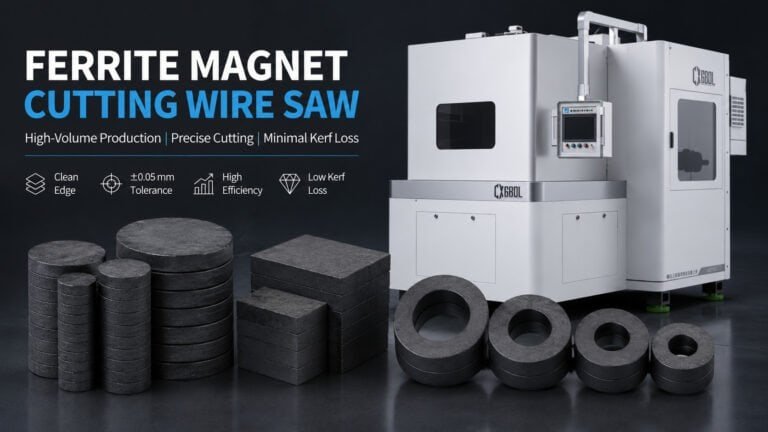
Rare earth magnet cutting equipment refers to specialized precision machines designed to slice NdFeB (neodymium-iron-boron) and SmCo (samarium-cobalt) magnets into finished dimensions without cracking, chipping, or thermal demagnetization. Choosing the right rare earth magnet cutting equipment is the single most important decision affecting your yield rate, dimensional tolerance, and production cost — because rare earth magnets are simultaneously the hardest, most brittle, and most heat-sensitive materials in permanent magnet manufacturing.
What Is Rare Earth Magnet Cutting Equipment?
Rare earth magnet cutting equipment is any precision cutting system engineered specifically for slicing sintered rare earth permanent magnets — primarily NdFeB and SmCo — into production-ready shapes such as thin slices, arc segments, rings, and custom profiles. Standard metalworking saws cannot process rare earth magnets because the material’s extreme hardness (Vickers HV 550–700), near-zero ductility, and sensitivity to heat require diamond abrasive cutting elements, controlled feed rates, and continuous coolant delivery.
The term “rare earth magnet” covers two main families, each with distinct cutting challenges:
- NdFeB (Neodymium-Iron-Boron): The strongest permanent magnet. Highly brittle, generates pyrophoric (flammable) metallic swarf during cutting, and begins losing magnetic properties at 80–150°C depending on grade. See our detailed NdFeB cutting machine guide for material-specific parameters.
- SmCo (Samarium-Cobalt): Higher temperature tolerance (up to 300°C working temperature) but even more brittle than NdFeB. Fractures along grain boundaries under impact or uneven cutting force. Requires slower feed rates and more rigid fixturing than NdFeB.
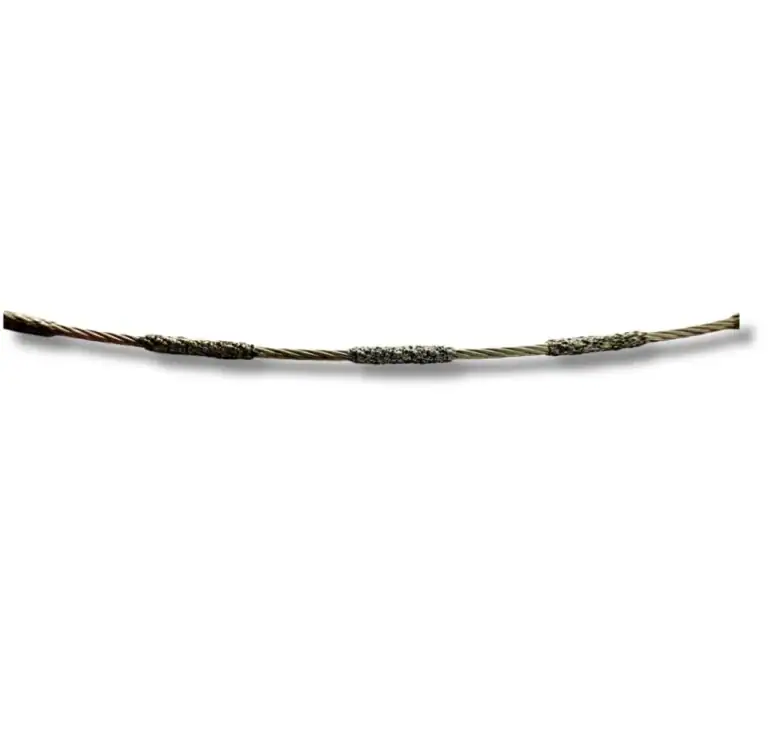
Both materials demand diamond wire or diamond blade cutting — carbide and HSS tooling cannot maintain edge quality or dimensional accuracy on rare earth magnets. For a full overview of all permanent magnet cutting technologies, see our permanent magnet cutting machine hub page.

Rare Earth Magnet Cutting Equipment — Key Parameters by Machine Type
| Parameter | Multi-Wire Diamond Saw | Single-Wire Diamond Saw | ID (Inner Diameter) Saw |
|---|---|---|---|
| Kerf width | 0.15–0.30 mm | 0.20–0.35 mm | 0.3–0.8 mm |
| Cutting accuracy (TTV) | ±0.01–0.03 mm | ±0.02–0.05 mm | ±0.01–0.02 mm |
| Min. slice thickness | 0.3 mm | 0.5 mm | 0.5 mm |
| Throughput | 100–500+ slices/run | 1 slice/run | 1 slice/run |
| Max workpiece | 200+ mm block | Model-dependent | Limited by blade ID |
| Profile capability | Flat slices only | Arcs, contours, custom | Flat slices only |
| Coolant requirement | Water-based, high flow | Water-based | Oil or water-based |
| Best application | High-volume NdFeB/SmCo wafer production | Custom shapes, prototypes, small batches | Single-piece precision, lab use |
Important: These are typical industry ranges. Actual performance depends on magnet grade, machine model, and diamond wire quality. Always request cutting test results on your specific material before purchasing rare earth magnet cutting equipment.
How to Select the Right Rare Earth Magnet Cutting Equipment
Step 1: Identify Your Magnet Material and Grade
NdFeB and SmCo have different optimal cutting parameters. NdFeB grades range from N35 to N55, with high-temperature variants (N35SH, N42UH) that are harder and more brittle. SmCo comes in SmCo5 and Sm2Co17 families — Sm2Co17 is harder (HV 600–700) and requires slower feed rates.
Define your material first because it determines wire type, feed rate range, coolant requirements, and expected yield. Equipment that performs well on N35 NdFeB may produce excessive chipping on Sm2Co17 without parameter adjustment.
Step 2: Define Geometry and Tolerance Requirements
Your workpiece geometry narrows the equipment choice:
- Flat slices from rectangular blocks — multi-wire saw for volume, ID saw for single-piece precision
- Arc segments for motors — requires arc magnet grinding or contour-capable single-wire cutting
- Thin slices below 0.5 mm — only multi-wire diamond saws can reliably produce ultra-thin slices without breakage
- Custom profiles and prototypes — single-wire diamond wire saw with programmable path control
- Dimensional tolerance — if TTV must be below ±0.02 mm, consider whether your equipment can achieve this as-cut or if post-processing (double-sided lapping) is required
Step 3: Match Throughput to Production Volume
| Production Scale | Recommended Equipment | Typical Output |
|---|---|---|
| Prototype / R&D (< 100 pieces/day) | Single-wire saw or ID saw | 50–100 slices/day |
| Medium batch (100–1,000/day) | Single-wire or small multi-wire | 200–1,000 slices/day |
| High volume (1,000+/day) | Multi-wire diamond saw | 2,000–10,000+ slices/day |
| Mixed geometries (arcs + slices) | Single-wire + ID saw combination | Varies by mix |
Over-specifying equipment wastes capital. A multi-wire saw is unnecessary for a lab cutting 50 samples per week. Conversely, trying to meet production targets of 5,000 slices/day on a single-wire machine creates bottlenecks and pushes operators to increase feed rates beyond safe limits — increasing scrap.
Step 4: Evaluate Total Cost of Ownership
The purchase price of rare earth magnet cutting equipment is only part of the cost. Evaluate:
- Wire/blade consumable cost per cut — diamond wire diameter and quality affect both cost and yield
- Coolant system requirements — rare earth swarf (especially NdFeB) is reactive; coolant must be filtered and maintained to prevent fire risk and equipment damage
- Maintenance schedule — guide roller replacement, tension system calibration, spindle bearing life
- Scrap cost — a machine with 3% lower scrap rate on expensive NdFeB blocks (costing $80–120/kg for sintered blocks) pays for itself faster than a cheaper machine with higher waste
Step 5: Request Cutting Tests on Your Material
Never select rare earth magnet cutting equipment based on specifications alone. Provide the equipment supplier with your actual magnet blocks and request test cuts demonstrating:
- Achieved kerf width and TTV on your grade
- Surface quality (Ra value, edge chipping rate)
- Scrap rate over a batch of 50+ slices
- Throughput at production-intent feed rates
Compare test results across suppliers using the same material to make an objective decision.
Rare Earth Magnet Cutting Equipment Troubleshooting
Excessive Edge Chipping on SmCo Magnets — What to Do?
Reduce feed rate by 20–30% compared to NdFeB settings. SmCo is more brittle at grain boundaries than NdFeB, and the fracture propagation pattern is less predictable. Also verify that the diamond grit size on your wire matches the material’s grain structure — finer grit (< 30 μm) reduces chipping on fine-grained Sm2Co17. If chipping persists, check fixture clamping uniformity; uneven pre-stress on the workpiece magnifies edge breakout during cutting.
NdFeB Swarf Catching Fire During Cutting — How to Prevent?
NdFeB cutting swarf is pyrophoric — fine metallic particles can ignite spontaneously when exposed to air, especially when dry. Ensure your coolant flow fully covers the cutting zone with no dry spots. Use water-based coolant (not oil-based, which adds fuel). Install a swarf collection system that keeps particles submerged in coolant. Clean swarf traps daily — accumulated dry swarf in corners or on machine surfaces is a fire hazard. The Occupational Safety and Health Administration (OSHA) classifies fine metallic dust as a combustible dust hazard requiring proper ventilation and housekeeping.
Yield Dropping When Switching Between NdFeB and SmCo on the Same Machine?
Each material requires different optimal parameters. Do not assume one setup works for both. Create separate cutting recipes for NdFeB and SmCo covering: feed rate, wire tension, wire speed, and coolant flow rate. SmCo typically requires 15–25% slower feed rate and 5–10% higher wire tension than NdFeB of similar hardness. Document recipes and train operators to switch completely — partial adjustments are the most common cause of cross-material yield loss.

Rare Earth Magnet Cutting Equipment: NdFeB vs SmCo Processing Comparison
| Factor | NdFeB Cutting | SmCo Cutting |
|---|---|---|
| Hardness (Vickers) | HV 550–620 | HV 600–700 |
| Brittleness | High | Very high |
| Max cutting temperature | 80–150°C (grade-dependent) | 250–350°C |
| Pyrophoric swarf risk | High (requires wet cutting) | Low to moderate |
| Typical feed rate | Baseline | 15–25% slower than NdFeB |
| Edge chipping tendency | Moderate | High (grain boundary fracture) |
| Wire wear rate | Moderate | Higher (harder material) |
| Post-cut demagnetization risk | High (low Curie temp grades) | Low (high thermal stability) |
| Coolant requirement | Water-based mandatory | Water-based preferred |
| Typical application | EV motors, consumer electronics, wind turbines | Aerospace, military, high-temp sensors |
Selection guidance: If your production exclusively processes one material family, optimize equipment and parameters for that material. If you process both NdFeB and SmCo, invest in a machine with programmable recipe storage and quick-changeover capability to minimize downtime and parameter errors when switching materials.
For NdFeB-specific equipment selection, see our dedicated NdFeB cutting machine guide. For EV motor magnet production lines processing rare earth magnets at scale, see EV motor magnet manufacturing equipment.
How Diamond Wire Saw Technology Improves Rare Earth Magnet Cutting
Diamond wire saw technology has become the standard for rare earth magnet cutting equipment because it directly addresses the material’s core challenges — brittleness, heat sensitivity, and high raw material cost.
Narrow kerf preserves expensive material. Diamond wire with 0.15–0.30 mm diameter removes far less material per cut than ID saw blades (0.3–0.8 mm kerf). For NdFeB blocks costing $80–120/kg, the material saved in kerf alone can represent significant cost reduction over thousands of cuts. Multi-wire configurations multiply this advantage by cutting hundreds of slices simultaneously.
Controlled cutting force reduces cracking and chipping. Diamond wire distributes cutting force along a thin contact line rather than concentrating it on a blade edge. This produces lower peak stress on the brittle magnet, reducing the micro-crack initiation that leads to edge chipping and scrap. Our customers processing high-coercivity magnets report measurably lower scrap rates after switching from ID saw to diamond wire.
Low heat generation protects magnetic properties. The combination of thin wire, continuous coolant flow, and distributed abrasive action keeps cutting zone temperatures well below the thermal demagnetization threshold. This is critical for NdFeB grades with low maximum operating temperatures (N50 and above), where even brief exposure to temperatures above 80°C during cutting can permanently reduce magnetic output.
Flexible workpiece handling for diverse geometries. Single-wire diamond wire saws accommodate the full range of rare earth magnet shapes — blocks, cylinders, rings, and arc segments — with programmable cutting paths. This flexibility is essential for manufacturers serving multiple applications (EV motors, sensors, speakers) with different magnet geometries from the same equipment.
Whether you are setting up a new rare earth magnet cutting line or upgrading from ID saw technology, diamond wire saw equipment offers the best combination of yield, precision, and material conservation. Explore our full permanent magnet cutting machine product range, or contact our engineering team with your magnet grade, target dimensions, and production volume for a specific equipment recommendation based on cutting test data.