
Permanent Magnet Cutting & Machining — Complete Equipment Guide
Permanent magnets are small parts with unforgiving process requirements: brittle sintered bodies, expensive rare earth material, tight thickness tolerance, and high scrap cost. This guide helps engineering teams choose the right permanent magnet cutting machine, compare rare earth magnet cutting equipment, and plan the full block-to-wafer machining route from slicing to lapping and polishing.
What is Permanent Magnet Cutting & Machining?
Permanent magnet cutting and machining is the controlled transformation of sintered magnet blocks, slabs, arcs, rings, or tiles into application-ready parts. In a modern magnet factory, cutting is not one isolated operation. It is connected with orientation, sintering, rough shaping, precision slicing, surface grinding, double-sided lapping, cleaning, inspection, and finally coating or magnetization.
The right machine route depends on the material family, magnet size, target thickness, tolerance, throughput, and whether the part will be used in a high-speed motor, speaker, magnetic coupling, medical device, or wind turbine generator. For most rare earth magnets, diamond wire cutting has become the preferred method because it reduces mechanical shock, controls kerf loss, and keeps edge chipping more predictable than conventional sawing.
Why traditional methods don’t work well on sintered magnets
Sintered NdFeB and SmCo are brittle powder-metallurgy materials. They can crack under impact, lose value through excessive kerf loss, and create unstable edges when the cutting force is too high. High coercivity grades are especially sensitive because high material cost magnifies every yield loss.
Conventional blades and aggressive grinding can also create heat, subsurface damage, dimensional drift, and heavy coolant contamination. For thin slices and high-volume motor magnet production, this often turns into rework, low yield, or inconsistent downstream coating quality.
Modern diamond wire + lapping workflow
A modern workflow uses diamond wire saws for low-stress slicing, followed by controlled grinding and lapping to correct thickness, flatness, and surface finish. The goal is not only to cut faster. It is to protect the value already built into the sintered magnet block.
Vimfun’s permanent magnet equipment portfolio is organized around this workflow: slicing machines for block-to-wafer conversion, grinding and polishing machines for surface control, and production-line systems for factories that need stable monthly capacity.
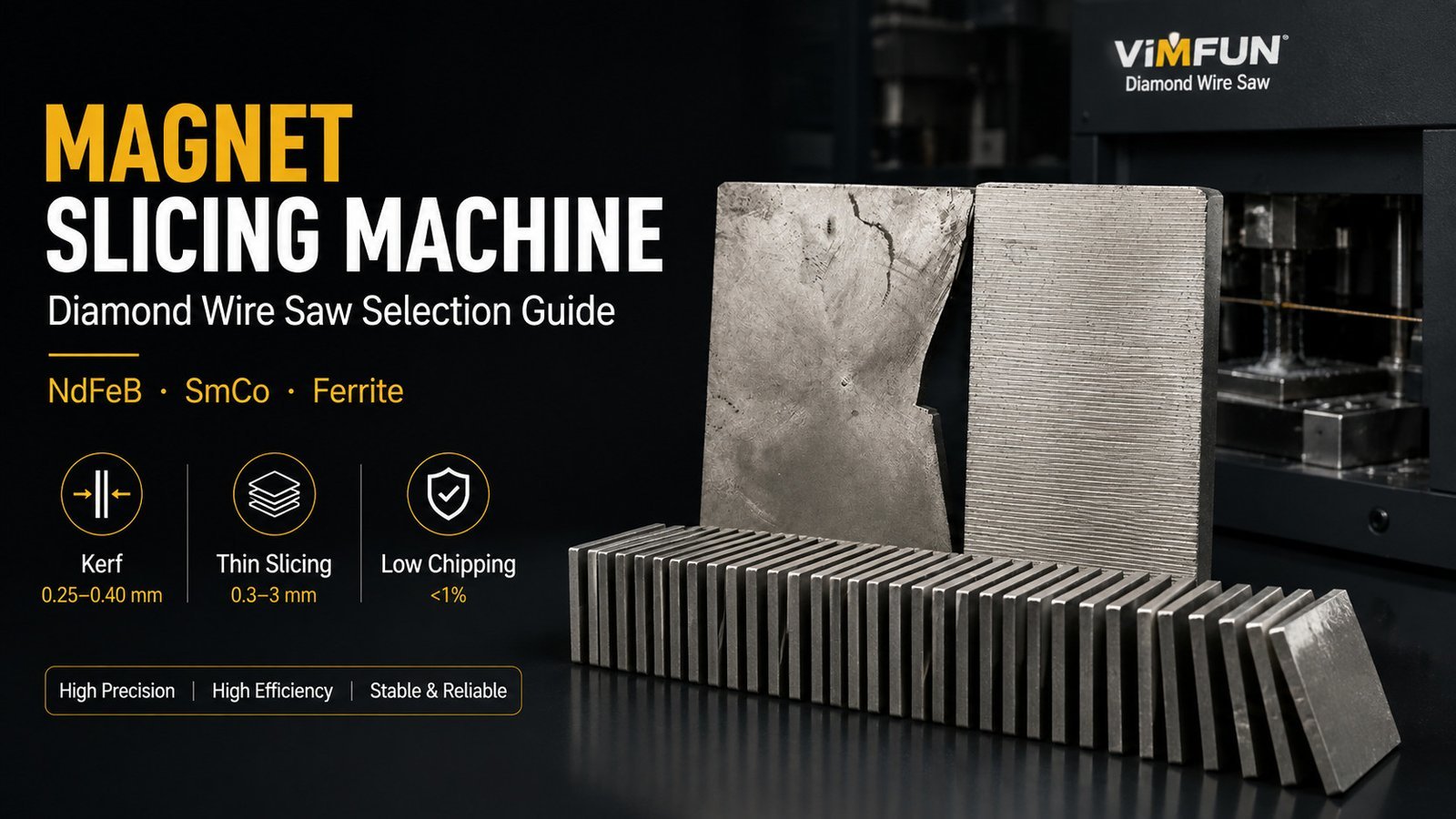
Material Characteristics Comparison
Different permanent magnets need different machine settings and fixture strategies. Before choosing a permanent magnet cutting machine, confirm the magnet family, hardness, fracture behavior, target part geometry, and downstream finishing requirement.
| Material | Cutting behavior | Recommended machine route | Main risk | Next page |
|---|---|---|---|---|
| NdFeB | Brittle rare earth magnet with high material value and frequent thin-slice requirements. | Diamond wire slicing, double-sided lapping, polishing, cleaning, coating preparation. | Kerf loss, edge chipping, oxidation, thickness variation. | NdFeB cutting machine |
| SmCo | Hard, brittle, thermally stable rare earth magnet used where temperature resistance matters. | Low-force diamond wire cutting with stable fixturing and controlled coolant management. | Micro-cracks, corner breakage, slower cutting speed. | Rare earth magnet cutting equipment |
| Ferrite | Ceramic-like permanent magnet, lower material cost but abrasive and fragile. | Wire saw or grinding route selected by part size, tolerance, and production volume. | Edge breakage, abrasive wear, dust/coolant management. | Ferrite magnet cutting wire saw |
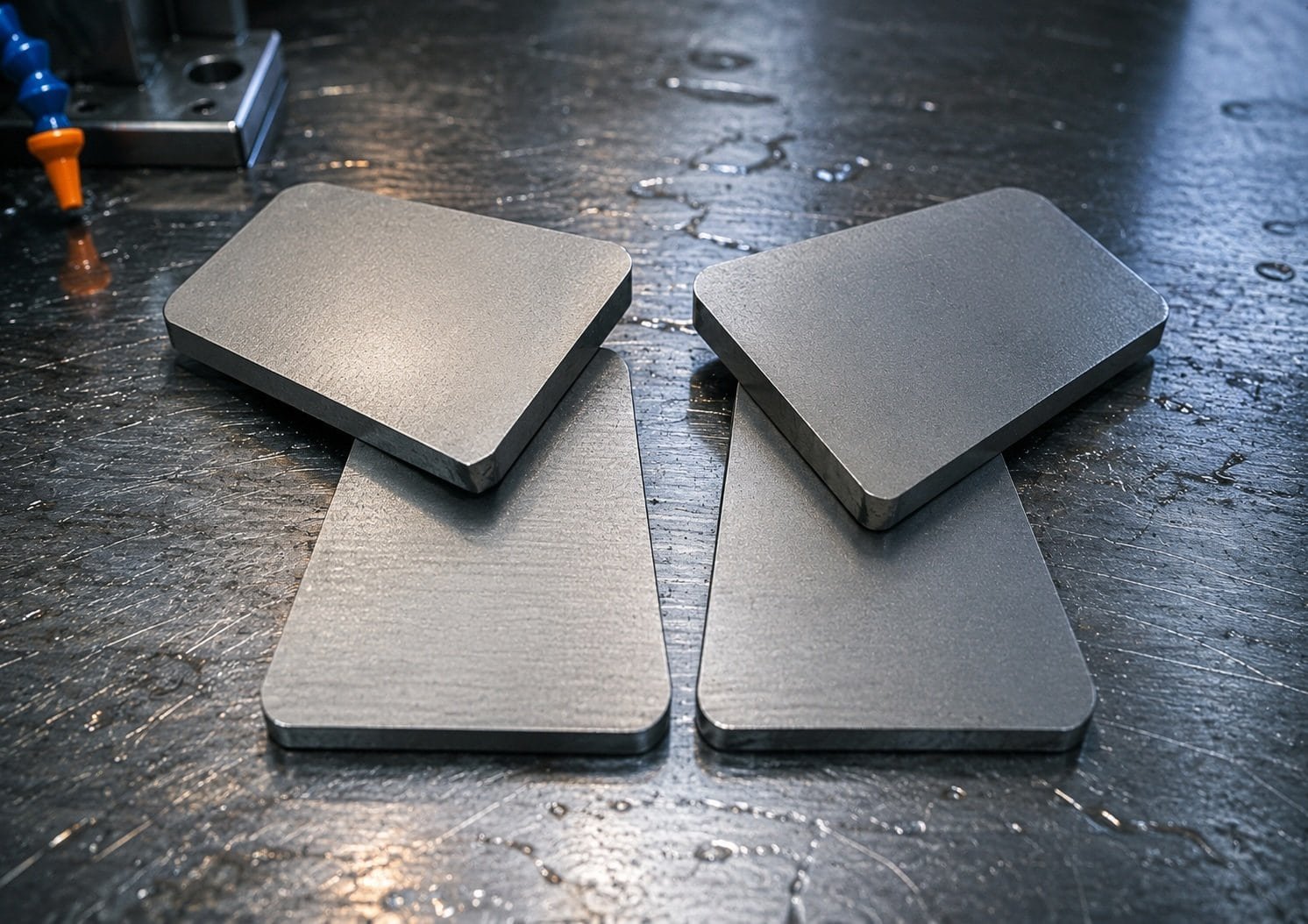
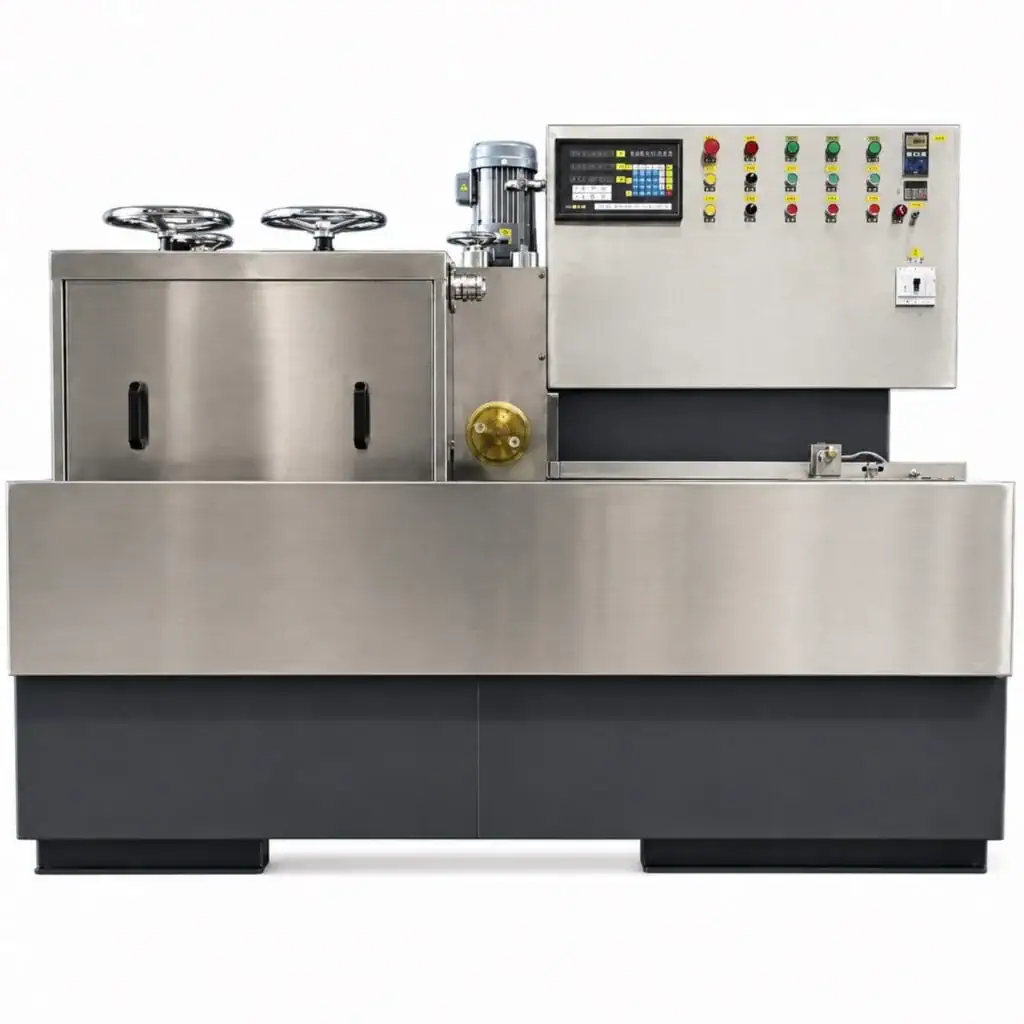
Rare Earth Magnets: NdFeB & SmCo Cutting Solutions
Rare earth magnet cutting equipment must balance low cutting force, controlled wire tension, stable coolant delivery, and repeatable fixture positioning. NdFeB and SmCo are both rare earth magnets, but their machining priorities are different.
NdFeB permanent magnet cutting
NdFeB is common in EV motors, servo motors, robotics, wind turbines, and high-performance magnetic assemblies. The challenge is reducing kerf loss while keeping slices flat and coating-ready. For thin slices, multi-wire or dedicated magnet slicing equipment can increase capacity without pushing cutting force too high.
SmCo magnet cutting
SmCo is selected for high-temperature and corrosion-resistant applications. It is expensive and brittle, so a controlled diamond wire process is often more important than raw cutting speed. Stable fixturing and process repeatability reduce fracture risk on small or thin SmCo parts.
Ferrite Magnet Cutting for Abrasive Ceramic-Like Materials
Ferrite magnets are usually less expensive than rare earth magnets, but they can still be difficult to machine at scale. Their ceramic-like structure makes edge breakage and abrasive wear common problems. The machine choice should be based on part size, required tolerance, and whether the factory needs flexible batches or stable mass production.
For ferrite blocks, rings, and custom shapes, wire saw cutting can reduce mechanical impact compared with hard contact cutting. When high flatness is required, grinding or lapping should be planned as part of the same production route.
From NdFeB Block to Wafer: Process Chain Flowchart
For high-volume factories, NdFeB sintered magnet machining should be planned as a connected line rather than a group of unrelated machines. The NdFeB block to wafer process usually starts from oriented and sintered blocks, then moves through slicing, thickness correction, surface finishing, cleaning, and coating preparation.
Choose Equipment by the Stage You Need to Control
Use this hub as the starting point, then open the specific machine category that matches your bottleneck. If your main issue is kerf loss, start with slicing. If your main issue is flatness or thickness variation, start with lapping and polishing. If your issue is stable output across operators and shifts, review complete production-line equipment.
Slicing machines
For block-to-slice conversion, thin wafer cutting, kerf-loss reduction, and high monthly capacity.
Grinding, lapping & polishing
For thickness correction, flatness, parallelism, surface finish, and coating-ready surfaces.
Production line equipment
For factories that need planned capacity, repeatable process flow, and connected upstream/downstream equipment.
Watch NdFeB Magnet Cutting with the SG20-R
This Vimfun demonstration shows diamond wire cutting of NdFeB magnet material with the SG20-R. It illustrates a single-wire cutting operation; production multi-wire slicing uses a different machine configuration.
Application-Specific Magnet Machining Routes
The same cutting machine can behave differently when part geometry, tolerance, and production rhythm change. Use the application pages below to connect material selection with real magnet formats used in motors, energy, robotics, audio, and medical equipment.
EV motor magnets
High-volume arc, tile, and segment magnets with strict consistency demands.
Wind turbine magnets
Large permanent magnets where yield and process stability protect material cost.
Robot servo magnets
Precision small magnets for servo motors, robotics, and automation systems.
Speaker and audio magnets
Ferrite and rare earth magnets for audio assemblies and consumer electronics.
Medical and MRI magnets
Stable machining routes for high-value magnetic components used in medical devices.
Process knowledge
Compare wire saw cutting choices and reduce kerf loss in brittle permanent magnet materials.
Permanent Magnet Cutting Equipment Built Around Factory Reality
Vimfun works with magnet manufacturers that need more than a catalog machine. The practical questions are usually about slice yield, operator repeatability, fixture design, coolant control, throughput, and whether the machine route can scale from sample validation to stable production.
9+ customers in the Baotou rare-earth cluster
Baotou is one of the world’s most important rare earth magnet manufacturing regions. Our experience with customers in this cluster helps us understand real NdFeB production constraints, including block variation, high-coercivity grades, and pressure to reduce kerf loss.
Engineering consultation before machine selection
Send material type, block size, target slice thickness, monthly capacity, and tolerance requirements. Vimfun can review the process route and recommend whether you should prioritize slicing, lapping, polishing, or a combined production-line solution.
Permanent Magnet Cutting Machine FAQ
What is the best cutting method for NdFeB magnets?
For many NdFeB blocks and thin slices, diamond wire cutting is preferred because it lowers mechanical stress and can reduce kerf loss compared with hard contact cutting. The best machine still depends on block size, grade, thickness, tolerance, and monthly capacity.
Can the same machine cut NdFeB, SmCo, and ferrite?
Some equipment platforms can be configured for multiple brittle magnet materials, but wire, coolant, fixture, speed, and tension settings should be adjusted. SmCo and ferrite often need more conservative process parameters than standard NdFeB.
When should we add lapping or polishing after slicing?
Add lapping or polishing when slice thickness, flatness, parallelism, or surface condition affects assembly, coating, or magnetic performance. Slicing creates the geometry; lapping and polishing make the surface more production-ready.
How do we reduce kerf loss in rare earth magnet cutting?
Use an appropriate diamond wire diameter, stable wire tension, optimized feed speed, and precise fixturing. Kerf-loss reduction should be balanced against wire life, cutting stability, and edge quality.
What information is needed for equipment selection?
Prepare material type, grade if available, block dimensions, target slice thickness, tolerance, expected monthly output, current pain points, and photos or drawings of the parts. This allows Vimfun to recommend a realistic machine route.