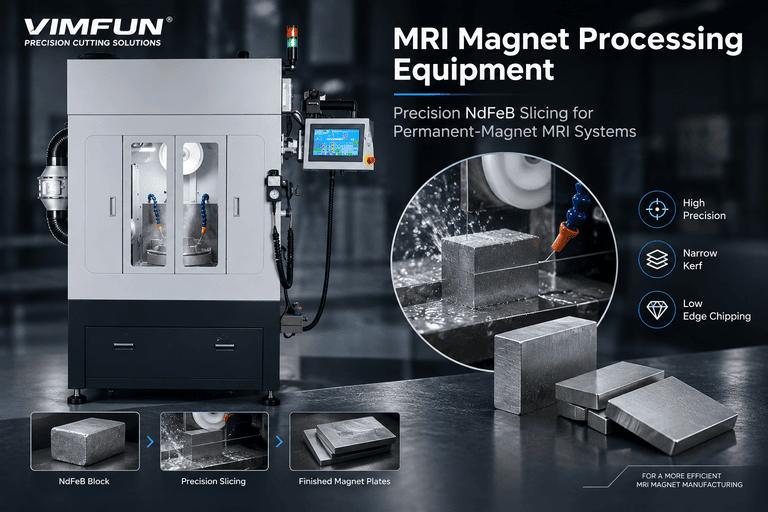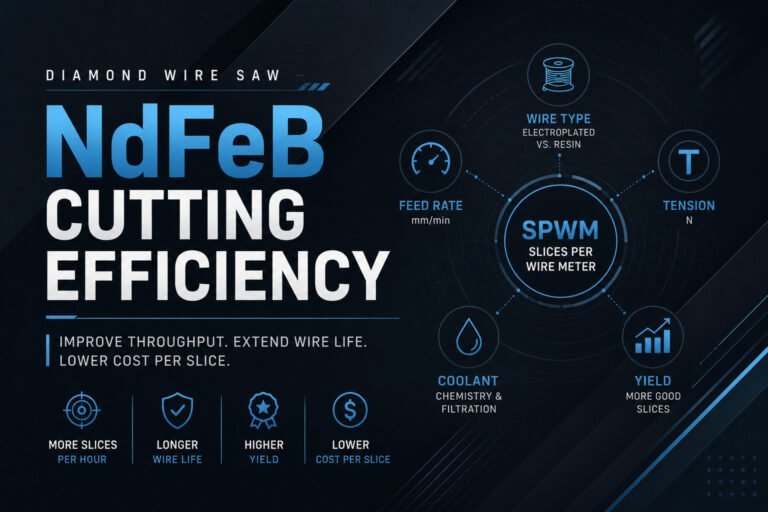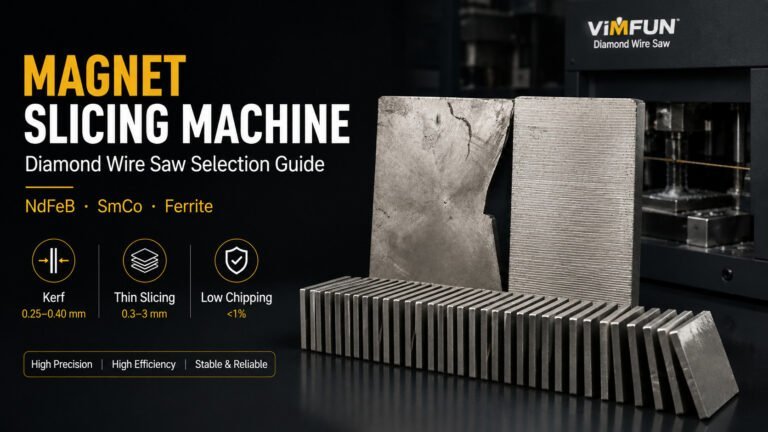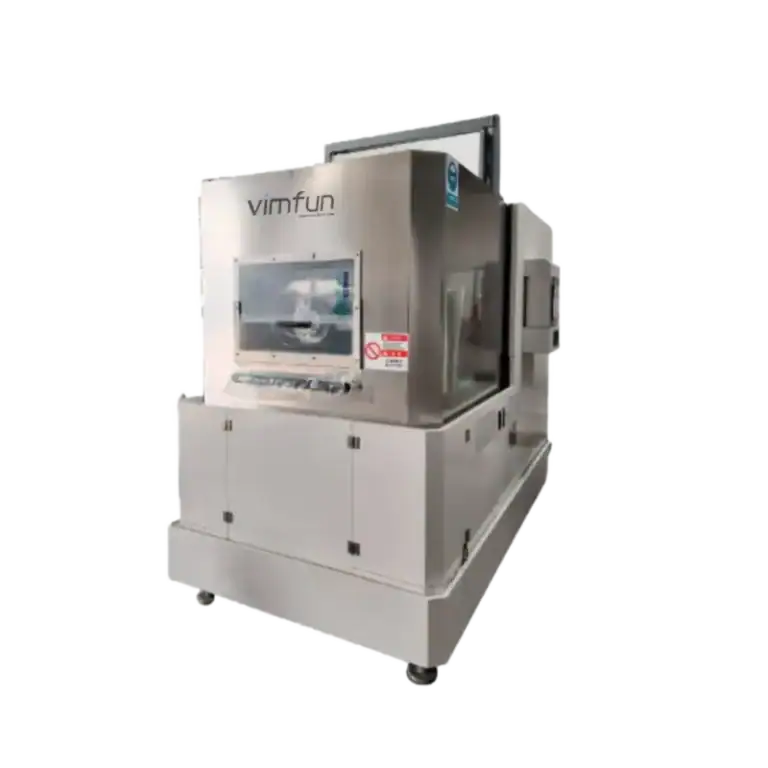
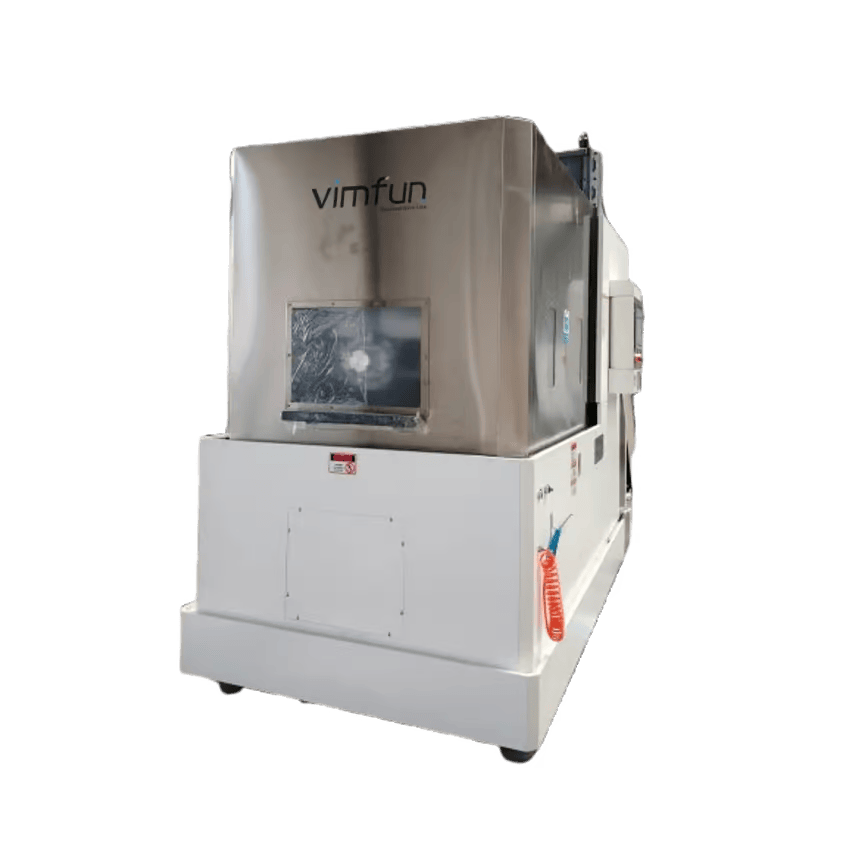
Une machine de découpe NdFeB est un équipement spécialisé conçu pour découper des aimants frittés au néodyme-fer-bore en dimensions précises pour les moteurs, les capteurs et les actionneurs. Le NdFeB est l'un des matériaux d'aimants permanents les plus durs et les plus cassants — les scies métallurgiques standard ne peuvent pas le couper sans le fissurer, le surchauffer ou détruire ses propriétés magnétiques. Le choix de la bonne machine de découpe NdFeB détermine votre taux de rendement, votre précision dimensionnelle et votre débit de production.
Qu'est-ce qu'une machine de découpe NdFeB ?
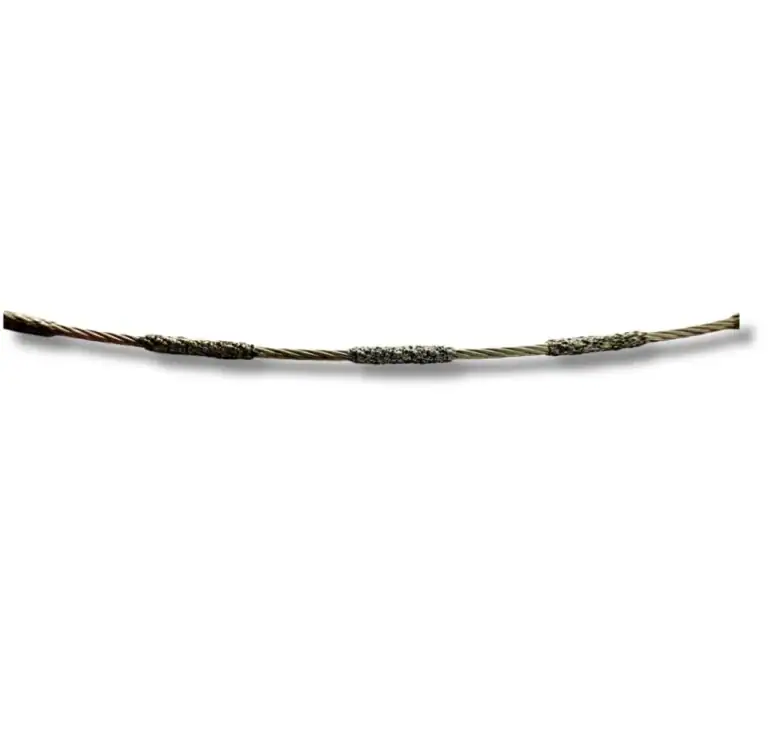
Une machine de découpe NdFeB est un système de coupe de précision qui utilise un fil ou des lames revêtus de diamant pour découper des blocs d'aimants frittés au néodyme-fer-bore en formes finies — généralement des tranches fines, des arcs ou des profils personnalisés. Contrairement aux scies à usage général, une machine de découpe NdFeB doit relever les défis uniques des aimants de terres rares : dureté extrême (Vickers HV 570–650), fragilité élevée, sensibilité à la démagnétisation thermique au-dessus de 80–150 °C (selon la nuance) et structure métallique conductrice qui génère des copeaux fins réactifs.
Les trois principaux types de machines de découpe NdFeB sont :
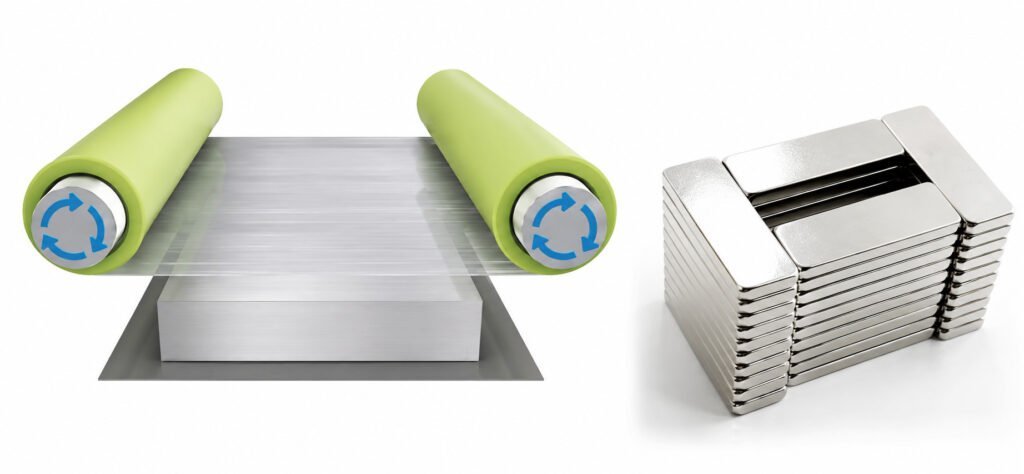
- Scie à fil diamanté multi-fils — découpe des dizaines à des centaines de tranches simultanément à partir d'un seul bloc
- Scie à fil diamanté mono-fil — pour les profils personnalisés, les coupes de contour et la production en petits lots
- Scie à alésage (ID) — coupe traditionnelle à lame unique pour les tranches individuelles
Paramètres clés des machines de découpe NdFeB
| Paramètre | Scie multi-fil | Scie mono-fil | Scie à alésage (ID) |
|---|---|---|---|
| Largeur de trait | 0,15–0,30 mm | 0,20–0,35 mm | 0,3–0,8 mm |
| Précision de coupe (TTV) | ±0,01–0,03 mm | ±0,02–0,05 mm | ±0,01–0,02 mm |
| Épaisseur min. de tranche | 0,3 mm | 0,5 mm | 0,5 mm |
| Débit | 100–500+ tranches/passage | 1 tranche/passage | 1 tranche/passage |
| Taille maximale de la pièce | Bloc de 200+ mm | Varie selon le modèle | Limité par l'ID de la lame |
| Type de liquide de refroidissement | À base d'eau | À base d'eau | À base d'huile ou d'eau |
| Idéal pour | Production en grand volume | Formes personnalisées, prototypes | Précision d'une seule pièce |
Ces paramètres varient selon le fabricant et le modèle. Lors de l'évaluation d'une machine de découpe NdFeB, demandez les résultats de tests de découpe sur votre nuance d'aimant spécifique — les performances sur N35 diffèrent considérablement de celles sur N52 ou des nuances haute température comme N35SH.
Comment choisir la bonne machine de découpe NdFeB
Étape 1 : Définissez votre géométrie d'aimant et vos besoins en volume
Commencez par ce que vous devez produire :
- Plage d'épaisseur de tranche — si vous coupez régulièrement en dessous de 0,5 mm, seules les scies multi-fils peuvent produire de manière fiable ces dimensions sans casse excessive
- Taille du bloc — les grands blocs (150–200+ mm) nécessitent des machines avec une course et une portée de fil suffisantes
- Complexité du profil — les segments d'arc et les formes de contour nécessitent machines de coupe à fil unique ou de contour avec capacité multi-axes
- Volume quotidien/mensuel — un volume élevé (milliers de tranches/jour) indique machines à scier multifilaires; un faible volume ou des géométries mixtes favorisent les systèmes à fil unique
Étape 2 : Associer la méthode de coupe à votre qualité de matériau
Les qualités d'aimants NdFeB varient considérablement en dureté et en sensibilité thermique :
- Qualités standard (N35–N52) : Température de fonctionnement maximale 80°C. Nécessitent un liquide de refroidissement agressif pour éviter la démagnétisation thermique pendant la coupe. Les scies diamantées multi-fils et mono-fils fonctionnent toutes deux bien.
- Qualités haute température (N35SH, N42UH, N38EH) : Tolèrent des températures de coupe plus élevées mais sont généralement plus dures. Le taux d'avance peut devoir être réduit pour éviter les microfissures.
- NdFeB fritté à gros grains : Plus sujet aux fissures intergranulaires. Un grain de diamant plus fin et des taux d'avance plus lents produisent des coupes plus nettes.
Pour toutes les qualités, la machine de coupe doit maintenir la température de la pièce bien en dessous de la température de fonctionnement maximale de la qualité. C'est pourquoi la conception du système de refroidissement est aussi importante que le mécanisme de coupe lui-même.
Étape 3 : Évaluer la perte de matière et le rendement du matériau
La matière première NdFeB représente un facteur de coût majeur dans la production d'aimants. Le équipement de découpe d'aimants de terres rares que vous choisissez a un impact direct sur la quantité de matière qui devient produit par rapport aux copeaux.
Comparaison de la perte de trait pour un bloc typique de 50 mm de NdFeB découpé en tranches de 1 mm :
| Type de machine | Largeur de saignée | Tranches par bloc | Rendement matière |
|---|---|---|---|
| Scie multi-fil (fil de 0,20 mm) | 0,22 mm | ~41 | ~82% |
| Scie à fil interne (lame de 0,5 mm) | 0,55 mm | ~32 | ~64% |
| Différence | — | +9 tranches | +18% |
Pour les opérations traitant des centaines de blocs par mois, cette différence de rendement se traduit directement par des économies significatives de matières premières.
Étape 4 : Vérifier le système de gestion du liquide de refroidissement et des copeaux
La découpe de NdFeB produit des copeaux métalliques qui sont :
- Pyrophoriques — les fines particules de NdFeB peuvent s'enflammer spontanément à l'air lorsqu'elles sont sèches
- Corrosif — le NdFeB s'oxyde rapidement ; les copeaux contaminent le liquide de refroidissement s'il n'est pas filtré
- Abrasif — les copeaux recirculés accélèrent l'usure du fil et des composants
Une machine de découpe NdFeB correctement conçue comprend :
- Flux continu de liquide de refroidissement avec filtration (séparateur magnétique + filtre papier)
- Système de collecte des copeaux qui maintient les particules humides en permanence
- Dispositifs de lutte contre l'incendie pour la zone de collecte des copeaux
- Contrôle de la température du liquide de refroidissement pour éviter les dommages thermiques aux aimants
Selon les directives de manipulation du NdFeB d'Arnold Magnetic Technologies, les copeaux de NdFeB fritté doivent être maintenus immergés dans du liquide de refroidissement ou de l'eau jusqu'à leur élimination appropriée — ne jamais les laisser sécher dans des conteneurs ouverts.
Problèmes courants et solutions pour les machines de découpe NdFeB
Les aimants se fissurent pendant la découpe — Que faire ?
Réduisez immédiatement la vitesse d'avance — la fissuration est presque toujours causée par une force de coupe excessive par rapport à la ténacité à la rupture de l'aimant. Le NdFeB a une ténacité à la rupture très faible (K_IC ≈ 1–1,5 MPa·√m), comparable à celle de la céramique. Si la réduction de la vitesse d'avance n'élimine pas la fissuration, vérifiez :
- Tension du fil (trop élevée, provoque une concentration de contraintes localisée)
- Montage de la billette (adhésif inégal ou pression de serrage excessive)
- État du grain de diamant (grain usé, augmente la force de coupe)
- Arrivée du liquide de refroidissement dans la zone de coupe (coupe à sec, provoque un choc thermique)
La surface coupée présente-t-elle des marques de brûlure ou une décoloration ?
Dommages thermiques dus à un liquide de refroidissement insuffisant ou à une vitesse d'avance excessive. La surface de l'aimant a été chauffée localement au-dessus de son seuil d'oxydation. Vérifiez le débit du liquide de refroidissement et l'alignement de la buse. Pour les nuances à haute température, la température de la zone de coupe doit rester inférieure à 60 °C pour maintenir les propriétés magnétiques. Envisagez de passer à un grain de diamant plus fin — il génère moins de chaleur par friction par passe.
Variation d'épaisseur (TTV) dépassant la spécification ?
La déflexion du fil est la cause la plus fréquente. Vérifiez la tension du fil par rapport aux spécifications, inspectez les rouleaux de guidage pour détecter l'usure et vérifiez que la billette est montée avec une épaisseur d'adhésif uniforme. Pour les scies multi-fils, vérifiez également la précision du pas du fil — un espacement inégal entre les fils produit une épaisseur de tranche incohérente. Le machine à trancher de précision avec contrôle de tension en boucle fermée maintient une TTV plus serrée sur de longues séries de coupes.
Les tranches d'aimant collent-elles ensemble après la coupe ?
Le magnétisme résiduel provoque l'attraction mutuelle des tranches coupées. Ceci est normal pour le NdFeB. Utilisez un montage non magnétique ou une étape de démagnétisation après la coupe. Certaines machines de coupe NdFeB incluent une bobine de démagnétisation intégrée qui démagnétise partiellement les tranches avant leur retrait, facilitant leur manipulation.
Machine de coupe NdFeB vs Machine de coupe Ferrite : Comment choisir ?
| Fonctionnalité | Machine de coupe NdFeB | Machine de coupe Ferrite |
|---|---|---|
| Dureté du matériau | HV 570–650 (très dur) | HV 400–600 (dur) |
| Fragilité | Extrêmement cassant | Cassant |
| Sensibilité thermique | Élevé (risque de démagnétisation) | Faible |
| Risque de copeaux | Pyrophorique (risque d'incendie) | Ininflammable |
| Exigence de liquide de refroidissement | Obligatoire, avec système de copeaux ignifuge | Obligatoire, système standard |
| Méthode de coupe typique | Scie à fil diamanté | Scie à fil diamanté ou lame abrasive |
| Coût du matériau | Élevé (teneur en terres rares) | Faible |
| Priorité à la perte de matière | Critique (matériau coûteux) | Important mais moins critique |
Quand choisir une machine NdFeB : Votre application nécessite de hautes performances magnétiques (BHmax > 30 MGOe) — Moteurs électriques, servomoteurs, systèmes IRM ou électronique grand public. Le coût plus élevé des matières premières rend la réduction des pertes de matière essentielle.
Quand la ferrite est suffisante : Votre application tolère des performances magnétiques plus faibles mais nécessite de grands volumes à faible coût — petits moteurs CC, haut-parleurs, séparateurs magnétiques. La ferrite est 10 à 20 fois moins chère au kg que le NdFeB, donc la perte de matière a moins d'impact sur l'économie.
Comment notre machine de découpe NdFeB résout ces défis
Nous concevons des machines de découpe NdFeB spécifiquement pour les lignes de production d'aimants de terres rares, abordant les défis décrits ci-dessus :
Minimisation des pertes de matière. Notre systèmes de scie multi-fils utilisent un fil diamanté de 0,20–0,25 mm, atteignant des largeurs de coupe de 0,22–0,28 mm — 50–65% plus étroites que les lames de scie à alésage. Pour une usine d'aimants typique traitant des blocs de NdFeB, cela se traduit par 20–30% de tranches finies supplémentaires par bloc.
Contrôle thermique. La gestion de la température du liquide de refroidissement en boucle fermée maintient la zone de coupe en dessous du seuil critique de démagnétisation. La surveillance de la température multipoint ajuste automatiquement la vitesse d'avance si la température de la pièce approche de la limite.
Système de copeaux intégré à la sécurité. Séparateur magnétique + collecte humide + conteneurs d'élimination scellés. Le système maintient les copeaux de NdFeB immergés de la coupe à l'élimination, éliminant le risque d'inflammation pyrophorique.
Configuration flexible. De découpe de contour à fil unique pour prototypes et segments d'arc, à systèmes multi-fils à grande échelle pour la production en grand volume — nous adaptons la configuration de la machine à votre géométrie d'aimant spécifique et à vos exigences de volume.
Contactez notre équipe d'ingénierie avec votre nuance d'aimant, vos dimensions cibles et votre volume mensuel. Nous fournissons des données de test de coupe sur votre matériau avant que vous ne vous engagiez sur une spécification de machine.