
Vimfun SOMI2-600S · Two-axis inverted cutting
Установка для резки сверхтонких пластин SOMI2-600S
An ultra thin wafer slicing machine for longer blanks and high-speed reciprocating wire operation. A two-axis, single-workstation inverted arrangement supports parallel slicing within a 660 × 160 × 150 mm workpiece envelope.
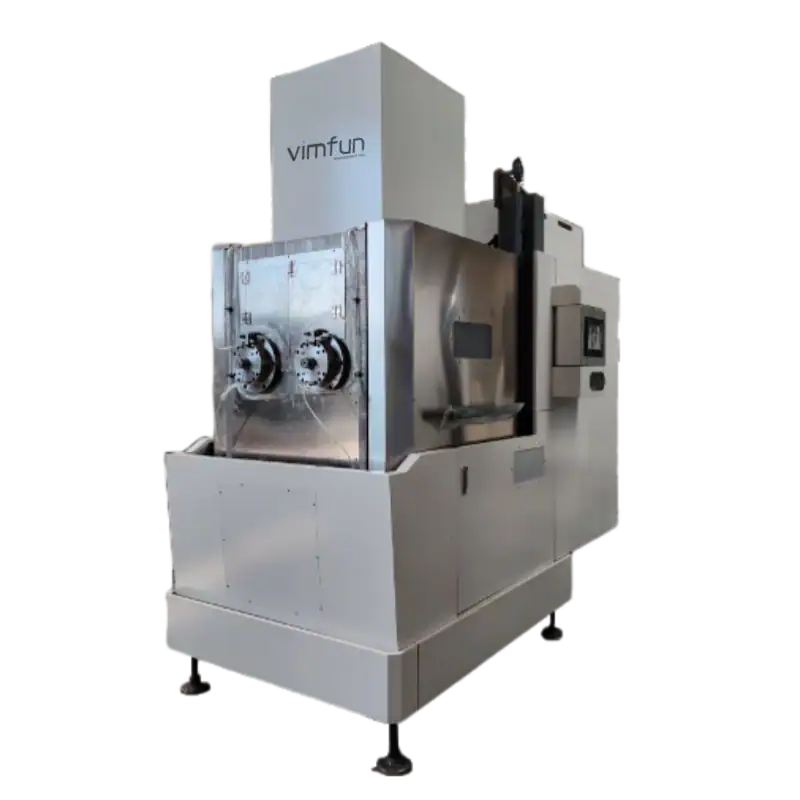
Where does SOMI2-600S fit in wafer preparation?
The machine sits at the slicing stage between prepared ingot handling and downstream finishing. The incoming blank must fit the usable workpiece envelope after allowing for its mounting and support. The output is an as-cut slice; grinding, lapping or polishing may still be needed to reach the finished substrate requirement.
The listed 0.3–3 mm range describes slice thickness, not thickness tolerance, total thickness variation or a universal finished-wafer specification. Agree on the target as-cut thickness and finishing allowance before choosing the setup. The grinding and lapping equipment overview covers the next equipment stage.
Start with this model when a longer blank or the listed higher wire-speed capability matters to the process review. For blanks within 430 mm length, compare SOMI-430 before moving to the larger envelope. Neither machine's maximum speed establishes the production feed rate or accepted output per hour.
How does the inverted wire web cut a longer blank?
Inverted cutting feeds the supported workpiece upward into the wire web. Parallel wire spans create multiple slices during the cut, while the wire travels reciprocally through the guide system. The source identifies two axes and one workstation, rather than the dual-workstation arrangement of other SOM models.
Concept illustration only. It compares feed directions and does not show the actual machine's wire routing, dimensions or control sequence.
The grooved rollers establish wire spacing. Nominal slice thickness depends on the selected groove pitch and the effective cutting kerf; wire diameter alone is not a complete kerf specification. Roller pitch, wire selection and material conditions must be reviewed together for the requested thickness.
The source describes a smaller center distance in the single-plate arrangement. This is not evidence that slice spacing becomes smaller simply because cutting is inverted. The layout and the cutting recipe must be evaluated separately. No unsupported claim about subsurface damage or reduced polishing is used as a substitute for trial results.
Selecting an ultra thin wafer slicing machine for your blank
Longer single-station loading
The listed envelope is 660 × 160 × 150 mm. Check blank length and cross-section together, then account for fixtures, bonded supports and loading clearance. A matching blank length alone does not establish that the mounted assembly fits.
High-speed wire capability
The listed maximum reciprocating wire speed is 2,200 m/min. Treat it as an equipment limit. Feed, tension, coolant and the usable operating speed must be selected for the actual material and target surface condition.
A high speed multi wire saw should be compared on accepted slices after inspection, not maximum wire speed alone. Include preparation, loading, separation, inspection and changeovers when assessing a production route. Thin wafer multi wire saw selection also needs a practical handling plan for the separated slices.
Technical specifications
| Параметр | SOMI2-600S |
|---|---|
| Maximum blank size | 660 × 160 × 150 mm |
| Listed slice thickness | 0,3–3 мм |
| Grooved roller diameter | 160–180 мм |
| Maximum reciprocating wire speed | 2,200 m/min |
| Overall machine dimensions | 2,450 × 2,000 × 2,000 mm |
| Cutting arrangement | Two-axis, single-workstation inverted cutting |
Listed machine ranges do not guarantee a material-specific thickness tolerance, surface roughness or yield. Wire diameter, tension, feed range, machine power and weight require confirmation; values from other SOM machines are not substituted.
Installation dimensions describe the machine, not the full space required for loading, access and service. Confirm the final installation drawing before preparing the site. The minimum listed slice thickness must also be distinguished from the finished substrate thickness after material removal.
What material information is needed before a trial?
This model is positioned for wafer and thin-slice preparation. Material suitability must be confirmed against the actual grade, crystal structure, geometry and required result. A generic list of semiconductor materials does not establish that one recipe or thickness tolerance applies to all of them.
| Input | What to provide | Почему это важно |
|---|---|---|
| Материал | Grade, composition and crystal orientation where relevant | Defines the trial material rather than relying on a broad family name |
| Incoming blank | Dimensions, shape, reference surfaces and mounting method | Checks the usable envelope and support arrangement |
| Required slice | As-cut thickness, finishing allowance and inspection criteria | Separates slicing requirements from final substrate acceptance |
No material-specific minimum thickness or guaranteed cutting yield is asserted here. Send the material information with the drawing so the team can review a representative trial rather than transferring an unrelated machine's result.
Main assemblies and what they do
Grooved rollers and wire web
The two-axis arrangement supports the parallel cutting spans. Groove geometry and wire selection must match the intended slice setup. The documented roller diameter range is 160–180 mm; no unverified wire diameter is assigned to this model.
Single workstation
The workstation supports one mounted cutting arrangement. Review the fixture, reference surfaces and access before deciding how the full blank envelope will be used. A single-station layout must not be described as a dual-plate machine.
Inverted feed arrangement
The workpiece feeds upward into the web. Loading, support and slice handling should be considered together, using the actual workpiece and tooling. The simplified diagram explains direction rather than proving an automatic quality improvement.
Reciprocating wire movement
Wire travel supplies cutting motion while workpiece feed controls engagement. The maximum travel speed and the actual production feed are separate parameters. Confirm operating settings through process review and sample cutting.
SOMI2-600S or SOMI-430: which fits your workpiece?
Both use two-axis inverted cutting and list a 0.3–3 mm slice range. The main documented distinctions are blank length and maximum wire speed. Choose the required envelope first, then evaluate whether the extra speed capability is relevant to your tested process.
| Selection factor | SOMI2-600S | SOMI-430 |
|---|---|---|
| Maximum blank size | 660 × 160 × 150 mm | 430 × 160 × 150 мм |
| Listed slice thickness | 0,3–3 мм | 0,3–3 мм |
| Maximum wire speed | 2,200 m/min | 1,200 m/min |
| When to evaluate | Longer blanks or higher wire-speed capability | Blanks within the shorter envelope |
See the SOMI-430 product details for its full specifications. For laboratory-scale batches, review SOM200. For other cutting arrangements, use the multi-wire saw selection guide rather than assuming this model covers every slice or workpiece size.
Installation, trial planning and support
Electrical supply, cooling, compressed air, foundation, lifting access and environmental requirements are confirmed with your order — please ask us. The compact machine dimensions do not establish cleanroom suitability or specify the required surrounding service area.
Before the trial, agree on the thickness measurement method, edge condition, surface inspection and acceptable output. Record the material, mounting and operating conditions used so the result can be interpreted in context. Free sample cutting is available; sample logistics and the precise scope should be agreed with the team.
CE certified · 12-month warranty · Response within 12 hours. These support terms do not replace the order-specific technical agreement or create a guaranteed cutting result.
Questions before selecting the machine
Is 0.3 mm the finished wafer thickness?
No. It is the lower end of the listed slice range. The required as-cut thickness must account for downstream finishing and the agreed acceptance criteria.
Does 2,200 m/min mean the maximum production rate?
No. It is maximum wire travel speed. Feed, blank dimensions, material, handling and inspection all affect accepted production output.
Can the same settings be used for different materials?
That should not be assumed. Material grade, workpiece support, wire setup and target result must be reviewed for the actual cut.
Send your blank dimensions and target slice requirements
Share the material grade, drawing and inspection limits so the team can review SOMI2-600S against the actual cutting task.
Request free sample cuttingCE certified · 12-month warranty · 12-hour response · Free sample cutting
- Material grade and orientation
- Blank and fixture dimensions
- As-cut thickness and finishing allowance
- Batch size and acceptance criteria