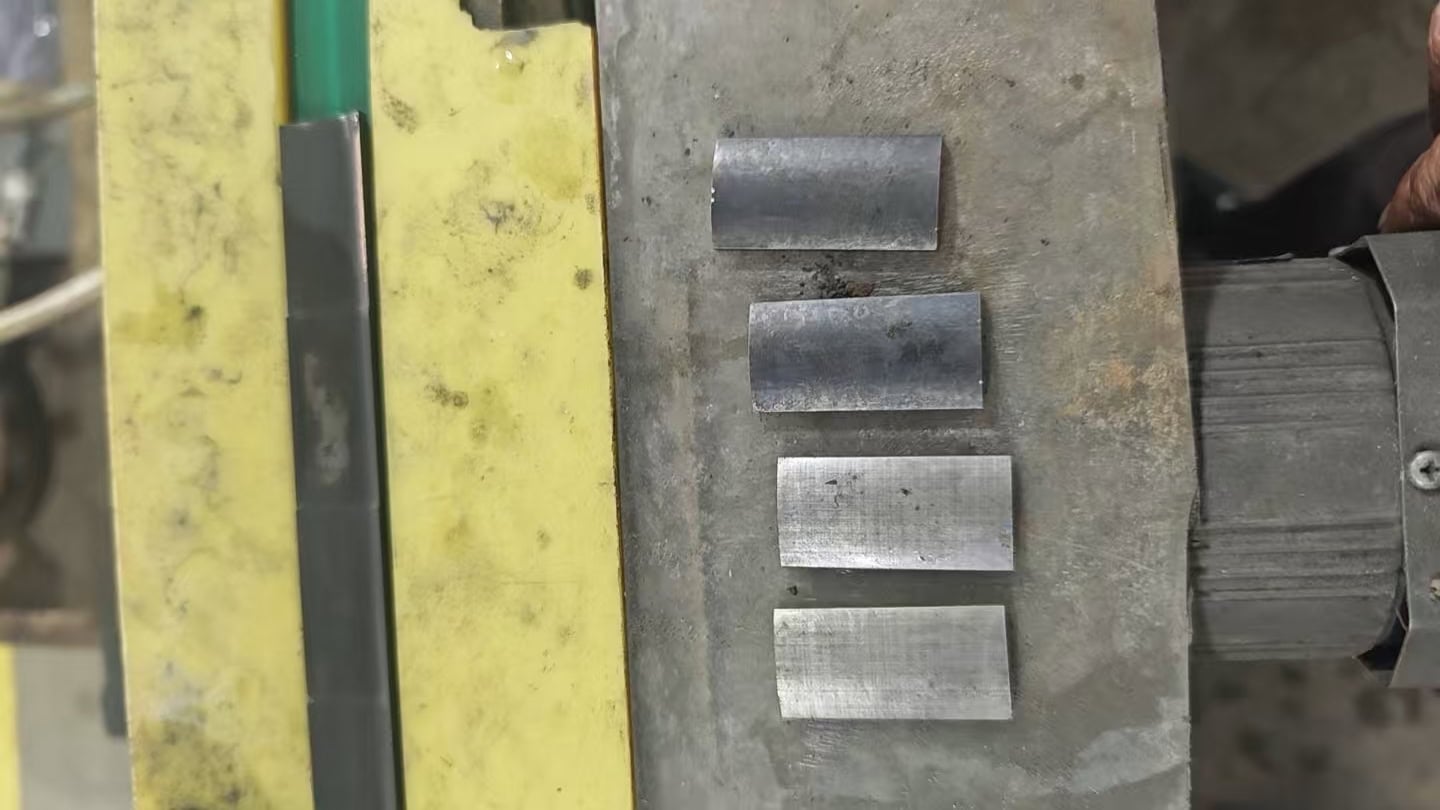
Arc Magnet 研削 機械
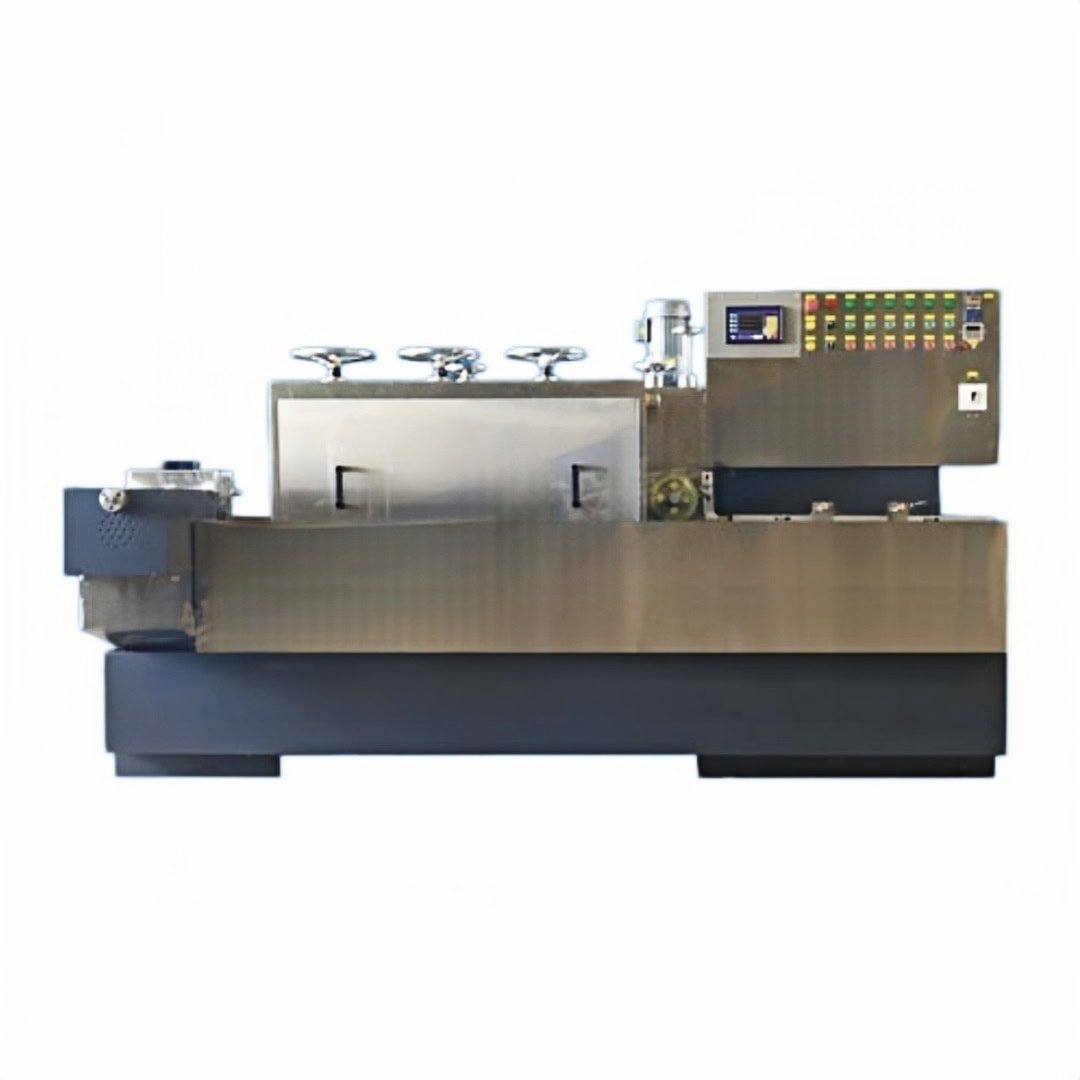
The VMG-490 is a 4-station pass-through arc magnet grinding machine that finishes the inner arc, outer arc, or end faces of tile-shaped permanent magnets at up to 20 pieces per minute. Workpiece envelope is 10–70 mm long × 10–90 mm wide. It's built for permanent magnet motor production lines — EV traction, servo, blower, audio — where reload time on single-station grinders is the bottleneck.
The design priority is throughput without losing arc tolerance. Four grinding stations sit on one continuous conveyor; the part is clamped at infeed and stays clamped through all four stations until it drops off the outfeed. No reclamp, no realign, no secondary fixturing.
Where the VMG-490 is in production
The machine is in production across the following workpiece classes. If your tile is outside the 10–70 × 10–90 mm envelope — bigger wind-turbine segments, for example, or sub-10 mm sensor magnets — this isn't the right answer.
-
A.01EV traction motor rotor magnets
Sintered NdFeB tiles, typical arc length 30–55 mm, thickness 5–10 mm, grades N42UH to N52H. Used in IPM and SPM rotor architectures.
-
A.02Servo & machine-tool spindle motors
Sintered or bonded NdFeB tiles, smaller arc (15–25 mm), tighter R tolerance. The 4-station setup matters here — rough + finish on the same arc face in one pass.
-
A.03HVAC, blower & compressor motors
Sintered ferrite (hard ceramic) tiles, arc length 40–70 mm. Cost-driven applications where wheel wear rate dominates the operating budget.
-
A.04Audio drivers & speaker assemblies
Ferrite arc segments, 30–50 mm. High-volume production where 20 pcs/min throughput is the line target.
-
A.05電動工具・小型家電モーター
Sintered NdFeB, smaller tiles (10–20 mm arc). Often run alongside larger automotive parts in the same shift; parameter recall handles the changeover.
仕様書
| 設定 | 4-station pass-through, in-line |
| 加工ワーク長範囲 | 10 – 70 mm |
| 加工ワーク幅範囲 | 10 – 90 mm |
| スループット | Up to 20 pcs/min (≈ 1,200 pcs/h) |
| アークトレランス (R) | ±0.03 mm |
| 研削ヘッド主軸モーター | 7.5 kW × 2 |
| 空圧クランプクリアランス | 0.01 mm |
| In-feed servo motor (per station) | 0.75 kW × 4 |
| 砥石ドレッシングモーター | 1.5 kW × 2 |
| コンベヤベルトサイズ | 1920 × 100 × 3 mm |
| コンベヤ駆動モーター | 減速機付き0.3 kW高周波モーター |
| 送り速度 (可変) | 0.2 – 3 m/min |
| クーラント / 潤滑 | グリコールエステル基材 + 防錆剤 |
| フレーム構造 | 溶接鋼製フレームベッド、板金製エンクロージャー |
| 適合材料 | 焼結NdFeB・ボンドNdFeB・SmCo・ハードフェライト・AlNiCo |
| 自動ローディング/アンローディング | オプション |
How the arc magnet grinding machine works
パススルー研削は、オシレーティングカップホイールグラインダーやシングルステーションダブルエンドフェイスグラインダーとは異なります。ワークピースはインフィードでコンベアに載せられ、リファレンスレールに対して空圧でクランプされ、4つの研削ステーションを順番に通過します。アウトフィードに到達する頃には、アーク面は仕様通りに完全に研削されています。.
4つのステーションのうち2つは7.5 kWのスピンドルを備えています。これらは重切削ステーションであり、通常は内側アークの粗研削と外側アークの粗研削を行います。残りの2つのステーションは、インフィード深さが小さい仕上げ研削パス、または構成によっては、アーク長寸法を設定するための端面研削を処理します。.
各ステーションには独自の0.75 kWインフィードサーボがあります。これは、粗研削ステーションと仕上げステーションで同じワークピースに対して異なるインフィード深さが必要なため重要です。独立したサーボを使用すると、コンベア速度を乱すことなく、例えば粗研削を0.15 mm/パス、仕上げを0.02 mm/パスに調整できます。シングルステーションマシンでは、粗研削と仕上げの間でホイールを変更する(またはジョブセットアップ全体を変更する)必要があります。これが20個/分のスループットの由来です。.
コンベアは、材料グレードの生産パラメータによって設定された0.2〜3 m/minで動作します。厚さ8 mmの焼結N52 NdFeBは通常約1.5 m/minで動作します。厚さ12 mmのフェライトは、ホイールの摩耗ペースのため0.6 m/minに低下します。0.01 mmのクリアランスでの空圧クランプにより、4つのステーションすべてで部品がレールに対して平坦に保持されます。.
Upstream of this machine the typical workflow is: NdFeB block → multi-wire saw → tile blanks at 0.18–0.25 mm kerf → VMG-490 grind to spec → chamfering → polishing → plating. Each of those steps belongs to a different machine; the VMG-490 covers the arc/face grinding step.
材料ガイド
The VMG-490 handles the full range of permanent magnet materials in tile form. Wheel selection and feed rate change with material — the machine itself is material-agnostic.
| 素材 | 互換性 | 備考 |
|---|---|---|
| 焼結NdFeB | ✓ 主な用途 | Diamond / CBN wheel; reduce feed for grades > N50; flood coolant mandatory to keep local heat below ~60 °C and protect magnetic properties. |
| ボンデッドNdFeB | ✓ 互換性あり | 低速送り;樹脂マトリックスは~80℃以上で劣化するため、クーラントの流れは必須です。. |
| SmCo(Sm₂Co₁₇ / SmCo₅) | ✓ 互換性あり | More brittle than NdFeB. Reduce in-feed depth per pass to avoid edge chipping. Expensive scrap, so run-in carefully on a new wheel. |
| 焼結ハードフェライト | ✓ 互換性あり | Wheel wear is 3–5× faster than on NdFeB at the same removal rate. Plan dressing intervals shorter. |
| AlNiCo | ✓ 互換性あり | Less common in tile form, but compatible. Cast structure can grab on the wheel — verify clamping force before running production. |
推奨されません
- フレキシブルボンド磁石(ゴムボンド、ナイロンボンドシート) — これらはダイカットであり、研削ではありません。.
- "「グリーン」未焼結レアアースプレスブランク — 焼結後まで待ってください。グリーンパーツの研削はチップではなく粉塵を発生させ、寸法は保持されません。.
NdFeBグレードの定義については、ハード磁性材料に関するIEC規格を参照してください。 webstore.iec.ch (IEC 60404-8-1は焼結レアアース磁石を対象としています)。.
What makes the design hold up under production load
Four independent grinding stations on one belt
Single-station grinders force you to reclamp the part 3–4 times to hit all the surfaces. Each reclamp adds 20–30 seconds of cycle time and introduces alignment error that shows up as ±0.05 mm or worse R variation between batches. The VMG-490 keeps the part clamped from infeed to outfeed — four stations work the same workpiece in sequence without releasing it.
This is the single biggest difference between 4-station throughput (20 pcs/min) and single-station throughput (4–6 pcs/min) on identical parts.
0.01 mmの空圧クランプクリアランス
Clamps that drift more than 0.02 mm during the grind cycle let the same workpiece see different removal depths at different stations. The fixed 0.01 mm pneumatic clearance is what holds the ±0.03 mm arc tolerance across all four stations.
It's also what keeps tolerance stable shift-to-shift. Air pressure and clamp wear are the usual drift sources; pneumatic is more repeatable than mechanical spring clamps over 8-hour runs.
2つのオンボードホイールドレッシングモーター(1.5 kW × 2)
Ferrite chews wheels fast. Without on-machine dressing, you stop the line and re-true the wheel on a separate fixture — production sites lose 45 minutes per shift to off-machine dressing on ferrite-heavy schedules. On-board dressers re-profile in under 2 minutes between batches, and they can re-true the wheel without breaking down the setup.
Surface finish stays predictable on long runs. A glazed wheel doesn't fail catastrophically — it slowly drifts. Inline dressing catches the drift before parts go to chamfering.
Glycol-ester coolant with corrosion inhibitor
NdFeB rusts within 30 minutes of grinding if you use an unmodified water-based coolant. By the time the parts reach chamfering or plating, the freshly ground surface is already degraded. The glycol-ester blend wets the cutting interface, carries grinding heat away, and leaves a thin corrosion-inhibitor film.
That's the difference between a clean substrate for nickel plating and a re-cleaning step before the plating tank. 24-hour transit time becomes safe.
Welded steel-frame bed
At 20 pcs/min with two 7.5 kW spindles running, vibration shows up directly in arc tolerance. A welded steel frame absorbs grinding force and damps spindle harmonics passively. The sheet-metal panels you see are enclosure only — chosen for serviceability and cost. The structure under them is what carries the load.
An earlier prototype on a stamped-frame base opened up to ±0.06 mm under sustained load. The welded frame brought it back inside ±0.03 mm with no change to spindles or wheels.
Variable feed 0.2–3 m/min
Sintered N50 NdFeB at 8 mm thickness needs a different feed than ferrite at 12 mm thickness. Production lines that switch grades every shift need infinitely variable feed — a 5-step gearbox isn't enough. The VMG-490 covers the full range with parameter recall.
A grade changeover is a screen press, not a setup change. Same machine handles N35 to N52H, ferrite to SmCo.
モジュラーアドオン
| モジュール | 機能 | 指定時期 |
|---|---|---|
| 自動ローダー/アンローダー | バイブレーターボウルまたはロボットインフィード+アウトフィードコンベアからビンへ | Lights-out shifts, >2 shifts/day, or high-cost magnet grades where operator handling risks scrap |
| インライン厚さゲージ | インフィードのレーザー変位センサー。研削前の許容誤差±0.1 mmを超える部品は排除します。 | カット時のばらつきが大きい異種サプライヤーのブランク |
| 磁気チップ/クーラントセパレーター | ドラムまたはベルト磁気セパレーター(ペーパーポリッシュフィルター付き) | NdFeB多量生産。ISO 14001閉ループクーラントサイトに必須 |
| ホイールモニターアドオン | 音響放射センサー(摩耗率アラート付き) | 長時間の無人運転。バッチをスクラップする前にホイールのグレーズを検出します。 |
| 事前に真円度を出したプロファイルホイール | スピンドルマウントダイヤモンド/CBNプロファイルホイール(お客様のタイルRに適合) | 注文時にR範囲とボンドを指定してください。事前に真円度を出して出荷します。 |
| クーラントチラー | クーラントを18~22℃に保つ閉ループ冷却 | 高温地域、または熱老化に敏感なNdFeBグレード |
エンジニアが購入前に尋ねる質問
Can the VMG-490 grind 50 × 30 × 8 mm sintered NdFeB tiles for a 48V drive motor?
Yes — that part sits well inside the 10–70 mm length × 10–90 mm width envelope, and 8 mm thickness is comfortable for a four-station pass. For an N48H grade with no surface coating, expect throughput around 18–20 pcs/min and one wheel dressing per ~2,000 pieces. Send the tile drawing and material grade with your inquiry — we'll specify the matching wheel pair (rough + finish) and quote lead time.
What's the difference between this machine and a double-end face grinder?
Different jobs, not interchangeable. A double-end face grinder grinds the two flat faces of a magnet — fast, but only those two surfaces. The VMG-490 grinds the curved arc faces (and optionally the end faces) on tile-shaped magnets. For a typical EV rotor tile you'd run the part through both machines: arc faces on the VMG-490, then thickness on a double-end face grinder.
They're complementary, not substitutes. A 4-station pass-through arc magnet grinding machine occupies about 4 m of floor length; a double-end face grinder is closer to 1.5 m.
How much grinding wheel do I burn through running ferrite vs. NdFeB?
Roughly 3–5× faster wheel wear on hard ferrite at the same material removal rate. Ferrite hardness is comparable to NdFeB but the abrasive grain pulls out more easily on ferrite, so wheels glaze and need re-dressing sooner. Plan the dressing schedule around the dominant material in your batch — and don't run NdFeB and ferrite back-to-back on the same wheel without re-dressing in between, or you'll get inconsistent finish on both.
Is auto loading / unloading included or is it a separate option?
It's optional. The base machine ships with manual load at the infeed and a gravity outfeed chute to a parts bin. Most customers running two or three shifts add the auto loader — operator handling risk on high-grade NdFeB is real. Single-shift operations often run manual to save on capital expenditure and add the loader later. The conveyor is built to mate with downstream automation, so retrofit is straightforward.
What surface roughness (Ra) can this arc magnet grinding machine achieve?
Ra is set by the wheel you specify, not the machine. With a fine-grit resin-bond diamond finishing wheel (#400 grit or finer), customers report Ra 0.4–0.8 µm — within the typical range for nickel or zinc plating prep without an additional polishing step. Coarser rough wheels for stock removal will leave Ra 1.6 µm or higher, and that's where downstream polishing fits in. Tell us your plating spec at quote time and we'll recommend the wheel pair.
表面粗さ測定基準については、以下を参照してください。 ISO 21920-2.
通常のリードタイムと、コミッショニングに含まれるものは何ですか?
Standard configuration ships in 60–90 days from purchase order. Commissioning at the customer site includes uncrating, levelling, coolant fill, wheel mounting and truing, control-system parameterization, first-article validation against your tile drawing, and operator training (typically 3–5 days on-site). We don't sign off until acceptance criteria are met against the drawing — not against a generic spec sheet.
How does parallelism hold up over a long production run?
Across the customer base running this machine, parallelism on the ground arc faces stays within drawing spec — the welded frame and pneumatic clamping handle the structural side, and the on-board dressers handle wheel drift. The variable that matters most for parallelism is incoming blank flatness; if your multi-wire-saw output has thickness variation > 0.1 mm, that propagates downstream regardless of how well the grinder holds tolerance. The optional inline thickness gauge catches that at infeed.