
Vimfun SOMIS-400 · Three spindles / One station
Oszillierendes Multi-Drahtsäge SOMIS-400
An oscillating multi wire saw for silicon carbide, alumina and other hard, brittle materials. A small-angle swing worktable changes the wire-to-workpiece contact during slicing.
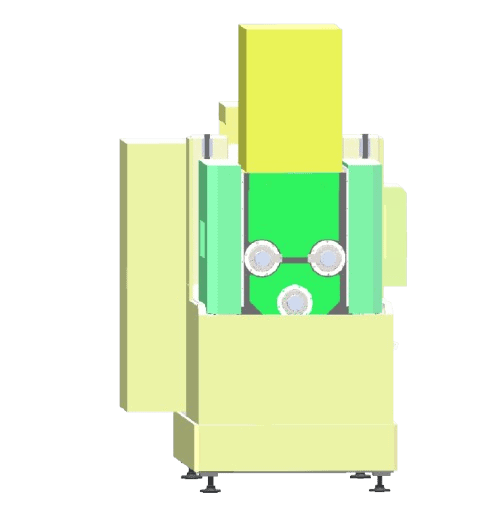
From hard-material block to slices ready for finishing
SOMIS-400 is intended for precision slicing and squaring within a 400 × 160 × 160 mm billet envelope. Start with a prepared workpiece and a defined mounting method. The saw separates the material; downstream grinding, lapping or polishing establishes the finished surface and final dimensions.
For thin parts, the finishing allowance must be included before setting the as-cut thickness. A listed 0.3 mm minimum does not establish finished-wafer thickness variation or edge quality. Review the subsequent operation in our double-sided lapping guide.
How does an oscillating multi wire saw change the cut?
The worktable moves the workpiece through a controlled small-angle reciprocating swing while feeding it into the running wire web. This changes the engagement across the cut, reducing the instantaneous contact area and distributing cutting load. The mechanism is intended to address difficult cutting behavior and edge chipping in hard, brittle materials.
Motion concept only: swing positions are exaggerated. This is not a machine-layout or wire-routing drawing.
The technical specification reports a cutting-efficiency improvement of more than 30% versus traditional equipment. Test conditions and the comparison baseline are not supplied, so this is a specification claim rather than a guaranteed production improvement. Compare accepted parts per shift on your own material.
Swing and feed are separate motions
The planned configuration combines inverted feed with swing. The technical document also allows downward or upward feed according to the order. Confirm the delivered feed direction and fixture arrangement; do not assume both configurations switch automatically on one machine.
Conventional feed remains possible
The documented swing function can be stopped when the process requires conventional feed. This gives a basis for comparing swing-on and swing-off trials without promising the same recipe for every material.
Silicon carbide, alumina and sapphire applications
The SOMIS-400 application plan prioritizes silicon carbide and alumina. Sapphire slicing and squaring are also within the technical specification. A material name alone is not enough to select the wire or cutting recipe: grade, geometry and acceptance requirements come first.
| Material | Selection question | Trial inspection |
|---|---|---|
| Siliziumkarbid (SiC) | Does the grade and workpiece section justify swing-assisted cutting? | Cutting stability, edge damage and finishing allowance |
| Tonerde | How will the ceramic block and thin slices be supported? | Edge condition and thickness consistency |
| Saphir | Is the job slicing or squaring, and what is the crystal orientation? | As-cut dimensions and downstream material removal |
A silicon carbide multi wire saw or ceramic multi wire saw must be assessed as part of the complete process. The 0.3–15 mm machine range does not mean every grade can be cut at every thickness with the same result. For a sapphire multi wire saw application, include the intended slice orientation in the enquiry.
Technical specifications
| Artikel | SOMIS-400 |
|---|---|
| Spindles / work stations | 3 spindles / 1 station |
| Maximum billet dimensions | 400 × 160 × 160 mm |
| Schnittdicke | 0.3–15 mm |
| Diamond wire diameter | 0.10–0.20 mm |
| Wire spool capacity | Up to 30,000 m |
| Reciprocating wire speed | Up to 1,400 m/min |
| Worktable lifting stroke | Up to 180 mm |
| Grooved roller material | High-molecular-weight polyethylene |
| Spindle structure | Clamping-type |
| Feed direction | Upward or downward; confirmed with order |
| Swing function | Small-angle reciprocating worktable swing |
| Overall dimensions | 2,450 × 2,000 × 2,000 mm |
| Maschinengewicht | Approx. 4,000 kg |
Final roller diameter, feed settings, reversal-frequency definition and electrical requirements are confirmed in the technical agreement. The listed thickness range is not a finished-part tolerance. No numerical thickness-tolerance or flatness guarantee is given here.
How are the wire motion and worktable coordinated?
Diamond wire travels from the pay-off spool through the three-spindle roller system and onto the take-up spool. The grooved rollers position the parallel cutting spans. Groove pitch establishes cut spacing, while measured kerf determines the material lost between adjacent slices.
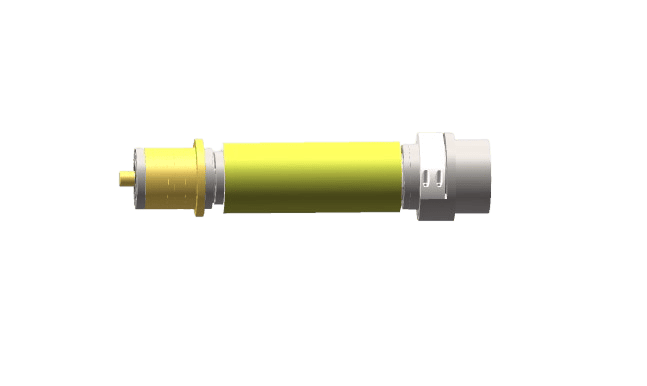
Three synchronized spindles
The clamping-type spindles use synchronized control to balance the drive load and maintain consistent wire speed. Oil-cooled bearing housings manage the operating environment of the roller bearings during high-speed running.
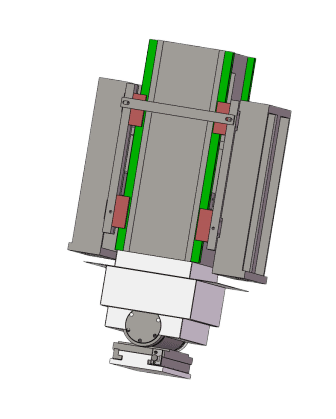
Guided feed and swing worktable
Rolling guides, ball screws and an integrated casting support worktable motion. The swing mechanism adds small-angle movement during cutting; the feed advances the mounted workpiece through the web.
Servo control and protection
An EtherCAT bus coordinates servo-driven spindle rotation, wire pay-off, take-up, traverse, tension and table feed. The controller monitors process data such as cutting tension and issues warnings or stops according to alarm severity. Documented wire-break protection stops the machine after a break to reduce the risk of further damage.
SOMIS-400 or SOMS3-430?
Both provide a swing-assisted route, but their listed thickness windows differ. A swing multi wire saw should be selected by the incoming section and required output, not by the word swing alone.
| Modell | Workpiece | Schnittbereich | Auswahlfokus |
|---|---|---|---|
| SOMIS-400 | 400 × 160 × 160 mm | 0.3–15 mm | Hard-material trials and a wider thickness window |
| SOMS3-430 | 430 × 160 × 150 mm | 0.5–3 mm | Repeat thin-slice production |
If the work only requires inverted feed and a 0.3–3 mm range, compare the SOMI-430 inverted multi wire saw. For larger cross-sections or different loading arrangements, use our complete SOM model guide.
The terms rocking multi wire saw and swing cutting describe oscillating motion, but do not specify its angle, frequency or feed configuration. Request those details for the proposed order. Our oscillating cutting guide provides further process background.
What should be confirmed before ordering?
Define an accepted slice
Send the material grade, incoming block dimensions, orientation, target as-cut thickness and finishing allowance. Agree the edge-damage and dimensional inspection method before trial cutting. Record wire condition, feed, swing settings and loading method with the result.
Compare the whole cycle
Measure accepted output after mounting, cutting, unloading and inspection. A faster cut with additional edge loss or finishing work may not improve the complete process.
Confirm the installation
Power supply, cooling, compressed air, foundation, lifting access, service space and safety requirements are confirmed with your order — please ask us. Main-body dimensions alone are not an installation plan.
Warranty and support
CE certified · 12-month warranty · Response within 12 hours · Free sample cutting.
Discuss your hard-material slicing application
Share the material, block dimensions and required slice quality so we can review the machine configuration and trial scope.
Request free sample cutting- Material grade and orientation
- Workpiece and fixture dimensions
- Slice thickness and finishing allowance
- Edge condition and accepted output target