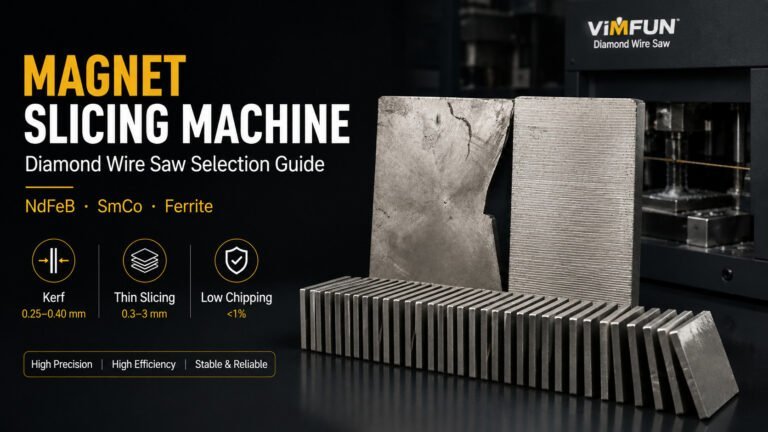
Pourquoi une rectifieuse d'aimants en tuile perd-elle sa précision si rapidement ? Depuis plus de 12 ans, je travaille dans l'industrie des équipements de rectification de surface d'aimants frittés et de finition d'aimants industriels. J'ai vu ce problème détruire d'excellentes lignes de fabrication.
Dans cet article, j'aborderai trois domaines de maintenance importants : la maintenance des roulements de broche, la maintenance des filtres de liquide de refroidissement et les inspections des brides de meule. Ces actions permettront à votre machine de fonctionner sans problème pendant des années.
Qu'est-ce qu'une rectifieuse d'aimants en tuile et pourquoi est-elle importante ?
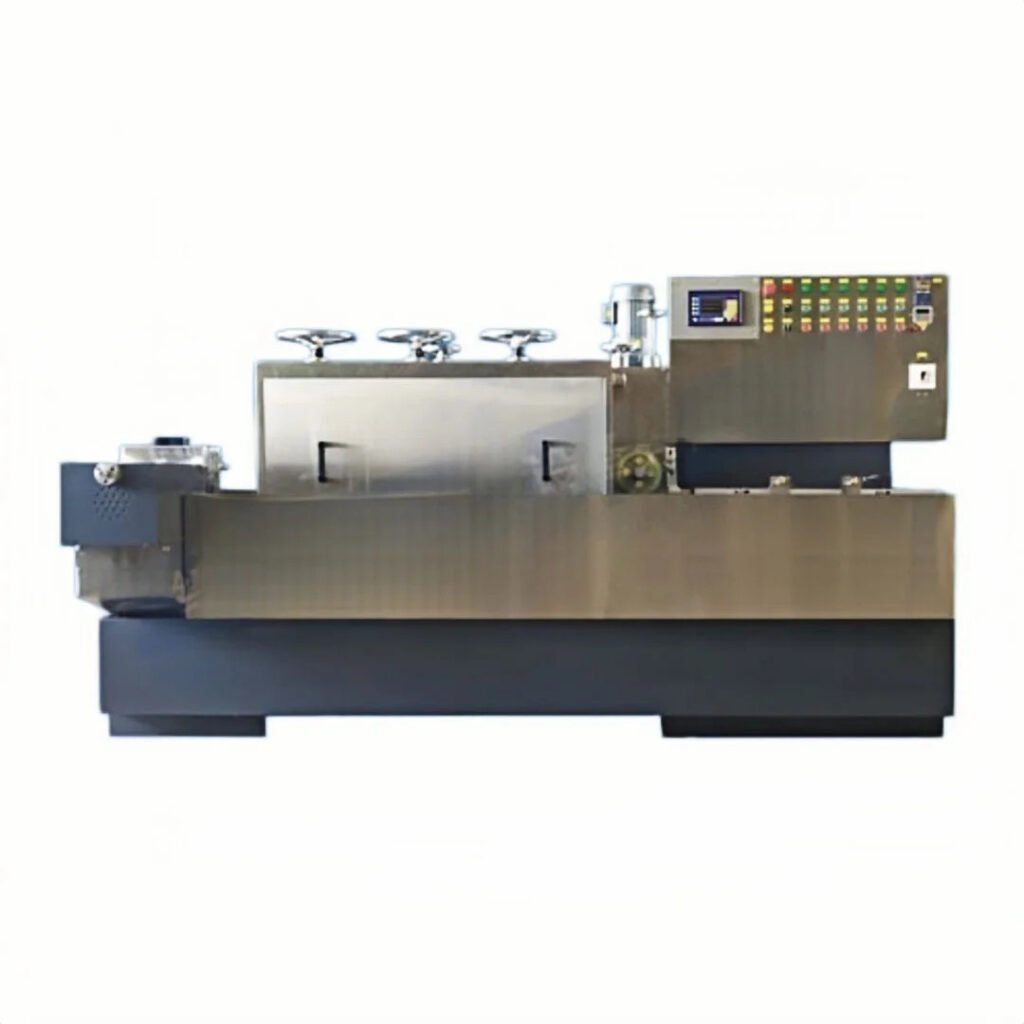
A Rectifieuse d'aimants en tuile Rectifie les aimants plats en forme de tuile à la bonne taille et au bon poli. Elle peut être utilisée pour les aimants en arc NdFeB et les blocs de ferrite. Meule, système de refroidissement, support magnétique. Ils maintiennent l'aimant stable pendant le processus de rectification d'aimants en forme de tuile. Cet équipement est essentiel pour la fabrication d'aimants de rotor de moteur.
Même de légers écarts de forme endommagent la sortie du moteur. Ces équipements sont présents dans les machines de traitement d'aimants de moteurs EV et les usines de rectification d'aimants de servomoteurs. S'ils ne sont pas manipulés avec soin, la finition se dégradera. Les temps de cycle augmentent. Les coûts de retravail augmentent.
| Composant | Fonction | Risques en cas de négligence |
| Roulement de broche | Fait tourner la meule | Vibrations, défauts de surface |
| Coolant Filter | Cleans the cutting fluid | Heat damage, clogged nozzles |
| Wheel Flange | Holds wheel to spindle | Imbalance, wheel breakage |
| Magnetic Chuck | Holds magnets during grind | Slippage, poor finish |
| Dresser Unit | Sharpens the wheel | Glazed wheel, slow cycle |
How Do Spindle Bearings Affect Grinding Precision in Magnet Machines?
The spindle bearing is the heart of any motorized magnet grinding device. The wheel starts wobbling as it becomes old. Even a few microns of runout may destroy the finish of Finition d'aimant en arc NdFeB parts. In a continuous grinding manufacturing line or pass-through grinding conveyor system, the bearings are under a tremendous strain all day.
You have to examine and grease them on a specific timetable. Don’t wait for anything to shatter. Catching wear early avoids expensive replacement of the spindle and extended periods of down time.
À quelle fréquence faut-il lubrifier les roulements de broche ?
- Lubrification des roulements 500-800 heures
- Systèmes de brouillard d'huile : Vérifier le niveau quotidiennement avant le démarrage
- Au-dessus de 3 000 tr/min pour les broches à haute vitesse : Utiliser uniquement de la graisse de précision
- Toujours retirer l'ancienne graisse avant d'appliquer de la graisse neuve. Ne pas trop remplir
Signes d'usure des roulements de broche
| Signe d'avertissement | Cause probable | Action nécessaire |
| Vibrations élevées pendant le meulage | Usure des roulements | Vérifier le faux rond, remplacer le roulement |
| Bruit inhabituel de la broche | Roulement sec ou sale | Relubrifier ou remplacer |
| Rugosité de surface croissante | Loss of spindle stiffness | Full spindle check |
| Heat near spindle housing | Too much grease or failure | Reduce lube, inspect bearing |
Step-by-Step Spindle Bearing Check
- Step 1: Shut Down and Lock Out
- Step 2: Dial indicator – goal less than 2 microns of run out
- Step 3: Spin by hand – listen for clicking or grinding
- Step 4: Run it for a few minutes and feel the housing for heat
- Step 5: Document outcomes and compare to your prior check
How Does a Dirty Coolant Filter Damage Your Magnet Grinding Output?
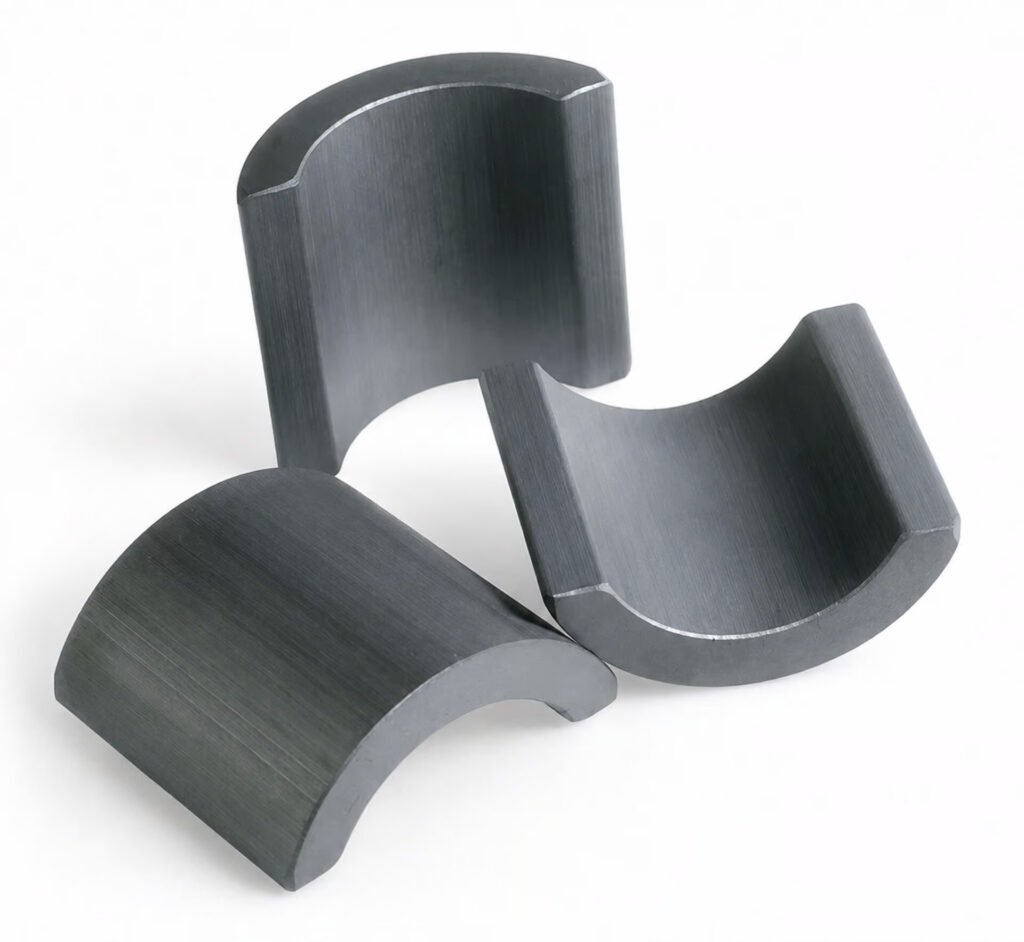
Coolant serves three objectives in high throughput magnet machining. It cools the part down. It washes away swarf. It lubricates the grinding zone. Dirty filter violates all three at once. As the flow diminishes, the heat increases up.
The heat generates micro-cracks in the surface grinding regions of the sintered magnet. Swarf in the tank scratches completed surfaces in a ferrite Rectifieuse d'aimants en tuile. Good parts turn to junk – quickly. Coolant filter maintenance is cheap, but highly effective.
Coolant System Maintenance Checklist
- Daily: Check nozzle flow for weak or irregular stream
- Weekly: Clean out filter mesh and eliminate swarf build up.
- Monthly: Empty, clean and replenish the entire coolant tank
- Quarterly: Check coolant mix with refractometer – aim 5–8%
Coolant Filter Types and Performance
| Filter Type | Mesh Size | Meilleur cas d'utilisation | Change Interval |
| Paper Band Filter | 25–50 micron | NdFeB fine grinding | Daily advance |
| Magnetic Separator | N/A | Ferrite and steel swarf | Weekly cleaning |
| Cartridge Filter | 10–25 micron | Arc tolerance precision grinding | Monthly |
| Centrifugal Cleaner | Variable | Multi-station grinding system | Quarterly flush |
What Happens If You Skip Coolant Filter Maintenance?
- Magnet surfaces scratched by swarf – parts fail testing
- Bacteria grows in the tank. Bad smell and danger of skin infection for workers
- Clogged nozzles produce hot areas – magnets break or lose their strength
- Pump and nozzle obstructions lead to increased downtime over time
Why Does Wheel Flange Condition Control Your Grinding Safety and Quality?
Wheel flange: Holds the grinding wheel to the spindle. The wheel is vibrating if it is worn or filthy. On rare occasions it breaks, at speed. This is a major safety issue for EV motor magnet processing equipment and servo motor magnet grinding lines.
An imbalanced wheel also produces chatter marks on the magnet faces. These do not meet the strict arc tolerance precision grinding standards required for motor usage. The flange inspection takes less than 10 minutes. It’s good for your people and your parts.
Wheel Flange Inspection and Mounting Steps
- Clean both sides of the flanges before each wheel change
- Look for cracks or chips – repair immediately if any are detected.
- Never use an impact tool on flange bolts Use a torque wrench
- Mount the wheel using a static balancer
- 3-minute no-load test – Listen for noise or vibration
Wheel Flange: Advantages and Disadvantages by Type
| Flange Type | Avantage | Désavantage | Idéal pour |
| Fixed Hub Flange | High rigidity, low runout | Slower wheel change | Precision arc magnet grinding |
| Quick-Release Flange | Fast wheel swap | Less rigid at high RPM | Multi-station grinding system |
| Blotter Flange | Absorbs vibration | Wears faster | Ferrite magnet rough grinding |
| ISO Standard Flange | Universal fit | May need adapter | General industrial magnet finishing |
The greatest accuracy of fixed hub flanges is beneficial for tight tolerance operations. Quick release type for high mix lines. Always fit the flange to the machine speed rating .
What Are Real-World Examples of Tile Magnet Grinding Machine Maintenance Saving Production?
And this isn’t simply a hypothesis. Real factories benefit greatly from taking care of their automated tile magnet grinding machine. Here are four actual field examples:
Case Study: Maintenance Impact on Magnet Grinding Lines
| Type d'usine | Problem Found | Maintenance Action | Résultat |
| EV Motor Plant | Rising surface roughness on NdFeB tiles | Spindle bearing replaced at 800 hrs | Ra dropped from 0.8 to 0.3 micron |
| Fabricant d'aimants en ferrite | Déchets importants dus au liquide de refroidissement sale | Rinçage hebdomadaire du filtre ajouté | Les déchets ont diminué de 34% en 60 jours |
| Fournisseur de servomoteurs | Marques de bavardage sur les aimants d'arc | Bride rééquilibrée mensuellement | Le rendement est passé de 88% à 97% |
| Ligne de rectification multi-stations | Arrêts imprévus fréquents | Journal de maintenance préventive ajouté | Le temps d'arrêt a chuté de 52% en un trimestre |
Les conclusions montrent une chose. La maintenance proactive l'emporte sur la réparation réactive. Peu importe si vous exploitez une petite machine de rectification d'aimants en ferrite ou un système complet de rectification multi-stations. Vérifiez tôt. Petite réparation. “ Ne tombez pas en panne durement.
FAQ sur la maintenance des rectifieuses d'aimants en carreaux
How Often Should I Replace the Spindle Bearing on a Tile Magnet Grinding Machine?
In industrial magnetic finishing machines, most of the spindle bearings have a service life of 8,000 to 12,000 hours. With the right lubrication and attention. Check them every 500 hours. Change when runout is more than your limit. Normally 2 to 5 microns. Early replacement is usually less costly than a mid-run failure.
- Check runout with dial indication every 500 Hrs
- Track each check – patterns suggest early wear
- Always specify the bearing grade for the manufacturer
What Coolant Mix Ratio Works Best for NdFeB Magnet Grinding?
Water soluble oil 5 to 7% mix for completing NdFeB arc magnets. Weekly refractometer check. Rusts too thin. If it becomes too thick, it froths. Change the complete tank every 4-6 weeks to avoid bacteria development.
- Use a pH-neutral or slightly alkaline coolant
- Never combine various kinds of coolants
- Full clean tank before each filling
How Do I Know If My Grinding Wheel Flange Needs Replacement?
Every time you change the wheel, check the flange face. Look for corrosion, pits or fractures. If the face is not flat, the wheel will not run true. It’s gonna rattle. Any crack implies replace immediately, do not run it.
- Check the flange flatness using a straight edge.
- Replace O-rings or gaskets if your flange utilizes them.
- Never re-use a flange that has been dropped or over-torqued
Can Poor Maintenance Cause Magnets to Lose Magnetic Strength?
Yes, the primary danger is heat. Partial demagnetization may occur if the coolant fails and the temperature of the NdFeB magnet exceeds 80°C. It can’t be undone. Stop this. Good coolant care, constant nozzle flow. Surface grinding of sintered magnet requires temp control as important as size control.
- Keep coolant flow at the level established by the manufacturer
- Check the magnet heat with a contact thermometer now and then
- If your coolant system is poor, reduce wheel speed
What Is the Right Way to Dress a Grinding Wheel on a Tile Magnet Grinding Machine?
Dress the wheel if the finish quality deteriorates or the cut rate decreases. Use diamond dresser at a depth of 0.01 to 0.02 mm /pass. Too deep opens the wheel up much too much. Too light and it glazes up too quickly. Record dress cycles to monitor wheel life.
- Dress between each batch of tight-spec components
- Regularly clean the dresser tip – a worn diamond delivers terrible results
- Keep depth the same each pass – use auto-dress if you have it
Conclusion
Daily Maintenance for your Tile Magnet Grinding Machine Verify the spindle. Wipe the coolant filter. check the flange of the wheel. Small inspections prevent large issues. They keep your components clean and your line moving. Vimfun produce amazing automated grinding machine magnet.
They provide multi-station grinding systems and continuous grinding production lines. Their equipment are good for processing the magnets of EV motors and making the magnets for motor rotors. Go to Vimfun now! Find the machine that suits your line.