Plan your magnet machining route with Vimfun. Explore diamond wire cutting, magnet slicing, and grinding equipment for turning brittle magnet blanks into parts ready for downstream finishing.
NdFeB and SmCo applicationsCutting and finishing equipmentMaterial-led equipment selection
Equipment Selection Starts with Your Magnet
When comparing China rare earth magnet equipment, start with the part you need to produce. A machine that accepts the workpiece is only the beginning. Slice thickness, edge condition, finishing allowance, fixture stability, and production rhythm determine whether the complete process fits your application.
Vimfun's magnet equipment portfolio brings together cutting and finishing options. This page introduces that portfolio and the information needed for a useful engineering discussion. For a detailed comparison of materials and process stages, use our permanent magnet cutting and machining guide.
Share a drawing or a representative sample alongside the material grade. This connects the equipment discussion to dimensions that can be measured, surfaces that can be inspected, and production conditions that can be reproduced.
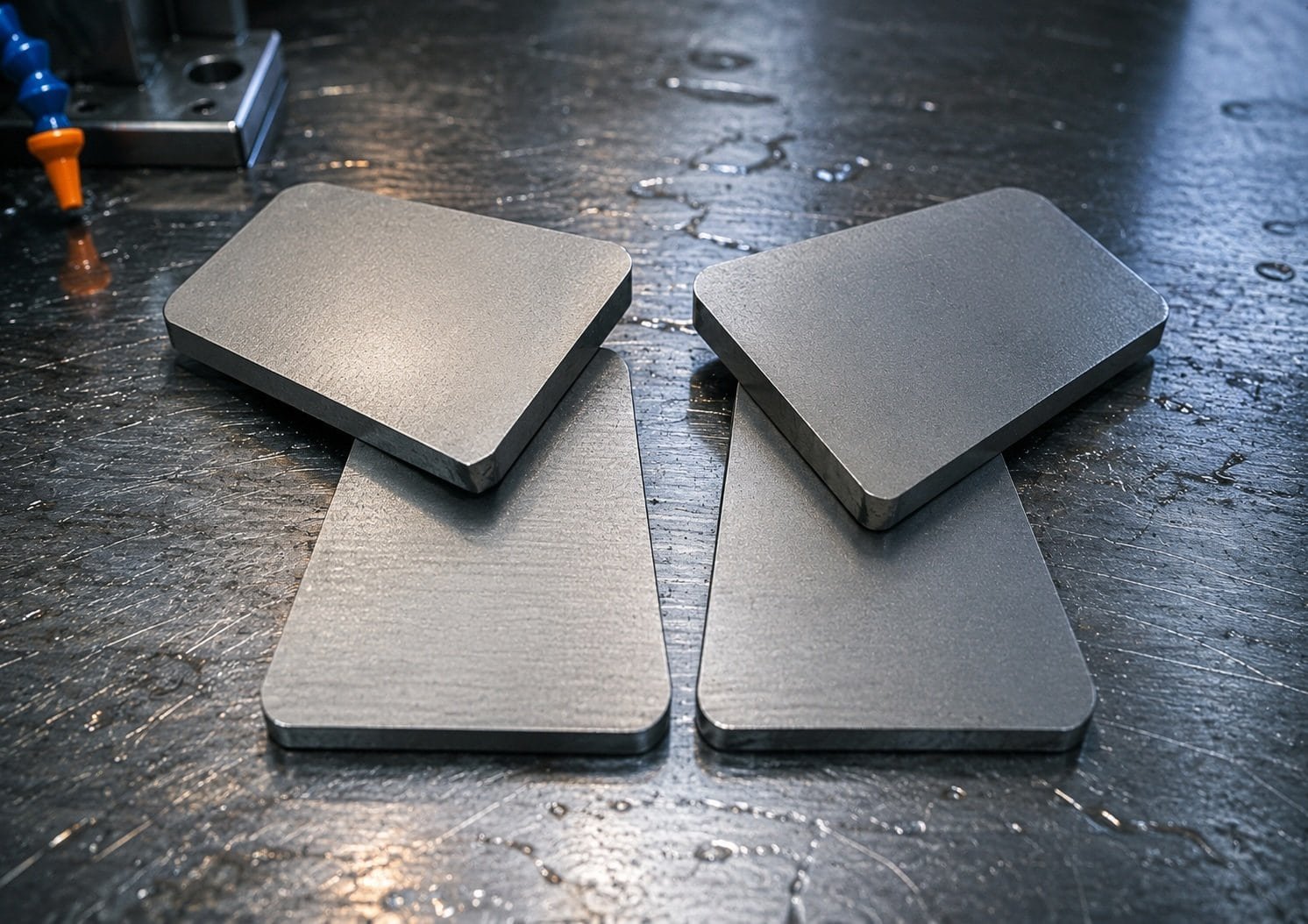
Magnet slices: surface condition, edge integrity, and remaining machining allowance all matter.
From Cutting to Controlled Finishing
Magnet manufacturing equipment from China should be evaluated as a process route, not simply as a list of machines. Cutting creates the initial geometry. Grinding and lapping address the dimensions and surfaces required by the final drawing. Each stage needs an agreed input condition and a measurable output requirement.
Diamond Wire Cutting
For block preparation and application-specific cuts, review cutting travel, workholding, and the material's response to the wire. Sample testing helps establish whether the proposed setup suits the blank and its required geometry.
Repeated slices require attention to loading, slice spacing, and batch consistency. Compare a single-wire operation with a multi-wire production setup using the same part drawing and realistic loading assumptions.
Plan the finishing allowance before selecting the cutting process. Flat parts and curved magnet profiles need different fixtures and equipment. Define thickness, flatness, and edge requirements separately.
VMG-290 arc grinding equipment for curved magnet profiles.
Match the Machine to the Surface
A flat slice and an arc-shaped motor magnet do not have the same finishing requirements. Identify which surfaces locate the part during assembly, which faces need a controlled finish, and where chipping is unacceptable.
This helps distinguish a slicing requirement from a profile-grinding requirement. It also prevents an equipment comparison from overlooking the workholding and handling needed between operations.
For several connected operations, see the magnet production-line equipment overview. Use it to prepare a process discussion rather than assuming every machine belongs in every line.
Define the Material Before the Machine
Rare earth magnet materials require careful handling during machining. NdFeB and SmCo are distinct material families; a setting established for one should not be presented as a validated setting for the other. Ferrite is another permanent magnet material, but it is not a rare earth magnet.
Material
Information to provide
What to inspect in a trial
NdFeB
Grade, blank dimensions, orientation, and whether the blank is magnetized.
Edge condition, slice consistency, surface condition, and finishing allowance.
SmCo
Grade, part geometry, handling restrictions, and allowable edge defects.
Cracking, corner damage, workholding stability, and repeatability.
Ferrite
Blank shape, target profile, batch size, and downstream operations.
Chipping, profile accuracy, tool wear, and handling between operations.
Include both the incoming blank drawing and the finished part drawing where possible. A single final thickness value does not describe the entire process: there may be allowances for grinding, lapping, or other downstream operations. Keeping these stages explicit makes supplier proposals easier to compare.
See NdFeB Cutting in Operation
This Vimfun video demonstrates NdFeB magnet cutting with an SG20-R diamond wire saw. It shows a single-wire operation, not a multi-wire production line. Use it to understand the type of cutting process, then discuss a trial that matches your own material and part.
Visible cutting footage is useful, but it does not establish a guaranteed tolerance, cycle time, or yield for a different workpiece. Those results should come from a documented test with agreed inspection methods.
A Practical Sample-Cutting Review
A representative trial gives engineering and purchasing teams a common basis for evaluation. Agree what the trial needs to demonstrate before material is shipped or machine settings are selected. A successful visual demonstration and an accepted production process are different milestones.
01 / DEFINE
Agree the Part and Criteria
Provide the material grade, incoming dimensions, target drawing, and priority measurements. Identify critical edges and surfaces, and explain whether the result will be inspected immediately after cutting or after finishing.
02 / PREPARE
Confirm the Test Setup
Discuss fixture contact, blank orientation, wire selection, and the scope of the test. Confirm the sample quantity and shipping arrangements with the engineering team before sending material.
03 / MEASURE
Review More Than Appearance
Inspect dimensional variation and edge condition alongside the cut face. Record the measurement method and the number of parts checked so that a later trial can be compared on the same basis.
04 / SCALE
Translate the Trial into a Route
Separate cutting time from loading, unloading, cleaning, and inspection. Review what changes when moving from a sample to a repeated batch, including fixtures, consumables, and operator handling.
What to Confirm Before Ordering
For overseas sourcing, a clear technical agreement is as valuable as a machine specification. Keep the machine configuration, acceptance procedure, documentation, and service terms together in the proposal review. This reduces ambiguity between purchasing expectations and the equipment delivered.
Review area
Confirm in the proposal
Configuration
Machine model, work envelope, fixtures, included accessories, and utility requirements.
Acceptance
Test material, drawing revision, inspection method, and agreed acceptance criteria.
Documentation
Manuals, electrical information, maintenance instructions, and model-specific compliance documents applicable to the destination.
Delivery
Packing scope, shipping responsibilities, installation arrangements, and commissioning scope.
Service
Warranty period and coverage, exclusions, spare parts, training, and the agreed support channel.
Request supporting documents for the exact model and configuration being considered. A logo, a general company statement, or a document covering a different product does not establish the requirements for your order. Warranty and service commitments should be confirmed in writing as part of the commercial agreement.
For the first engineering discussion, prepare your material, block dimensions, finished drawing, expected batch size, and monthly output. Add photographs of the current blank and describe the issue you want to resolve: breakage, material loss, inconsistent thickness, or a bottleneck between operations.
Common Sourcing Questions
Can I select a machine using only the magnet material?
Material is the starting point. Geometry, incoming dimensions, final tolerances, and production volume are also needed. Provide a drawing so that cutting and finishing requirements can be discussed together.
Does the demonstration represent every magnet cutting process?
No. The video shows the SG20-R working on NdFeB. Other materials, multi-wire slicing, and arc grinding involve different equipment or setups. Request an evaluation relevant to your actual part.
How should I compare equipment quotations?
Use the same drawing, material specification, and acceptance criteria for each proposal. Compare included fixtures, consumables, utilities, documentation, and service scope alongside the machine price.
Where can I explore the complete machining route?
Visit the permanent magnet equipment guide for the relationship between slicing, grinding, lapping, and production-line planning.