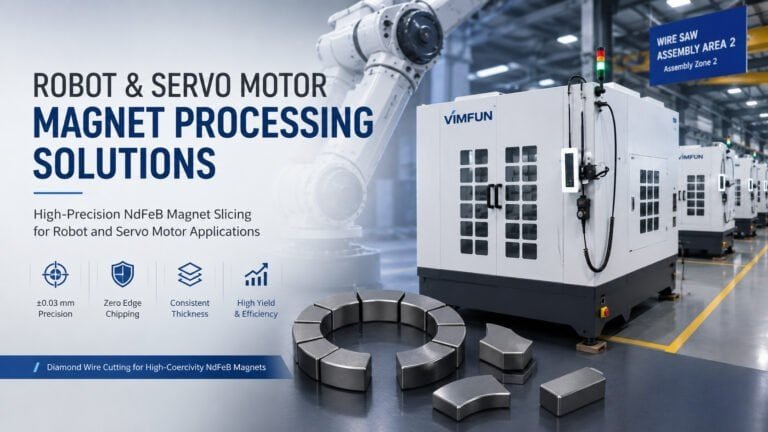
Servo motor performance is decided before the motor is assembled. The magnetic field uniformity that determines torque ripple, positioning accuracy, and speed stability comes directly from how consistently the NdFeB magnets inside were cut and finished. A 0.05 mm thickness variation across a batch of arc-segment magnets shows up as measurable torque variation at the shaft — something no tuning parameter can correct after the fact.
This page covers the magnet processing requirements specific to robot and servo motor applications, and how diamond wire cutting addresses the precision and consistency demands of small, high-coercivity NdFeB components.
Robot and Servo Motor Magnet Requirements
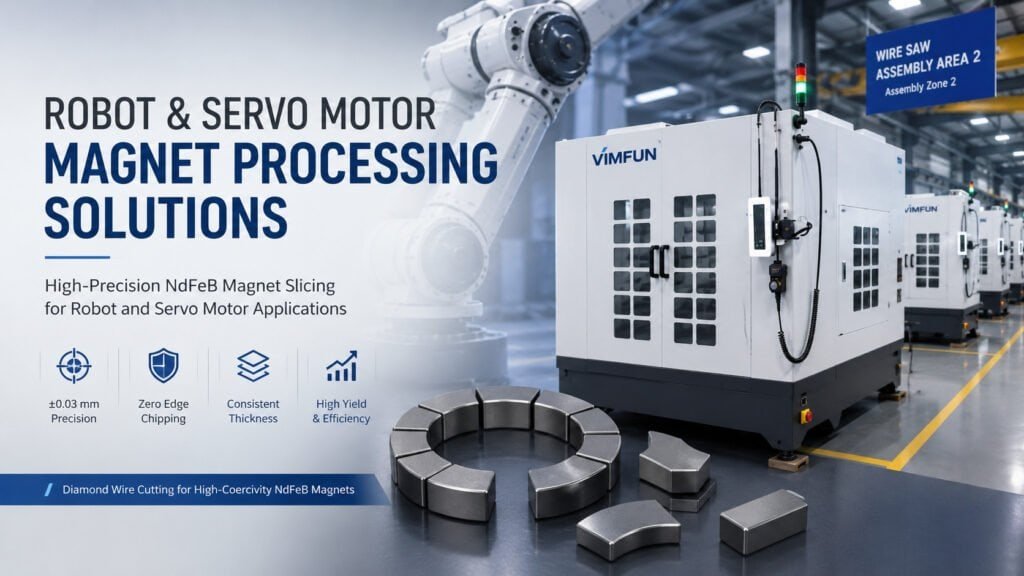
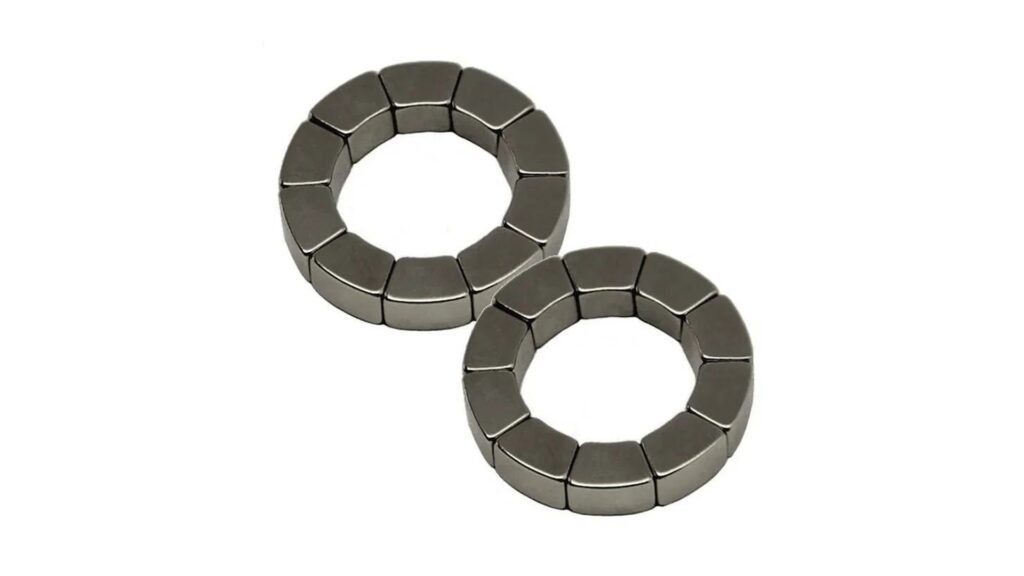
Servo motors for robotics use arc-segment NdFeB magnets, typically 5–40 mm in arc length with wall thickness in the 2–6 mm range. The dimensional requirements are tighter than general industrial motor applications:
| Parameter | Typical Requirement | Why It Matters |
|---|---|---|
| Thickness tolerance | ±0.03–0.05 mm | Consistent air gap → uniform flux density |
| Arc surface flatness | ≤ 0.02 mm | Even contact with rotor/stator surface |
| Surface roughness | Ra ≤ 0.8 µm | Assembly fit and adhesive bonding quality |
| Edge chipping | Zero tolerance | Chipped edges cause field distortion and assembly rejection |
The challenge with small arc-segment magnets is that their geometry concentrates cutting stress at the edges. NdFeB is brittle — the same high coercivity that makes it perform well in servo motors also makes it prone to chipping under the wrong cutting conditions. Conventional band saw or inner-diameter saw cutting introduces enough vibration and cutting force to damage edges at this scale.
For a closer look at why NdFeB material properties drive equipment selection, see our overview of NdFeB cutting machine capabilities.
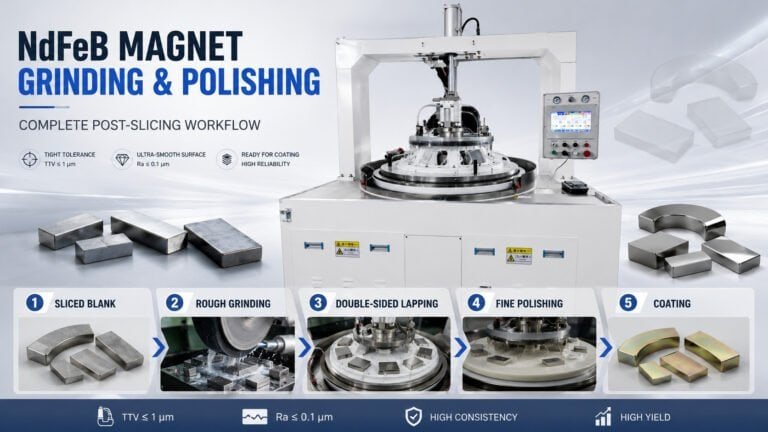
Small-Size High-Precision NdFeB Slicing
Diamond wire cutting is the standard approach for servo motor magnet blanks because it combines the low cutting force needed to protect small geometries with the dimensional consistency required for batch production.
The key parameters for NdFeB arc-segment slicing:
| Parameter | Typical Range | Notes |
|---|---|---|
| Wire diameter | 0.35–0.5 mm | Smaller wire → narrower kerf, less material loss |
| Wire speed | 30–60 m/s | Higher speed for coarser grades, lower for high-coercivity |
| Feed rate | 1.5–3 mm/min | Conservative to prevent edge micro-cracking |
| Coolant | Water-based coolant | Controls heat and contains magnetic swarf |
| Cutting precision | ±0.03 mm | Consistent across full production run |
| Surface roughness | Ra 0.3–0.5 µm | Ready for lapping or direct bonding |
Parameters based on equipment specifications for NdFeB magnetic material processing.
Three factors make diamond wire cutting the right fit for servo motor magnets specifically:
Consistent kerf. At 0.35–0.5 mm wire diameter, material loss per cut is predictable and stays constant across the production run. This matters when you’re slicing high-coercivity NdFeB blocks — material cost is not trivial and yield per block directly affects unit economics.
Low cutting force. The wire applies distributed abrasive force rather than the concentrated mechanical impact of a saw blade. For small arc-segment geometries where the edge-to-volume ratio is high, this difference determines whether parts come off the machine clean or with micro-chips that cause downstream rejection.
No drift under batch conditions. Unlike blade-based cutting where tool wear changes cutting geometry, diamond wire wear shows up as reduced cutting speed rather than dimensional drift. A fresh wire and a worn wire produce the same part size — only the cycle time differs. This is critical in servo motor production where a batch of 500 magnets must be dimensionally consistent enough to be interchangeable across motor assemblies.
Equipment for Servo Motor Magnet Production
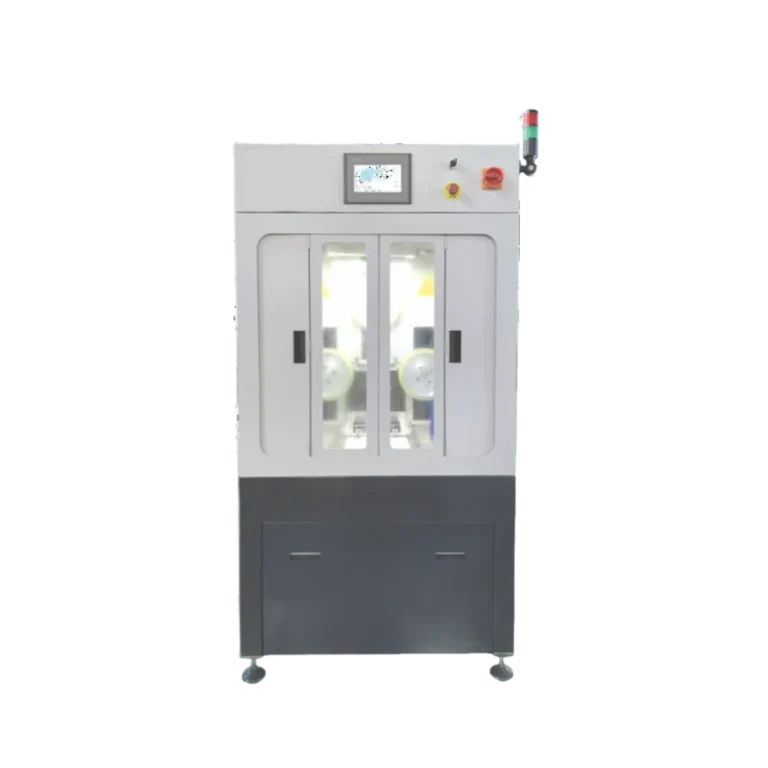
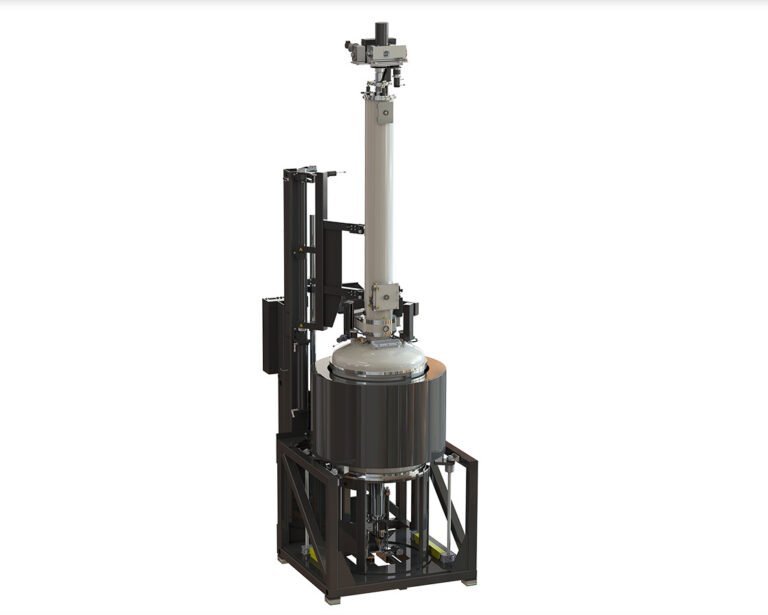
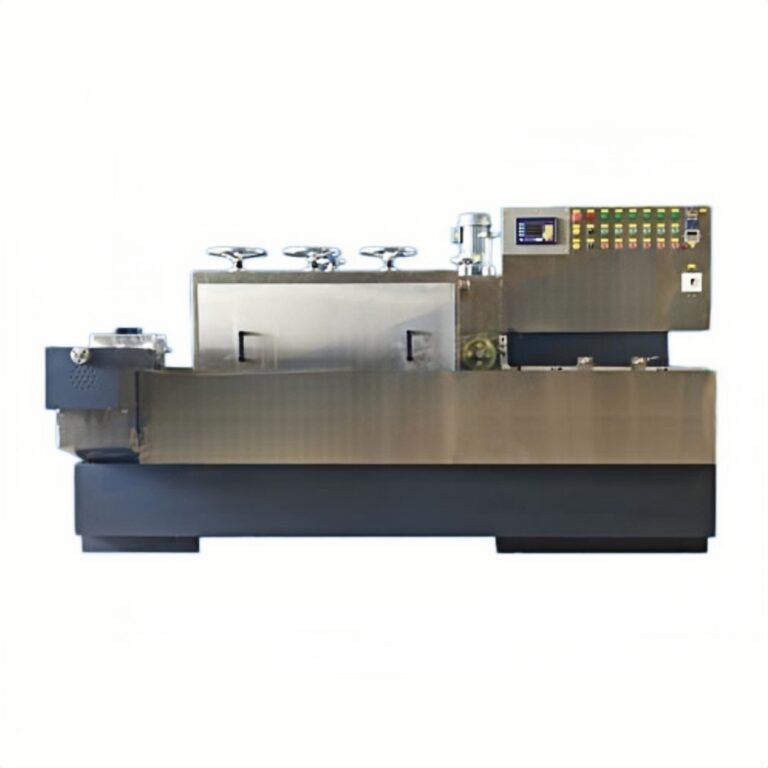
Servo motor magnet processing typically runs on single-wire slicing machines configured for small NdFeB geometries. The requirements that differ from general magnet cutting:
Fixture design for small parts. Arc-segment magnets need fixtures that hold geometry precisely without applying clamping force that could crack the part. Wax bonding or vacuum fixturing is standard.
Coolant containment. NdFeB swarf is magnetic and fine-grained. Water-based coolant must be circulated with magnetic separation to prevent particle buildup in the machine and on cut surfaces.
Automatic feed adjustment. Servo motor production runs require consistent cycle time across large batches. Feed rate auto-adjustment maintains throughput as the wire wears without operator intervention between parts.
For high-volume servo motor magnet production, see how our EV motor magnet manufacturing equipment scales to handle the output volumes that electric drive and robotics applications demand.
High-coercivity grades (H, SH, UH series) used in compact servo motors require additional care — lower feed rates and tighter coolant flow control to prevent thermal stress at the cut surface. See our guide on cutting high coercivity magnets for grade-specific parameters.
Humanoid Robots and Scaling Demand
Humanoid robot development is creating a new demand profile for servo motor magnets that didn’t exist at scale five years ago. A single humanoid robot platform contains 40–50 servo motors across its joints. Each motor uses multiple arc-segment magnets. At production volumes of even 10,000 units per year, that translates to 2–4 million individual magnet pieces requiring consistent processing.
The implications for magnet processing:
- Tolerance stacking is real. In a humanoid robot joint, position accuracy depends on the cumulative tolerance of motor, encoder, reducer, and magnet. A 0.03 mm variation in magnet thickness that might be acceptable in an industrial arm becomes a measurable positioning error in a dexterous hand.
- Grade diversity is increasing. Different joints have different temperature and coercivity requirements. A hip actuator and a finger motor may require different NdFeB grades — H versus SH, or different geometry families — on the same production line. Equipment flexibility matters.
- Volume is growing faster than expected. Robot OEMs are securing magnet supply contracts with 3–5 year horizons. Magnet processors who can demonstrate consistent dimensional output at scale are gaining preferred supplier status early.
Diamond wire cutting scales to these requirements more directly than alternative processes. The same equipment configuration that cuts R&D prototype quantities of 50 magnets can be replicated for production volumes without process re-validation.
Request Servo Magnet Consultation
If you are processing NdFeB arc-segment or block magnets for servo motor or robotics applications — or scaling capacity to meet robot production demand — send us your target geometry, grade, tolerance, and volume. We will return a configured equipment proposal and yield projection within 3 business days.