
Vimfun SOMI-430 · Two-axis inverted cutting
Inverted Multi Wire Saw SOMI-430
An inverted multi wire saw for thin slices of silicon, sapphire, ceramics, optical glass and silicon carbide. The workpiece feeds upward into the wire web.
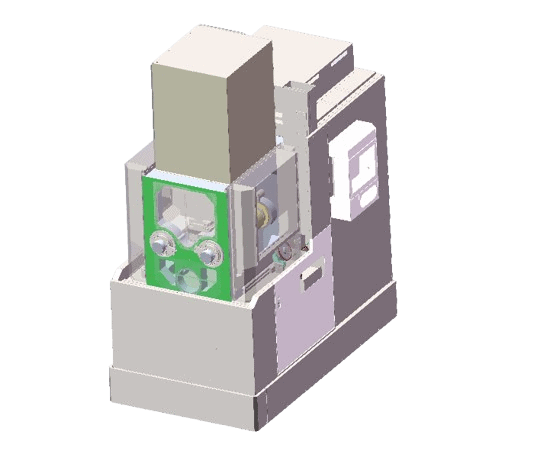
Where does SOMI-430 fit in your process?
SOMI-430 accepts a prepared hard and brittle workpiece within a listed 430 × 160 × 150 mm envelope. It divides the material into parallel slices before subsequent grinding, lapping or polishing. Define the as-cut thickness together with the allowance needed for those later operations.
The 0.3–3 mm range describes slice thickness, not flatness, total thickness variation or finished-wafer quality. Those acceptance requirements need to be agreed and checked on the actual material. For downstream equipment, see our double-sided lapping machine guide.
How does an inverted multi wire saw feed the workpiece?
In inverted cutting, the workpiece approaches the running wire web from below. In standard downward-feed cutting, it approaches from above. The distinction is the workpiece feed direction; both arrangements can use wire that reverses direction during the cutting cycle.
Feed-direction illustration only. Wire routing, fixturing and machine clearances are schematic, not to scale.
Diamond wire passes from the pay-off spool through the grooved-roller system and onto the take-up spool. The parallel wire spans cut the workpiece as the table advances. Roller groove pitch establishes the spacing between cuts; actual kerf removes material from that spacing. Measure kerf on a trial cut rather than equating it with nominal wire diameter.
Specify the mounting arrangement
Review how the workpiece is supported during upward feed and how the resulting slices will be handled. Include bonding or fixture dimensions in the usable-capacity check.
Verify the thin-slice result
Feed direction alone does not establish a yield or edge-chipping improvement. The supplied material, wire, feed recipe and holding method must be evaluated together before accepting a production process.
Which workpieces are within the intended application range?
The technical presentation identifies photovoltaic, semiconductor, optical and electronic-ceramic slicing. Material suitability still depends on the grade, geometry and acceptance criteria.
| 재료 | What to specify before a trial |
|---|---|
| 실리콘 | Ingot dimensions, orientation and downstream finishing allowance |
| 사파이어 | Crystal orientation, workpiece section and edge-quality requirement |
| Silicon carbide | Material grade, target slice thickness and surface acceptance |
| 세라믹 | Composition, incoming condition and support during slicing |
| Optical glass | Glass type, dimensions and permitted edge damage |
The minimum listed thickness is not a promise for every material in this table. Request sample cutting when thin sections, expensive material or limited finishing allowance make the result especially sensitive.
Technical specifications
| 항목 | SOMI-430 |
|---|---|
| 절단 방법 | Inverted feed; reciprocating wire |
| Maximum workpiece dimensions | 430 × 160 × 150 mm |
| 슬라이스 두께 | 3–3 mm |
| Spindles | 2 axes |
| Grooved roller material | Polyurethane |
| Roller diameter | 140–160 mm |
| 와이어 직경 | 0.13–0.25 mm |
| Wire spool capacity | Up to 30,000 m |
| Reciprocating wire speed | Up to 1,200 m/min |
| Direction reversals | Up to 10 per minute |
| Worktable lift stroke | Up to 180 mm |
| Traverse stroke | 80 mm |
| Main-unit power (listed) | 20 kW |
| 전체 치수 | 2,450 × 2,000 × 2,000 mm |
| 기계 중량 | 3,000 kg |
These are listed equipment specifications, not the recommended settings for every cut. Cutting-feed settings and electrical load calculations are confirmed in the technical agreement. No numerical thickness-tolerance claim is supplied for this model.
What controls the wire web and cutting motion?
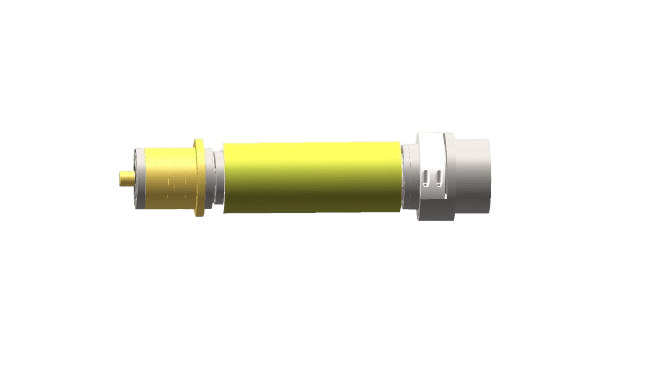
Clamped spindle and roller support
The specification describes clamped spindles with synchronized control. The roller bearings use an oil-cooled bushing arrangement to manage their operating conditions during high-speed running. Roller condition and groove selection remain part of the cutting setup.
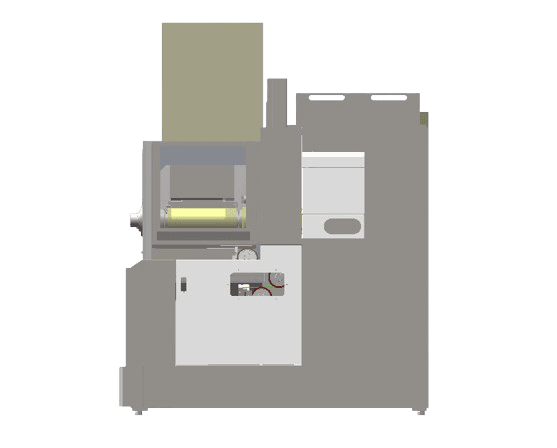
Servo-driven feed and wire handling
Spindle rotation, wire pay-off, take-up, traverse, tension and worktable feed use servo drives and an EtherCAT control system. The axes perform different tasks: moving wire, laying it onto the spool, controlling tension and advancing the workpiece.
Process monitoring and wire-break protection
Process data such as cutting tension are monitored during operation. Depending on alarm severity, the controller warns or stops the machine; operation can resume after user confirmation. The documented wire-break protection stops the machine when a break is detected. This protective function does not replace correct setup and inspection.
SOMI-430 or SOMI2-600S?
Start with workpiece length, then review the required process window. Both are inverted-cutting models with a listed 0.3–3 mm slice range. The larger model accommodates a longer workpiece and has a higher maximum wire speed; that does not automatically mean a shorter accepted-part cycle for your material.
| 모델 | Workpiece capacity | Maximum wire speed |
|---|---|---|
| SOMI-430 | 430 × 160 × 150 mm | 1,200 m/min |
| SOMI2-600S | 660 × 160 × 150 mm | 2,200 m/min |
For workpieces up to 430 mm long, assess SOMI-430 first. When the same width and height must accommodate a longer charge, compare SOMI2-600S. For small laboratory batches within 200 × 200 × 200 mm, consider SOM200. For swing-assisted cutting of SiC, alumina or sapphire, compare the SOMIS-400 oscillating multi wire saw. If you need a different loading arrangement, use the complete multi wire saw model guide.
When a specification uses the term reverse cutting wire saw, confirm whether it describes upward workpiece feed or simply reciprocating wire travel. On SOMI-430, inverted cutting refers to upward workpiece feed.
Utilities, installation and sample cutting
Power supply, coolant, compressed air, foundation, lifting access, service space and site safety requirements are confirmed with your order — please ask us. Overall machine dimensions alone do not define the complete installation area.
For a useful trial, provide the material grade, incoming dimensions, finished-part drawing, target as-cut thickness and finishing allowance. Agree the inspection method and acceptance criteria before comparing results. Include loading, unloading and changeover when estimating production capacity.
Warranty and after-sales support
CE certified · 12-month warranty · Response within 12 hours · Free sample cutting.
Send your material and target slice thickness
Share the workpiece dimensions and required result so we can review the inverted cutting multi wire saw configuration with you.
무료 샘플 절단 요청Include with your enquiry
- Material grade and incoming condition
- Workpiece and fixture dimensions
- Target thickness and finishing allowance
- Batch size and inspection requirements