
Sapphire processing guide
Sapphire Cutting Methods: Endless, Multi-Wire and Single-Wire Saws Explained
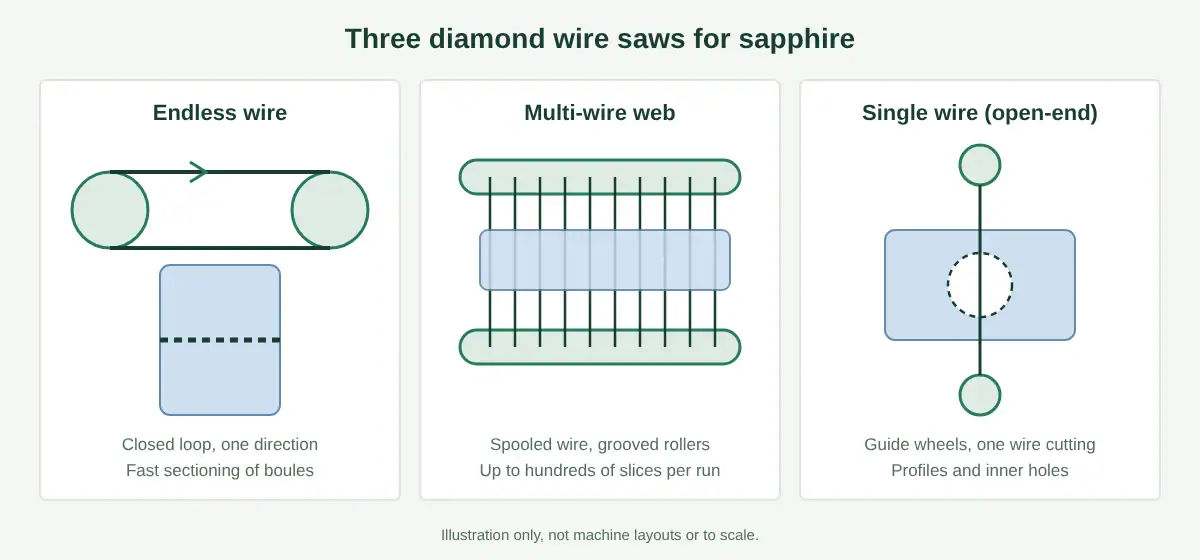
Sapphire cutting methods in industry rely on diamond wire, because few other tools can cut a crystal this hard at boule scale. Three wire saw designs cover almost all sapphire cutting methods used in production. An endless diamond wire saw is the fast choice for sectioning a boule. A multi-wire saw makes the most slices per run, so it handles wafers and thin plates. A single-wire saw is slower, but it leaves a narrow kerf and can follow profiles and inner holes.
This guide explains how the three sapphire cutting methods work, where each one fits in a sapphire process, and how to match the machine to your parts.
Why Sapphire Is Difficult to Cut
Sapphire is single-crystal aluminium oxide. It rates 9 on the Mohs scale, just below diamond, so only diamond abrasive cuts it at a practical rate. It is also brittle. A cut that loads the crystal unevenly can chip an edge or leave microcracks, and that damage has to be removed later by grinding and polishing.
Sapphire is anisotropic: its properties change with crystal direction. That is why substrates and optical windows are cut to a specified crystal plane rather than at an arbitrary angle, and why the boule is usually oriented before the first cut.
Industrial sapphire starts as a large boule grown in a furnace, for example by the Kyropoulos method described in our article on the Kyropoulos sapphire crystal growth furnace. A boule is far too large to slice in one step. Most sapphire cutting methods are therefore used in sequence: first section the boule into blocks, then slice the blocks, then cut any special shapes. Each step has different priorities, and that is where the three wire saws come in.
Sapphire Cutting Methods Compared at a Glance
All three sapphire cutting methods below cut with diamond-coated wire. A wire saw is simply a machine that cuts with a moving wire instead of a blade. The differences lie in how the wire is supplied, how it is routed, and how many lengths of wire cut at the same time.
| Endless diamond wire saw | Multi-wire saw | Single-wire saw (open-end) | |
|---|---|---|---|
| Wire | Closed diamond wire loop | Spooled diamond wire, thousands of metres | Spooled diamond wire |
| Wire path | Runs continuously in one direction around wheels | Wound around long grooved rollers into a parallel wire web; reciprocates | Runs over guide wheels; reciprocates; one wire in the cut |
| Cuts per run | 1 | Up to hundreds | 1 |
| Time for one cut through a 200 mm sapphire boule | About 3–4 hours | Spooled wire: about 15–20 hours | Spooled wire: about 15–20 hours |
| Kerf on sapphire | About 0.6 mm | About 0.2 mm | About 0.2 mm |
| Output per run | Low | Very high | Low |
| Typical sapphire job | Sectioning boules, cropping, cutting blocks | Slicing wafers and thin plates | Profiles, inner holes, lab samples |
Typical values from Vimfun sapphire cutting; actual time and kerf depend on wire diameter, feed rate and workpiece size.
Choosing between these sapphire cutting methods comes down to three trade-offs: speed per cut, output per run, and material lost in the kerf. No single machine wins on all three, which is why many sapphire plants run more than one.
Diamond blades, inner-diameter saws and lasers can also cut sapphire, mainly for small parts or for dicing finished wafers. For boules and large blocks, the blade diameter limits how deep a blade can cut, while a diamond wire can pass through a large section with a narrow kerf. That is why wire is the usual tool for the steps described below.
Endless Diamond Wire Sawing: Fast Sectioning of Sapphire Boules
An endless diamond wire saw uses a closed loop of diamond wire running around two or more wheels. The loop moves continuously in one direction, so the machine never has to stop and reverse the wire. Continuous one-way motion keeps the wire speed high and the cut steady.
That is the main reason it is the fastest of the sapphire cutting methods for single cuts. In Vimfun sapphire cutting, one cut through a 200 mm diameter sapphire boule typically takes about 3–4 hours with endless wire, compared with about 15–20 hours with spooled wire.
Typical jobs on sapphire include:
- cutting a boule in half;
- removing the seed and tail ends;
- squaring a round boule into blocks for later slicing;
- cutting thick blocks for windows and optical parts.
The cost is kerf, the main trade-off between sapphire cutting methods. On sapphire the endless wire kerf is about 0.6 mm, against about 0.2 mm for spooled wire. For one sectioning cut through a boule, that loss is small. For slicing many thin wafers it would waste too much material, and the machine makes only one cut at a time in any case.
The loop machines themselves are covered on our sister site under endless diamond wire saw, and the wire is described in endless diamond wire for sapphire.
Multi-Wire Sawing: Hundreds of Sapphire Wafers in One Run
A multi-wire saw does not use a loop. Thousands of metres of diamond wire are fed from a supply spool, wound many times around long grooved rollers, and taken up on a second spool. Each groove holds one turn of wire, so the rollers carry a web of parallel wires. The wire runs back and forth while the sapphire block is fed slowly through the web, and every wire in the web cuts at the same time.
Each cut is slow, because spooled wire cuts far more slowly than a loop. But up to hundreds of cuts are made in one run, so output per run is the highest of all sapphire cutting methods. This is the standard route for slicing sapphire wafers for LED substrates and for thin optical plates.
Kerf matters more here than in the other sapphire cutting methods. At about 0.2 mm per cut on sapphire, spooled wire removes far less material than a loop wire, and the saving is repeated for every slice in the block. Lower kerf loss means more usable wafers from each boule.
Oscillating multi-wire machines are designed for very hard materials such as silicon carbide and sapphire. The Vimfun oscillating multi wire saw SOMIS-400 uses 0.10–0.20 mm diamond wire, holds up to 30,000 m of wire on the spool, and slices plates from 0.3–15 mm thick. Our multi wire saw overview compares the other SOM models.
The limit is geometry: a multi-wire saw only produces flat, parallel slices. It cannot cut contours or inner holes.
How the Wire Web Sets Wafer Thickness
Slice thickness is set by the groove pitch on the rollers, not by a program. The pitch is the distance between two neighbouring wires. Each wire removes one kerf width, and what remains between two cuts is the slice. In simple terms, slice thickness equals groove pitch minus kerf. To change the thickness you change the roller grooving. To get more slices from the same block, you reduce either the kerf or the slice thickness.
Single-Wire (Open-End) Sawing: Low Kerf, Profiles and Inner Holes
A single-wire saw also uses spooled wire, but the wire runs over guide wheels instead of long rollers. Only one length of wire is in the cut. The wire runs back and forth between two spools while the CNC moves the workpiece along a programmed path.
Compared with the other sapphire cutting methods, this design has three advantages:
- Narrow kerf. The kerf is about 0.2 mm, the same narrow cut as multi-wire sawing, which matters when the material is expensive.
- Profiles. Because only one wire cuts, the path does not have to be straight. The machine can follow curves and contours.
- Inner holes. The wire is open-ended, not a closed loop, so it can be threaded through a start hole in the part and then cut an inner hole or an enclosed internal shape. An endless loop cannot do this.
Typical sapphire parts include shaped windows, parts with holes or slots, irregular blanks, and research samples where every millimetre of crystal counts.
The limit is speed. Spooled wire takes about 15–20 hours for the same 200 mm sapphire cut that endless wire makes in about 3–4 hours, and a single-wire saw makes one cut at a time. Among sapphire cutting methods, it is the one to choose for geometry, not volume. The Vimfun SVO-40 precision diamond wire saw takes workpieces up to 400 × 400 × 300 mm.
Where Each Saw Fits in a Sapphire Production Line
- Crystal growth: the furnace produces a large sapphire boule.
- Sectioning: an endless wire saw crops the ends and cuts the boule into blocks.
- Slicing: a multi-wire saw turns each block into wafers or thin plates.
- Shaping: a single-wire saw cuts profiles, inner holes and samples.
- Finishing: wafers and parts go on to grinding and lapping, then polishing.
A high-volume substrate plant usually runs these sapphire cutting methods side by side, one per step. A laboratory or a small optics workshop may need only one of these sapphire cutting methods: a single-wire saw, or a compact multi-wire saw for small batches. For the full substrate workflow, see our guide to sapphire slicing.
How to Choose a Wire Saw for Your Sapphire Parts
Four questions usually settle the choice between sapphire cutting methods:
| Question | If the answer is… | Look at |
|---|---|---|
| How many cuts per part? | One or a few | Endless wire (speed) or single wire (precision) |
| Dozens to hundreds of parallel slices | Multi-wire | |
| How large is the workpiece? | Large boule or block | Check the machine’s maximum workpiece size before anything else |
| Flat slice or shape? | Contours, slots or inner holes | Single wire only |
| How much kerf can you accept? | About 0.6 mm is acceptable for a sectioning cut | Endless wire |
| Material is valuable; kerf must stay near 0.2 mm | Multi-wire or single wire |
If your parts fall between two sapphire cutting methods, a test cut on your own material is the quickest way to decide. Vimfun offers free sample cutting, so you can compare the result before choosing a machine.
Frequently Asked Questions
What is the fastest way to cut a sapphire boule?
For a single cut, an endless diamond wire saw is the fastest. A 200 mm diameter sapphire boule typically takes about 3–4 hours with endless wire and about 15–20 hours with spooled wire. When you need many slices, compare total output per run instead; among sapphire cutting methods, multi-wire slicing usually comes out ahead.
Can a wire saw cut holes in sapphire?
Yes, with a single-wire (open-end) saw. The open wire is threaded through a start hole in the part and then follows the programmed internal path. Of the three sapphire cutting methods, it is the only one that cuts inner holes: an endless loop cannot be threaded, and a multi-wire web only makes parallel slices.
What is the difference between endless and spooled diamond wire?
Endless wire is a closed loop that runs continuously in one direction. It cuts fast, but the kerf on sapphire is about 0.6 mm. Spooled wire runs back and forth between two spools. It cuts more slowly, with a kerf of about 0.2 mm, and it can be wound into a multi-wire web or threaded as a single wire.
How many sapphire wafers can a multi-wire saw cut at once?
Multi-wire slicing is the most productive of the sapphire cutting methods. The count depends on the block length, the slice thickness and the groove pitch on the rollers, and a multi-wire saw can make up to hundreds of slices in one run. Check the model’s workpiece size and thickness range, or send a sample for a test cut.
Is a wire saw better than a diamond blade for sapphire?
For boules and large blocks, usually yes. Wire is not limited by blade diameter and leaves a narrow kerf, which is why wire-based sapphire cutting methods dominate sectioning and slicing. For small parts and dicing finished wafers, blades and lasers are still common.
Send Us a Sapphire Sample
Three sapphire cutting methods, three jobs: endless wire for fast sectioning, multi-wire for volume slicing, single wire for profiles and inner holes. Tell us your material, workpiece size and the cut you need, and we will suggest the right route. Free sample cutting is available, and we reply within 12 hours.
Request a sample cut